Blog COMSOL

Simulate Mechanical Systems with the Multibody Dynamics Module

Mechanical | Posted on May 10th, 2013 by

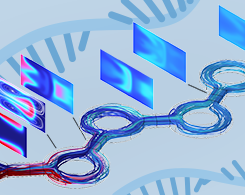
The new Multibody Dynamics Module provides engineers with an advanced set of tools to design and optimize mechanical systems to reduce product development costs. This module enables simulation of an assembly of flexible and rigid bodies, along with physical phenomena like structural, heat, electrical, and others. One of the key capabilities included in this module is an easier and faster way of building connections between different bodies using various types of predefined Joints.

The objective of multibody analysis is to find critical areas of a system to perform more detailed component-level structural analysis. Multibody analysis also gives insight into the system dynamics, forces experienced by segments of the structure, and stresses generated in flexible components leading to failure due to large deformation or fatigue.

Read more on: Simulate Mechanical Systems with the Multibody Dynamics Module

Sweep Your Meshes with Ease

Tips & Tricks | Posted on May 9th, 2013 by

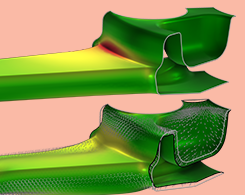
Swept meshing is a geometry discretization technique available in COMSOL Multiphysics for specific types of geometries, including thin geometries, geometries with bends, and models with little or no variation in a specific direction. A swept mesh starts at a source boundary and sweeps along to a specified destination boundary. In previous versions of COMSOL Multiphysics, the source and destination boundaries generally needed to be specified by the user. However, in the latest release, COMSOL Multiphysics version 4.3b, the swept mesh has become more automated, minimizing the number of source and destination boundaries manually defined.

Read more on: Sweep Your Meshes with Ease

The Graphene Revolution: Part 5

Electrical | Posted on May 8th, 2013 by

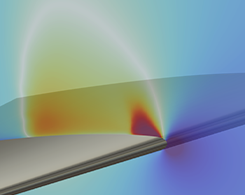
In a paper titled “Choosing a Gate Dielectric for Graphene Based Transistors” the applications of a semiconducting form of graphene are examined. As we have seen before, single-layer graphene is not a semiconductor, it is a zero band gap conductor (a semimetal). Efforts are well underway to introduce band gaps to graphene, which would make it semiconducting with a room temperature mobility an order of magnitude higher than silicon. The race is already underway to find applications for such a material once the remaining technical challenges have been overcome. An application of semiconducting graphene is the design of next-generation, fast switching semiconductor metal oxide field effect transistors (MOSFETs).

Read more on: The Graphene Revolution: Part 5

Taking Care of Fast Oscillations with the Wave Optics Module

Electrical | Posted on May 7th, 2013 by

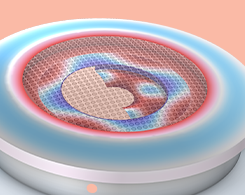
The new COMSOL Multiphysics Wave Optics Module provides engineers with a great set of features for designing their simulations. One of the new capabilities included in this module is the groundbreaking Beam Envelope Method for electromagnetic full-wave propagation. We hope this feature will become instrumental to the optics community.

Read more on: Taking Care of Fast Oscillations with the Wave Optics Module

Creating 2D Models from 3D Geometries in COMSOL Multiphysics

Tips & Tricks | Posted on May 6th, 2013 by

Our newest release, COMSOL Multiphysics version 4.3b, contains so many new modules and features, certain additions might get lost in the fray. One addition to the COMSOL Multiphysics base package we don’t want you to miss is the ability to create 2D models from cross sections of 3D geometries. This easy-to-use feature allows engineers to simplify the model, gain understanding of and fine-tune parameters, and dramatically reduce simulation time.

Read more on: Creating 2D Models from 3D Geometries in COMSOL Multiphysics

This Just In: COMSOL Multiphysics 4.3b

News | Posted on May 3rd, 2013 by

We’ve been dropping hints for the past few weeks here on the blog, and the time has finally come when we can officially unveil the release of COMSOL Multiphysics 4.3b. Five new products extend our product suite, and there are plenty of new features to enhance your simulation experience. The latest version of COMSOL Multiphysics is here, and you do not want to miss out on the news.

Read more on: This Just In: COMSOL Multiphysics 4.3b

The Graphene Revolution: Part 4

Fluid | Posted on May 2nd, 2013 by

Graphene can be created by way of thermal decomposition at high vacuum. In order to design and optimize these high vacuum systems engineers might look to simulation, but there are currently not many modeling tools that are up to the task. Let’s have a look at how vacuum systems are relevant to graphene production, why you should simulate them, and how.

Read more on: The Graphene Revolution: Part 4

The Greenhouse Effect

Heat Transfer | Posted on May 1st, 2013 by

Given the title of this blog post you might expect it to be about global warming, and I won’t blame you for it; greenhouse effect has become another popular term used when debating climate change. However, its original and literal meaning refers to a very different process, in particular when it comes to heat retention. Here we will describe the effect of heating up an actual greenhouse and suggest steps for optimizing its design.

Read more on: The Greenhouse Effect

Wave Optics, to Approximate or Not?

Electrical | Posted on April 30th, 2013 by

Engineers working with lasers, optical fibers and waveguides, nonlinear optical processes, metamaterials, and other large photonic devices ultimately deal with wave optics. Photonic devices are considered “large” when they are larger than a wavelength of light. In that case, you deal with optics frequencies as opposed to radio frequencies, and the device is not complex enough to justify approximating with rays.

Read more on: Wave Optics, to Approximate or Not?

IEEE Spectrum Puts the Spotlight on Multiphysics

Electrical | Posted on April 29th, 2013 by

The Institute of Electrical and Electronics Engineers (IEEE) is doing some really cool things for its members. Chances are that you have attended their top rated conferences, downloaded papers from IEEE Xplore, or participated in one of many local chapter events. For electrical engineers like me, IEEE certainly is a rock to lean on for continued education and to connect with colleagues from around the world. Even if you are not a member you can tap into IEEE resources such as newsletters, websites, and their flagship publication — IEEE Spectrum. With over 400,000 subscribers and sharp editorial it is with great expectations I pick up the magazine from my mailbox (you can get it as a PDF too) each month.

Read more on: IEEE Spectrum Puts the Spotlight on Multiphysics