News | Posted on
April 10th, 2013 by
Fanny Littmarck
Everyone’s talking about graphene right now. When was the last time a material received this much attention? Sure, other materials have peaked our interest before, but when something breaks into more mainstream news you know it’s going to be a very big deal.
Read more on: The Graphene Revolution: Part 3
Mechanical | Posted on
April 9th, 2013 by
Fanny Littmarck
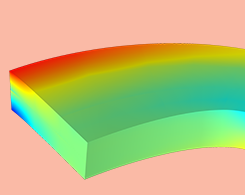
We’ve all encountered hinges before; they are frequently used to connect different parts of mechanical assemblies in a way that allows them to move freely relative to one another, in a single degree of freedom. There are several different types of hinges, including everything from barrel hinges to friction hinges, with lots in between. Before incorporating a hinge into a mechanical assembly, you might want to get a sense of how it will hold up by performing a hinge analysis.
Read more on: Barrel Hinge Analysis
Conference | Posted on
April 8th, 2013 by
Bernt Nilsson
The COMSOL Conference Program Chair is a special person. It is a person to envy. Wouldn’t you like to connect with the top multiphysics simulation experts, study their coolest applications, and showcase their work in the limelight of the COMSOL Conference 2013? I certainly would — but that is the role of the Program Chair.
Read more on: Meet the COMSOL Conference 2013 Program Chairs
Fluid | Posted on
April 5th, 2013 by
Cinzia Iacovelli
Have you ever noticed how water can flow through rocks and leave a trace of its passage by covering the surface with a patina, like white stripes? The whole process is quite complex but can roughly be explained by breaking it down into two coupled effects: gravity and chemical reactions. Gravity causes the water to infiltrate through discrete fractures (hard rocks) or pores (sedimentary rocks), until it charges the groundwater supply below to a point where excess water will surface on the face of the rock, like an overflowing glass of water. Chemical reactions, on the other hand, allow water to dissolve carbonates and similar substances present in the rock. Such chemical compounds will start sticking and accumulating on the surface.
Read more on: Discrete Fracture in Rocks
Mechanical | Posted on
April 4th, 2013 by
Andrew Griesmer
Back in January, I presented a video tutorial introducing the Structural Mechanics Module here on the blog. The video described the steps necessary to perform a static linear analysis on a bracket geometry. Now, to help you better understand the extra functionalities that exist within COMSOL Multiphysics and the Structural Mechanics Module, we are also creating additional tutorial videos of this bracket. The first two “mini-tutorials” to accompany the static linear analysis video focus on adding initial strain and thermal stress, and you can watch them here.
Read more on: Structural Mechanics Tutorials: Adding Initial Strain and Thermal Stress
Tips & Tricks | Posted on
April 3rd, 2013 by
Chandan Kumar
Some structural applications involve thin or high aspect ratio structures sandwiched between other relatively low aspect ratio structures. For example, if a piezoelectric transducer is glued on the surface of a mechanical system, the thickness of the adhesive layer is very small in comparison to the two structures it glues together. Numerical modeling of such a thin layer in two or three dimensions requires resolving it with an appropriate finite element mesh. This can result in a large concentration of finite elements near the adhesive layer, leading to high computational cost and time. To avoid this issue, one common assumption many numerical simulations make is to assume perfect bonding between the two structures. By making this assumption, the numerical model ignores the effect of the flexibility of the adhesive layer. This will lead to inaccurate results because the adhesive layer is not infinitely stiff. In this blog post, we will show how to model such thin layers using COMSOL Multiphysics — without the need to draw the layer’s thickness explicitly, while still accounting for the effect of the thin elastic layer. This can lead to a more efficient structural analysis with significant reduction in computational cost and time, without sacrificing the accuracy of the simulation.
Read more on: Structural Analysis with Thin Elastic Layers
Tips & Tricks | Posted on
April 2nd, 2013 by
Walter Frei
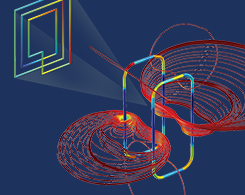
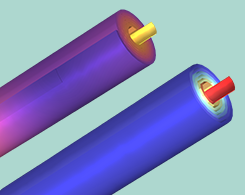
A question that comes up occasionally is whether or not you can compute the inductance of a single straight wire. This seemingly simple question actually does not really have an answer, and gives us the opportunity to talk about a very interesting point when solving Maxwell’s equations. Anybody working in the field of computational electromagnetics should have an understanding of this key concept, as it will help you properly set up and interpret models involving magnetic fields.
Read more on: Computing the Inductance of a Straight Wire
Electrical | Posted on
April 1st, 2013 by
Fanny Littmarck
In the world of bearings, there are many different types to choose from. For certain applications, magnetic bearings trump their mechanical counterparts in several regards. In order to understand how the bearing will perform, using a simulation tool to calculate design parameters is a good idea.
Read more on: Magnetic Bearings
Multiphysics | Posted on
March 29th, 2013 by
Fanny Littmarck
Smart materials are able to convert one form of energy to another. These materials can be either solid or fluid, and are typically located within what’s called a smart structure. What makes these materials and structures so “smart”? Let’s find out.
Read more on: Smart Materials Innately Transduce Energy, How Smart
Conference | Posted on
March 28th, 2013 by
Kristen O'Connor
As many of you may know, we have officially announced the dates for the COMSOL Conference 2013. Did you also know that we are continuously sharing updates, deadline reminders, past published Conference User Presentations, and more through social media? Follow our social pages to make sure you have up-to-date information regarding the Conference (among other things) — don’t forget to share this content with your friends and colleagues, too.
Read more on: Tell All Your Friends About the COMSOL Conference 2013