
La Bibliothèque d'Applications présente des modèles construits avec COMSOL Multiphysics pour la simulation d'une grande variété d'applications, dans les domaines de l'électromagnétisme, de la mécanique des solides, de la mécanique des fluides et de la chimie. Vous pouvez télécharger ces modèles résolus avec leur documentation détaillée, comprenant les instructions de construction pas-à-pas, et vous en servir comme point de départ de votre travail de simulation. Utilisez l'outil de recherche rapide pour trouver les modèles et applications correspondant à votre domaine d'intérêt. Notez que de nombreux exemples présentés ici sont également accessibles via la Bibliothèques d'Applications intégrée au logiciel COMSOL Multiphysics® et disponible à partir du menu Fichier.
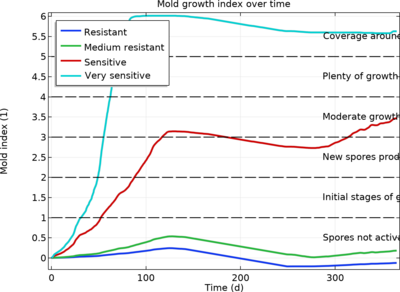
This tutorial demonstrates how to use the temperature and relative humidity computed from a heat and moisture transport simulation of an insulated roof as inputs for a mold prediction model. The VTT model for mold growth and decline prediction calculates a mold index M by solving an ... En savoir plus
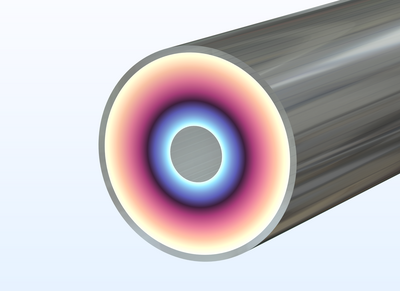
This example demonstrates how to compute transmission line parameters such as series resistance, series inductance, shunt conductance, and shunt capacitance per unit length using the predefined Transmission Line RLGC Parameters multiphysics interface. The demonstration also includes the ... En savoir plus
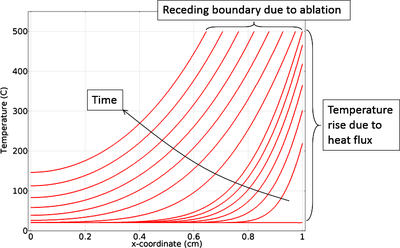
This example exemplifies how to model thermal ablation by taking into account material removal. A more detailed description of the phenomenon and the modeling process can be seen in the blog post "Modeling Thermal Ablation for Material Removal". En savoir plus
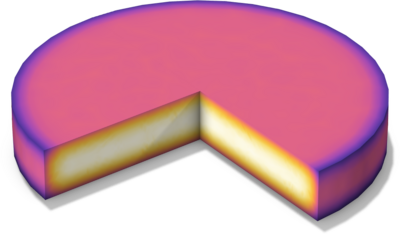
The purpose of this model is to introduce the Semitransparent Surface Feature from the Radiation in Participating Media Interface. It is a variation of the Radiative Cooling of a Glass Plate model with the DOM method. In this version a semitransparent surface is defined on external ... En savoir plus

Piezoelectric microblowers are compact, lightweight air pumps with varying applications including electronics cooling and airflow related medical devices. The device consists of a PZT-brass diaphragm and a specially designed housing including a pumping chamber, air inlet and outlet ... En savoir plus
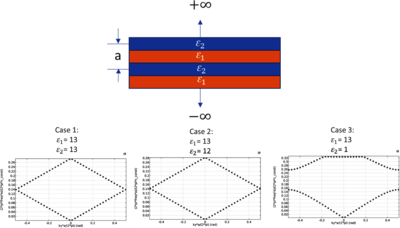
In this model, an eigenfrequency analysis is performed to give a bandgap analysis of a 1D multilayer photonic crystal extending to infinity in +/- y direction. We perform the bandgap analysis for three different cases of material properties, as discussed in Chapter 4 of Ref. 1. Case ... En savoir plus
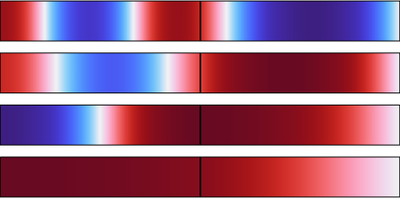
This tutorial demonstrates how to model the interaction between an acoustic field and the heat release from a flame, using the Flame Model domain feature. Modeling this interaction is important in order to understand and predict unstable acoustic modes in gas turbines and jet engines. ... En savoir plus
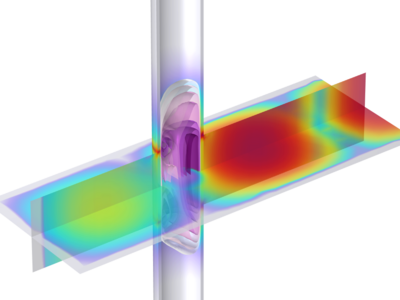
This tutorial model explores the behavior of a microwave plasma torch. The plasma is generated within a dielectric tube inserted in a rectangular waveguide. The simulation solves the coupled equations for plasma transport and heating, microwave electromagnetic fields, fluid flow, and ... En savoir plus
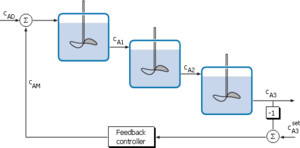
This example illustrates how to set up and solve a tank-in-series model in 0D using the Reaction Engineering interface. The model treats a series of three consecutive tank reactors. A feedback loop continuously adjusts the inlet concentration of the first tank to keep the concentration ... En savoir plus
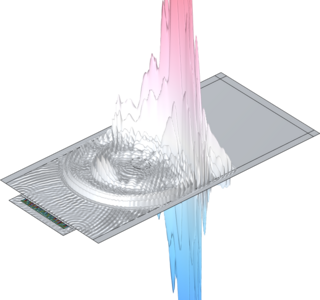
This tutorial demonstrates how to model ultrasound imaging in human tissue using an imaging probe composed of piezoelectric arrays that generate steered and focused beams. Simulating this process requires a transient multiphysics model to accurately capture sound generation, propagation, ... En savoir plus


