
La Bibliothèque d'Applications présente des modèles construits avec COMSOL Multiphysics pour la simulation d'une grande variété d'applications, dans les domaines de l'électromagnétisme, de la mécanique des solides, de la mécanique des fluides et de la chimie. Vous pouvez télécharger ces modèles résolus avec leur documentation détaillée, comprenant les instructions de construction pas-à-pas, et vous en servir comme point de départ de votre travail de simulation. Utilisez l'outil de recherche rapide pour trouver les modèles et applications correspondant à votre domaine d'intérêt. Notez que de nombreux exemples présentés ici sont également accessibles via la Bibliothèques d'Applications intégrée au logiciel COMSOL Multiphysics® et disponible à partir du menu Fichier.
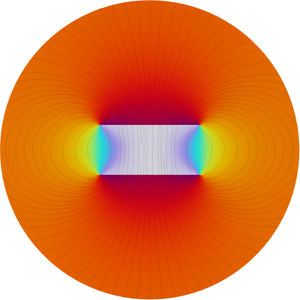
Permanent magnet manufacturers test magnets by applying a cyclic temperature load during the design process to assess the resulting thermal demagnetization. The heating process is usually slow enough that the temperature distribution inside the magnet can be considered uniform at any ... En savoir plus
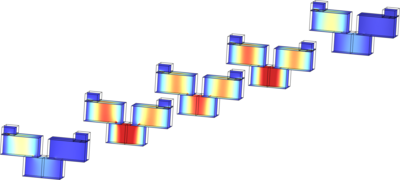
Cascaded cavity filters provide much better bandpass filter performance than single cavity filters. This example demonstrate how to use shape optimization to optimize three rectangular cavity filters coupled via slots. The calculated S-parameters show excellent out-of-band rejection. En savoir plus
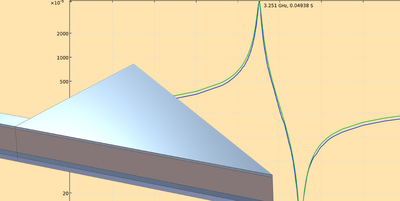
This model demonstrates how to extract the lumped parameters for an mBVD equivalent circuit from a FEM simulation and how to leverage such a model directly using the Electrical Circuit interface. A 3D layered FBAR resonator is considered as an example. Related Blog Post Leveraging the ... En savoir plus
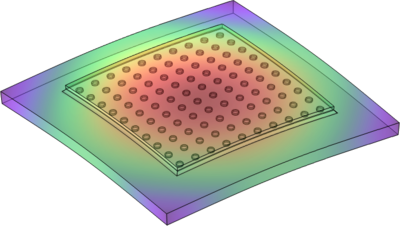
Flip chip (FC) is a widely used form of advanced semiconductor packaging that yields high interconnection density and good signal transmission performance of the semiconductor device as well as a reduction in size. In FC devices, the chip is placed face down and directly bonded to the ... En savoir plus
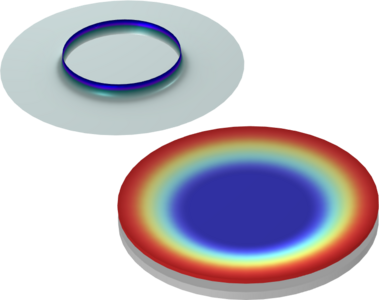
In direct bonding, the in-plane relative displacement between corresponding points on the bonding surfaces of the top and bottom wafers, denoted as IPD (In-Plane Distortion), is the primary yield killer in the bonding process. This model can predict the entire direct wafer bonding ... En savoir plus
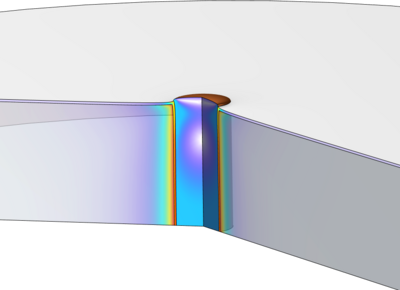
Through-silicon vias (TSVs) allow chips or wafers to be connected vertically, making TSV a crucial technology for 2.5D and 3D packaging. The basic structure of a TSV consists of a deep hole penetrating a silicon substrate, a filling metal (usually copper) in the deep hole, and an ... En savoir plus


