
La Bibliothèque d'Applications présente des modèles construits avec COMSOL Multiphysics pour la simulation d'une grande variété d'applications, dans les domaines de l'électromagnétisme, de la mécanique des solides, de la mécanique des fluides et de la chimie. Vous pouvez télécharger ces modèles résolus avec leur documentation détaillée, comprenant les instructions de construction pas-à-pas, et vous en servir comme point de départ de votre travail de simulation. Utilisez l'outil de recherche rapide pour trouver les modèles et applications correspondant à votre domaine d'intérêt. Notez que de nombreux exemples présentés ici sont également accessibles via la Bibliothèques d'Applications intégrée au logiciel COMSOL Multiphysics® et disponible à partir du menu Fichier.
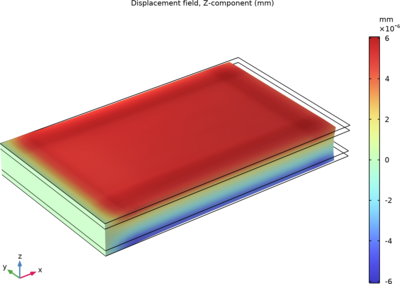
This tutorial is intended as a simple example showing how to model piezoelectric devices using the layered shell functionality. Two cases of material orientation are studied. In the first case, the pole axis is normal to the shell surface, which results in a thickness change. In the ... En savoir plus
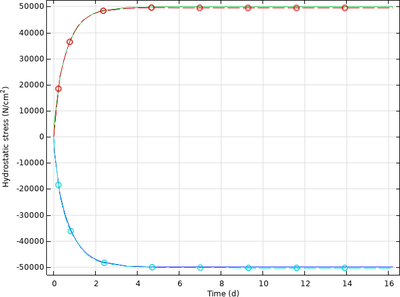
As integrated circuit (IC) technology advances, with circuits becoming more powerful and compact, it is increasingly important to identify and prevent any cause of circuit failure. One particularly critical factor contributing to circuit failure is electromigration within the ... En savoir plus
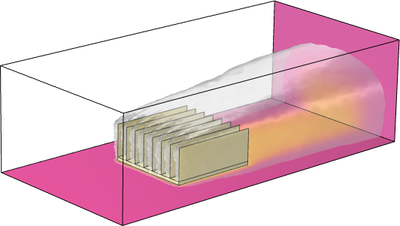
Thermoelectric elements are often used to cool or heat electronic components to a desired temperature. In such simulations, you are typically not interested in the behavior of the thermoelectric element itself but want to use its performance characteristics to model the overall response ... En savoir plus
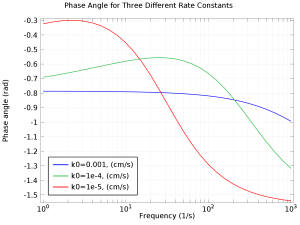
Electrochemical impedance spectroscopy (EIS) is a common technique in which a small oscillating perturbation is applied to an electrochemical system in order to investigate kinetic and transport properties. This example models EIS for a range of electrode reaction rates. Nyquist and Bode ... En savoir plus
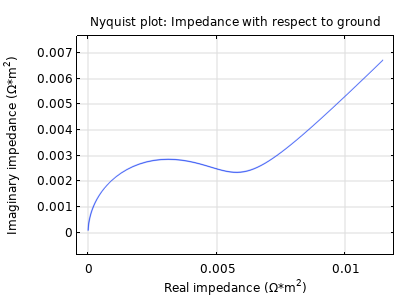
The purpose of this app is to understand EIS, Nyquist, and Bode plots. The app lets you vary the bulk concentration, diffusion coefficient, exchange current density, double layer capacitance, and the maximum and minimum frequency. Electrochemical impedance spectroscopy (EIS) is a common ... En savoir plus
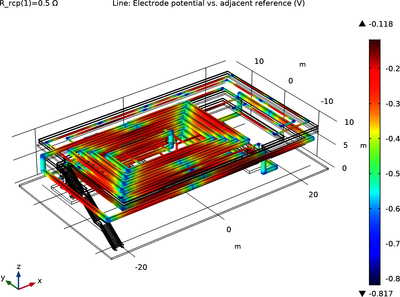
Highly alloyed stainless steel used in chlorinated seawater systems may be prone to corrosion under certain operating conditions. Conventional cathodic protection technique is less suitable for stainless steel due to unacceptable anode consumption rate and propensity to hydrogen ... En savoir plus
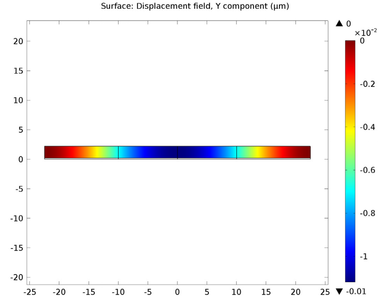
Silicon micromechanical resonators have long been used for designing sensors and are now becoming increasingly important as oscillators in the consumer electronics market. In this series of models, a surface micromachined MEMS resonator, designed as part of a micromechanical filter, is ... En savoir plus
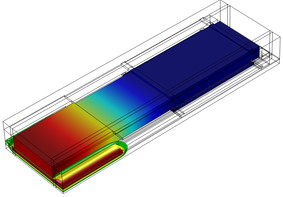
An electrostatically actuated MEMS resonator is simulated in the time and frequency domains. The device is driven by an AC + DC bias voltage applied across a parallel plate capacitor. The dependence of the resonant frequency on DC bias is assessed, and frequency domain and pull-in ... En savoir plus
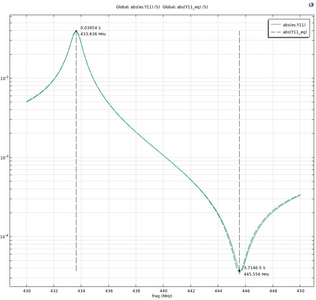
This model shows that the frequency response, i.e., admittance curve, of the SAW unit cell with IDT is in good agreement with the series resonance & antiresonance frequencies obtained from the eigenfrequency studies in the tutorial Surface Acoustic Wave Velocity Calculations from a ... En savoir plus
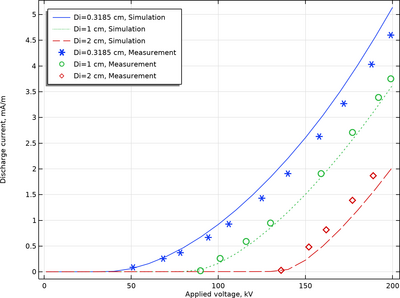
This model examines the behavior of a positive corona formed between concentric cylindrical conductors exposed to high applied voltages. The predicted current–voltage response closely matches the measurements. Rather than reproducing individual positive glow corona bursts, the setup ... En savoir plus


