
La Bibliothèque d'Applications présente des modèles construits avec COMSOL Multiphysics pour la simulation d'une grande variété d'applications, dans les domaines de l'électromagnétisme, de la mécanique des solides, de la mécanique des fluides et de la chimie. Vous pouvez télécharger ces modèles résolus avec leur documentation détaillée, comprenant les instructions de construction pas-à-pas, et vous en servir comme point de départ de votre travail de simulation. Utilisez l'outil de recherche rapide pour trouver les modèles et applications correspondant à votre domaine d'intérêt. Notez que de nombreux exemples présentés ici sont également accessibles via la Bibliothèques d'Applications intégrée au logiciel COMSOL Multiphysics® et disponible à partir du menu Fichier.
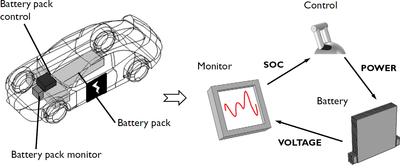
This is a template base model containing the physics, geometry and mesh of a lithium-ion battery, defined in 1D. The model makes use of four lithiation parameters which are used to define the relative balancing of the negative and positive electrodes, as well as global cell state of ... En savoir plus
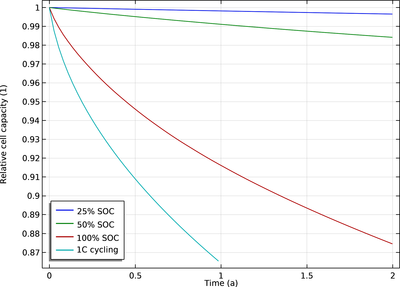
This tutorial demonstrates the Lumped Battery interface for modeling capacity loss in a battery. A set of lumped parameters are used to describe the capacity loss that occurs due to parasitic reactions in the battery, assuming no knowledge of the internal structure or design of the ... En savoir plus
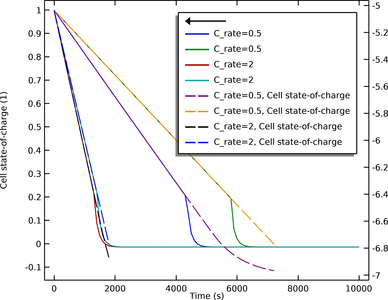
This tutorial demonstrates how to integrate multiple Lumped Battery models into the Electrical Circuit interface. Two batteries are connected in series. Each battery is protected by a shunt resistances that is activated if the battery state-of-charge reaches below a certain threshold ... En savoir plus
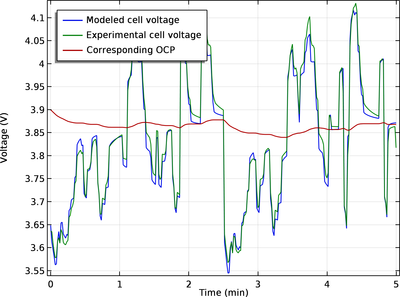
This tutorial uses a “black-box” approach to define a battery model based on a small set of lumped parameters, assuming no knowledge of the internal structure or design of the battery electrodes, or choice of materials. The input to the model is the battery capacity, the initial state ... En savoir plus
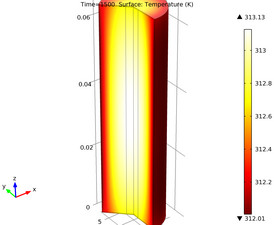
This model example simulates an air-cooled cylindrical 18650 lithium-ion battery during a charge-discharge cycle, followed by a relaxing period. A lumped (0D) cell model is used to model the battery cell chemistry, and a two-dimensional axi-symmetrical model is used to model the ... En savoir plus
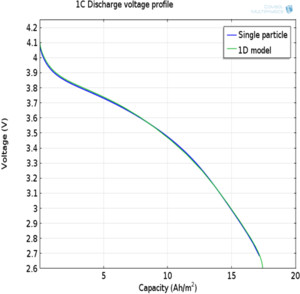
An isothermal single particle model formulation for a lithium-ion battery is presented in this work. The single particle model is a simplification of the 1D formulation for a lithium-ion battery along with a few assumptions. The model is typically valid for low-medium current scenarios. ... En savoir plus
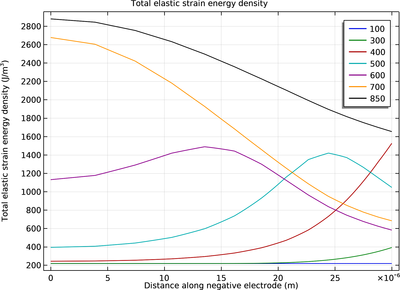
Diffusion-induced stress in lithium-ion battery electrode materials can occur as a result of compositional inhomogeneities during lithium intercalation in the host material particles. These stresses are important since the electrode host material can undergo significant volume changes ... En savoir plus
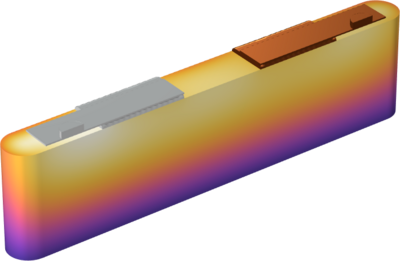
This model exemplifies how to compute the internal temperature distribution in a prismatic battery during a high-rate charge. The electrochemistry is described by a a lumped two-electrode model, which is coupled to the heat transfer model. The heat transfer model includes the effects of ... En savoir plus
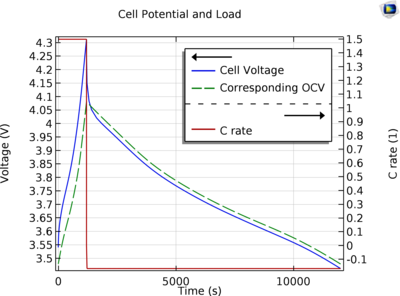
This app can be used as a design tool to develop an optimized battery configuration for a specific application. The application computes the capacity, energy efficiency, heat generation, and capacity losses due to parasitic reactions of a battery for a specific load cycle. Various ... En savoir plus
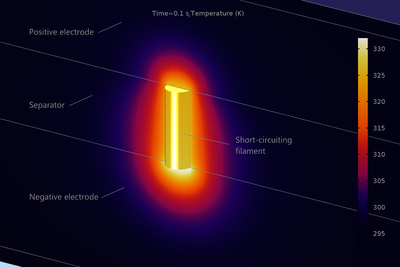
During an internal short circuit of a battery, the two electrode materials are internally and electronically interconnected, giving rise to high local current densities. Internal short circuits may occur in a lithium-ion battery due to, for instance, lithium dendrite formation or a ... En savoir plus