
La Bibliothèque d'Applications présente des modèles construits avec COMSOL Multiphysics pour la simulation d'une grande variété d'applications, dans les domaines de l'électromagnétisme, de la mécanique des solides, de la mécanique des fluides et de la chimie. Vous pouvez télécharger ces modèles résolus avec leur documentation détaillée, comprenant les instructions de construction pas-à-pas, et vous en servir comme point de départ de votre travail de simulation. Utilisez l'outil de recherche rapide pour trouver les modèles et applications correspondant à votre domaine d'intérêt. Notez que de nombreux exemples présentés ici sont également accessibles via la Bibliothèques d'Applications intégrée au logiciel COMSOL Multiphysics® et disponible à partir du menu Fichier.

Learn how to combine imported CAD with STL meshes in COMSOL Multiphysics using an example of a dental implant. The STL mesh is prepared in a Mesh Part, the imported CAD assembly is prepared in the Geometry sequence, and the two are combined in a Mesh-Based Geometry sequence. Watch this ... En savoir plus

Learn how to repair, edit and combine imported surface meshes in COMSOL Multiphysics. This model demonstrates how to cut out a part of the upper jaw, remove elements from the mesh, and combine the meshes of the teeth and bone. Watch this video on editing, repairing, and combining ... En savoir plus

This document explains how to install and run COMSOL Multiphysics® and COMSOL Server™ with Amazon Elastic Compute Cloud™ (EC2™). This requires that you have first acquired a Floating Network License (FNL) or COMSOL Server License (CSL) from COMSOL. The license manager ... En savoir plus

This document explains how to install and run COMSOL Multiphysics® and COMSOL Server™ with Microsoft® Azure. This requires that you have first acquired a Floating Network License (FNL) or COMSOL Server License (CSL) from COMSOL. The license manager software can run ... En savoir plus
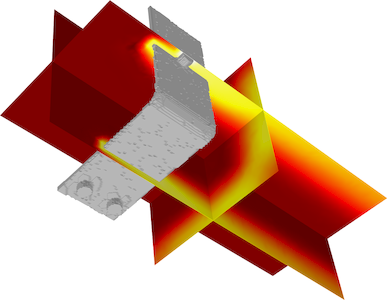
In COMSOL Multiphysics, you can import mesh and interpolation data created by other software for use in your simulations. You can also export data created in COMSOL Multiphysics to use in other COMSOL models and applications as well as other software. This document and accompanying ... En savoir plus

This example exemplifies how to compute the design sensitivities of your COMSOL Multiphysics® model. A more detailed description of the modeling process can be seen in the blog post "Computing Design Sensitivities in COMSOL Multiphysics". En savoir plus

This example exemplifies the basics in how to optimize shapes using COMSOL Multiphysics®. A more detailed description of the phenomenon and the modeling process can be seen in the blog post "Designing New Structures with Shape Optimization". En savoir plus

This example exemplifies how curve fitting can be performed in COMSOL Multiphysics®, and how this can be applied to your modeling. A more detailed description of the phenomenon and the modeling process can be seen in the blog post "Curve Fitting of Experimental Data with COMSOL ... En savoir plus
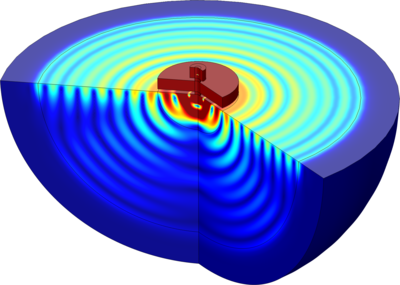
This model shows how to compute the anchor loss limited quality factor of a diamond disc resonator. The resonator is anchored to the substrate by a polysilicon post and power is transmitted to the substrate through the post. A perfectly matched layer is used to represent the essentially ... En savoir plus

This model simulates transition flow through a microchannel using the Transition Flow interface in COMSOL Multiphysics®, which solves the Boltzmann BGK equation. The analysis is carried out to understand the fluid flow behavior across five different pore-length (porosity) configurations, ... En savoir plus


