
La Bibliothèque d'Applications présente des modèles construits avec COMSOL Multiphysics pour la simulation d'une grande variété d'applications, dans les domaines de l'électromagnétisme, de la mécanique des solides, de la mécanique des fluides et de la chimie. Vous pouvez télécharger ces modèles résolus avec leur documentation détaillée, comprenant les instructions de construction pas-à-pas, et vous en servir comme point de départ de votre travail de simulation. Utilisez l'outil de recherche rapide pour trouver les modèles et applications correspondant à votre domaine d'intérêt. Notez que de nombreux exemples présentés ici sont également accessibles via la Bibliothèques d'Applications intégrée au logiciel COMSOL Multiphysics® et disponible à partir du menu Fichier.
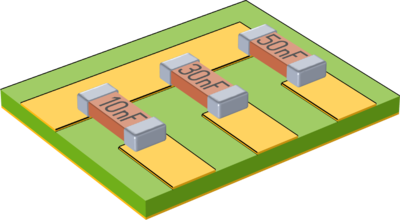
These models demonstrate the usage of the user defined lumped port and lumped elements to introduce excitations and lumped circuit elements between volumetric conductors. Additional models show how to use impedance and transition boundary conditions to model the conductors, instead of ... En savoir plus

This is a primer model of a permanent magnet machine. It is a generic model that can be modified to simulate a motor or generator. It demonstrates different capabilities of COMSOL Multiphysics® to examine aspects of machine design, such as air gap magnetomotive force (MMF), ... En savoir plus
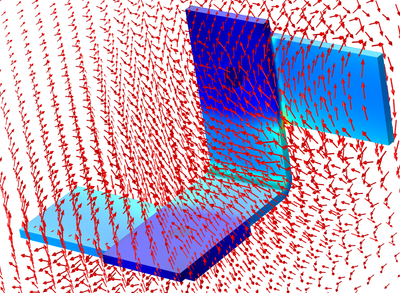
This is a busbar configuration with an AC analysis. The configuration is similar to the introductory tutorial in the book Introduction to COMSOL Multiphysics. However, two conductors are added to represent a more realistic case of magnetic fields surrounding the busbar. The results ... En savoir plus

This application demonstrates how the Application Builder in the COMSOL Multiphysics® software can be used to make advanced cable modeling available to a general audience. At its core is a multiphysics model based on the technology introduced in the Cable Tutorial Series. The ... En savoir plus
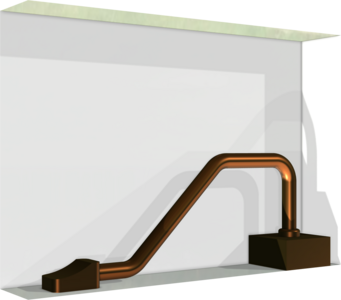
This model analyzes Joule heating and thermal expansion in a bond wire in an LED. Its purpose is to estimate the temperature increase and the resulting mechanical stresses in the bond wire due to thermal expansion. The magnitude of these stresses can be used to assess the risk of fatigue ... En savoir plus
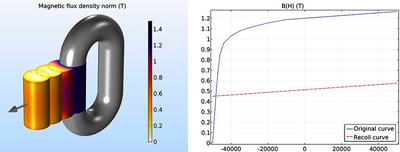
Soft permanent magnets like AlNiCo are easily demagnetized if handled incorrectly. This is a demonstration of how to model the self-demagnetization of a cylindrical AlNiCo magnet when moved out of its associated/protective magnetic circuit. The modeling is performed in three steps: The ... En savoir plus
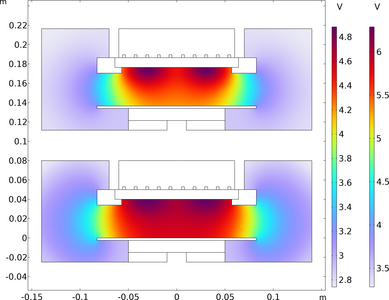
Electron transport in low-temperature plasmas depends strongly on the electron energy distribution function (EEDF), which is often approximated as Maxwellian but is frequently nonequilibrium in reality. Incorporating nonequilibrium EEDF behavior into spatially dependent models often ... En savoir plus
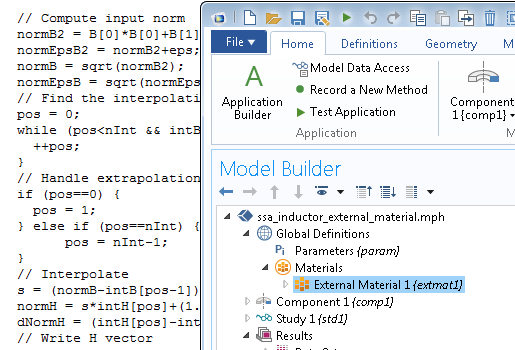
The AC/DC magnetic interfaces support material models defined in external C code. You can access external material functions, written in C code, which have been compiled into a shared library. By writing a wrapper function in C code, you can also use material functions written in another ... En savoir plus

This is a transient model of an electromagnetic plunger with stopper restricting the linear motion. The model consists of a magnetic core, nonmagnetic guider, multi-turn coil, nonmagnetic stopper/blocker, and magnetic plunger attached to the spring and damper at the base. The ... En savoir plus
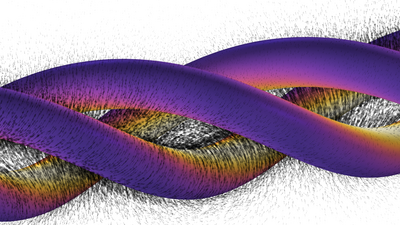
These models demonstrate various ways of exciting magnetic fields using the Magnetic Field Formulation interface in the AC/DC Module, an add-on to the COMSOL Multiphysics® software. To learn more about these models, see the accompanying blog post “Modeling of Excitations with ... En savoir plus


