
La Bibliothèque d'Applications présente des modèles construits avec COMSOL Multiphysics pour la simulation d'une grande variété d'applications, dans les domaines de l'électromagnétisme, de la mécanique des solides, de la mécanique des fluides et de la chimie. Vous pouvez télécharger ces modèles résolus avec leur documentation détaillée, comprenant les instructions de construction pas-à-pas, et vous en servir comme point de départ de votre travail de simulation. Utilisez l'outil de recherche rapide pour trouver les modèles et applications correspondant à votre domaine d'intérêt. Notez que de nombreux exemples présentés ici sont également accessibles via la Bibliothèques d'Applications intégrée au logiciel COMSOL Multiphysics® et disponible à partir du menu Fichier.
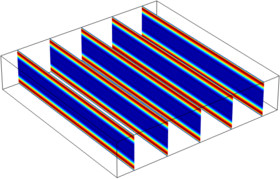
Whenever dimensions in waveguides become small compared to the viscous and thermal boundary layers it is necessary to model acoustics using thermoacoustics. In the present model the thermoacoustic wave field in a shallow uniform waveguide is modeled and compared to an analytical solution. En savoir plus
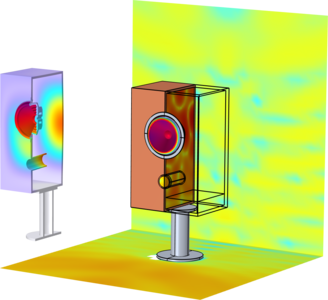
This model shows a full vibroacoustic analysis of a loudspeaker including driver, cabinet, and stand. It lets you apply a nominal driving voltage and extract the resulting sound pressure level in the cabinet and in the outside room, as well as the deformation of the cabinet and driver, ... En savoir plus
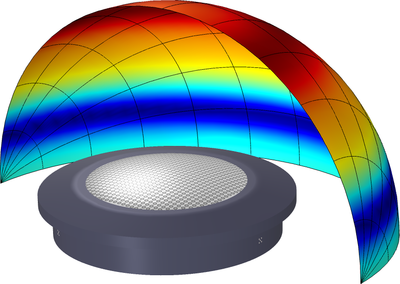
Model used as demonstration in the APEI/AES session on August 11. https://audioproducteducationinstitute.org/speakers-and-microphones-simulation-and-testing/ The geometry is invented and uses parts from two models: https://www.comsol.com/model/head-and-torso-simulator-acoustics-74381 ... En savoir plus

Underground train grids span large areas under London, Paris, New York, and other cities. The building regulations require strict noise standards, and failure to comply could result in significant losses in the market prices of developments. Therefore, train-induced noise has to be ... En savoir plus
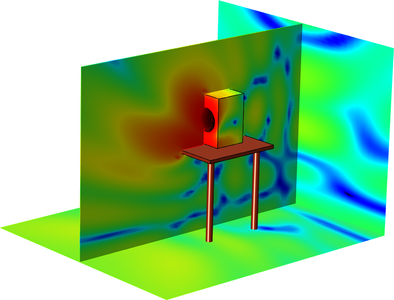
In this tutorial, the acoustic radiation pattern from a small generic loudspeaker is analyzed using the boundary element method (BEM). The loudspeaker is located on a small table above the floor and at a given distance from a wall. The model is set up using the Pressure Acoustics, ... En savoir plus
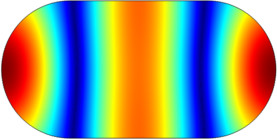
In this model, compute the propagating modes in the chamber of an automotive muffler. The geometry is a cross-section of the chamber in the Absorptive Muffler example. The model’s purpose is to study the shape of the propagating modes and to find their cut-off frequencies. As discussed ... En savoir plus
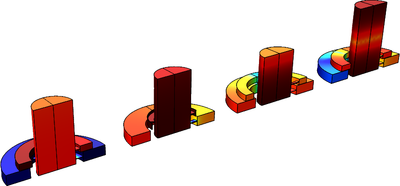
In this tutorial the geometry of an occluded ear-canal simulator is optimized to match the acoustic response of a given ear. The target data in this model stems from a simulation of an ear canal, but it can also be based on measurements, or a response specified by a standard. En savoir plus
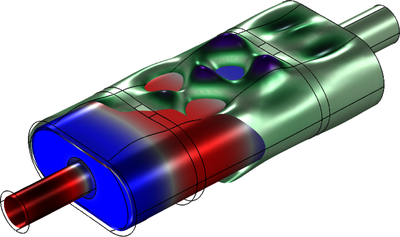
This model describes the pressure wave propagation in a muffler for an internal combustion engine. The purpose of the model is to show how to analyze both inductive and resistive damping in pressure acoustics as well as coupling the fluid to the surrounding elastic shell structure of the ... En savoir plus
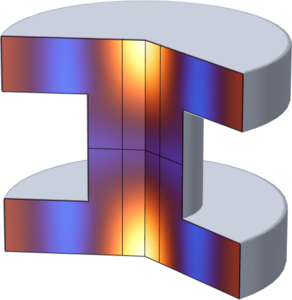
This is a model of a simple photoacoustic (or optoacoustic) resonator. A pulsating laser heats a gas causing expansion and contraction and thus creates pressure waves. Such devices are used as sensors for measuring material parameters of the gas inside the resonator. The resonance ... En savoir plus
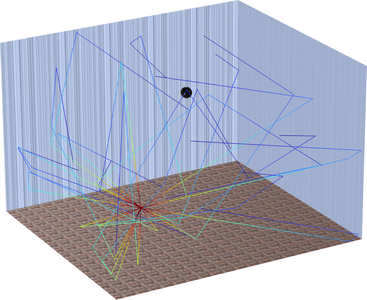
This model shows one approach for obtaining a broadband impulse response by combining ray-tracing and finite element methods. The combination is done all within COMSOL® and uses idealized filters. In this example, the simulation results are further compared to an analytical solution ... En savoir plus


