
La Bibliothèque d'Applications présente des modèles construits avec COMSOL Multiphysics pour la simulation d'une grande variété d'applications, dans les domaines de l'électromagnétisme, de la mécanique des solides, de la mécanique des fluides et de la chimie. Vous pouvez télécharger ces modèles résolus avec leur documentation détaillée, comprenant les instructions de construction pas-à-pas, et vous en servir comme point de départ de votre travail de simulation. Utilisez l'outil de recherche rapide pour trouver les modèles et applications correspondant à votre domaine d'intérêt. Notez que de nombreux exemples présentés ici sont également accessibles via la Bibliothèques d'Applications intégrée au logiciel COMSOL Multiphysics® et disponible à partir du menu Fichier.
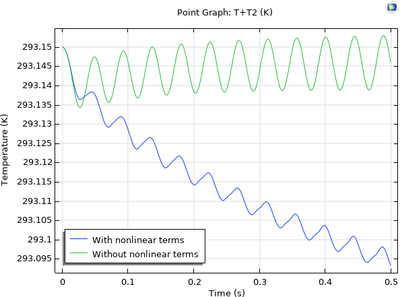
A thermoacoustic engine is a device with no moving parts that can generate acoustic energy from temperature gradients within the engine. It uses the relationship between the movement of oscillating air and the temperature changes in the air compressed and expanded by the acoustic waves. ... En savoir plus
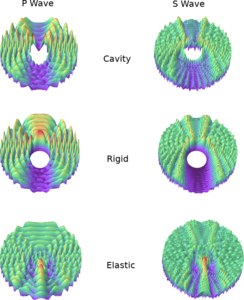
This model showcases how to solve for the scattered field when knowing the incident field for three different types of scatterer, that is, an infinitely rigid one, a cavity and an elastic inclusion. This formulation can be useful when the scatterer is in the far field of the source, so ... En savoir plus
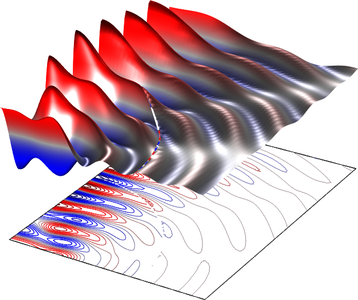
An axisymmetric model of a rigid piston in an infinite baffle is used to exemplify the Exterior Field Calculation feature of the Acoustics Module. The radiation results provided by the COMSOL Multiphysics® software are compared to analytical results for the on-axis radiation ... En savoir plus
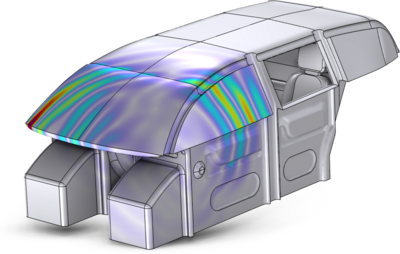
This tutorial shows the analysis of a car cabin in order to study the performance of a sound system in the low to mid frequency range. The model studies the transient response to an emitted Gaussian modulated harmonic signal solved with the Pressure Acoustics, Time Explicit physics ... En savoir plus
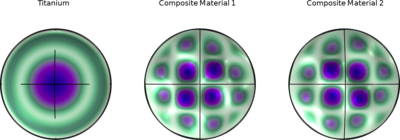
Analyzing resonances is essential when designing loudspeakers. Resonances can come from various sources in a loudspeaker, with the diaphragm being a significant one. There are numerous traditional approaches to address diaphragm resonances, each with its own benefits and drawbacks. A ... En savoir plus
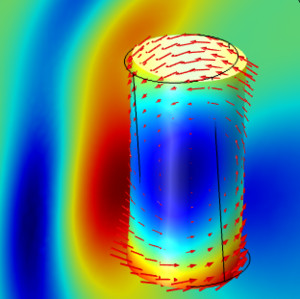
Liquid or gas acoustics coupled to structural objects such as membranes, plates or solids are important applications in many engineering fields. This model is a general demonstration of an acoustic fluid phenomenon in 3D that is coupled to a solid object. The walls of the solid object ... En savoir plus

This model shows how to use the scattered-field formulation to compute the transmission coefficient for impinging P and S plane elastic waves onto a finite-size phononic crystal. The transmission tends to zero in the frequency ranges corresponding to P- and S-wave band gaps, as ... En savoir plus
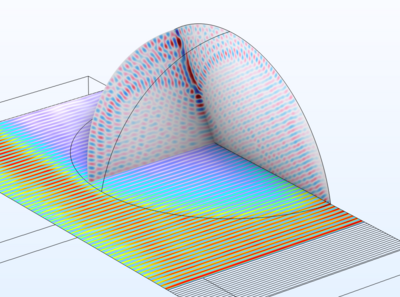
When a droplet is placed on a substrate on which surface acoustic waves (SAWs) are traveling, the energy of the SAWs is transferred into the droplet to form an acoustic field. The transferred energy is attenuated and generates a streaming flow. This type of streaming enables contactless ... En savoir plus
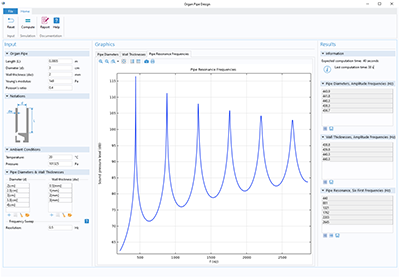
This app demonstrates the following: Using a Java® utility class for combining several waveforms and for playing sound Using tables for presenting results The app allows you to study the design of an organ pipe and then play the sound and pitch of the changed design. The pipe sound ... En savoir plus
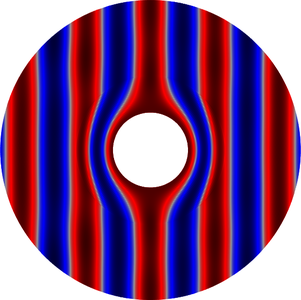
This example demonstrates how to use a background field in a sound scattering problem. The application is an acoustic invisibility cloak made of a metamaterial. Two different types of metamaterials are used, one using an anisotropic acoustic material with varying properties and one using ... En savoir plus


