
La Bibliothèque d'Applications présente des modèles construits avec COMSOL Multiphysics pour la simulation d'une grande variété d'applications, dans les domaines de l'électromagnétisme, de la mécanique des solides, de la mécanique des fluides et de la chimie. Vous pouvez télécharger ces modèles résolus avec leur documentation détaillée, comprenant les instructions de construction pas-à-pas, et vous en servir comme point de départ de votre travail de simulation. Utilisez l'outil de recherche rapide pour trouver les modèles et applications correspondant à votre domaine d'intérêt. Notez que de nombreux exemples présentés ici sont également accessibles via la Bibliothèques d'Applications intégrée au logiciel COMSOL Multiphysics® et disponible à partir du menu Fichier.
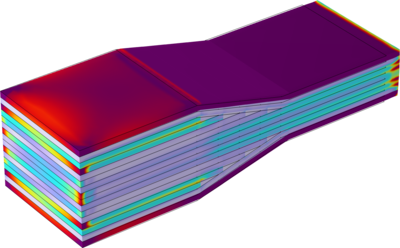
This example illustrates the modeling of ply drop-off in a composite panel. The panel considered for the analysis has three sections–thick, taper, and thin. The thick section plies are divided into the core, top-bottom belts, and dropped plies. The thick section of the panel has sixteen ... En savoir plus
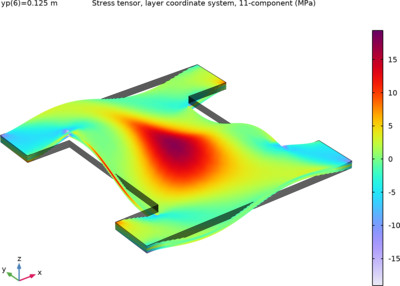
Composite materials are often used in structural applications because their properties, such as stiffness and strength, can be tailored to meet specific requirements. This makes them attractive alternatives to traditional engineering materials. Composites are also used in applications ... En savoir plus
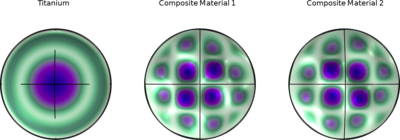
Analyzing resonances is essential when designing loudspeakers. Resonances can originate from various components, with the diaphragm being a significant source. Traditional approaches to controlling diaphragm resonances have different benefits and drawbacks. A more advanced approach is to ... En savoir plus
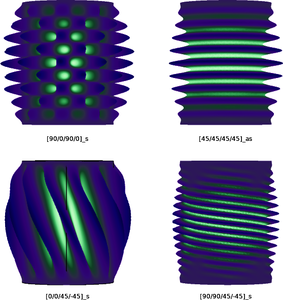
Buckling is a structural instability that can cause a component to fail even when the material remains within the elastic regime. Therefore, determining the critical buckling loads and corresponding mode shapes can be important from a design perspective, even when the applied loads ... En savoir plus
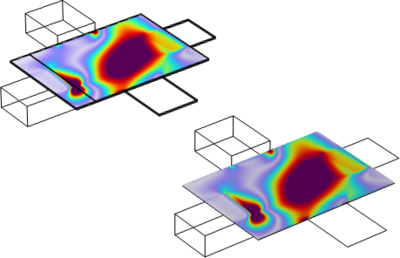
Layered shell elements, which are used for modeling composite shells, often connected to solid and shell elements in a cladding or side-by-side configuration to represent a realistic structure. For such applications, it becomes important to connect layered shell element correctly and ... En savoir plus

This example demonstrates the bending analysis of a simply supported composite laminate under sinusoidal distributed transverse load. The composite laminate is thick, with a thickness to side length ratio of 1/4. The laminate has three layers in a cross-ply layup. The model is solved ... En savoir plus
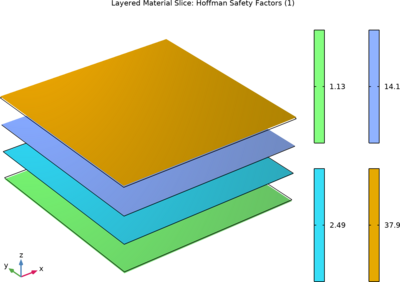
Laminated composite shells made of carbon-fiber-reinforced polymer (CFRP) are common in a large variety of applications due to their high strength-to-weight ratio. Evaluation of the structural integrity of a laminated composite shell for a set of applied loads is necessary to make the ... En savoir plus

This example demonstrates the modeling of a sandwiched composite blade made of carbon–epoxy, glass–vinylester, and PVC foam materials. Three different methods are used to model the sandwich composite structure: Layerwise theory, Equivalent Single Layer (ESL) theory, and a multiple model ... En savoir plus
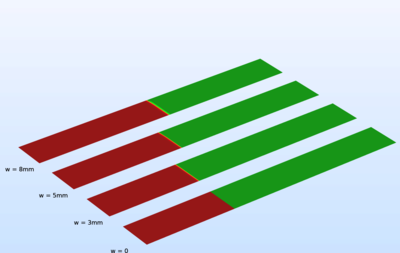
Interfacial failure or delamination in a composite material can be simulated with a cohesive zone model (CZM). A key ingredient of a cohesive zone model is a traction-separation law that describes the softening in the cohesive zone near the delamination tip. This example shows the ... En savoir plus

Small heating circuits find use in many applications. For example, in manufacturing processes, they heat up reactive fluids. The device in this tutorial consists of an electrically resistive layer deposited on a glass plate. The layer results in Joule heating when a voltage is applied to ... En savoir plus


