
La Bibliothèque d'Applications présente des modèles construits avec COMSOL Multiphysics pour la simulation d'une grande variété d'applications, dans les domaines de l'électromagnétisme, de la mécanique des solides, de la mécanique des fluides et de la chimie. Vous pouvez télécharger ces modèles résolus avec leur documentation détaillée, comprenant les instructions de construction pas-à-pas, et vous en servir comme point de départ de votre travail de simulation. Utilisez l'outil de recherche rapide pour trouver les modèles et applications correspondant à votre domaine d'intérêt. Notez que de nombreux exemples présentés ici sont également accessibles via la Bibliothèques d'Applications intégrée au logiciel COMSOL Multiphysics® et disponible à partir du menu Fichier.
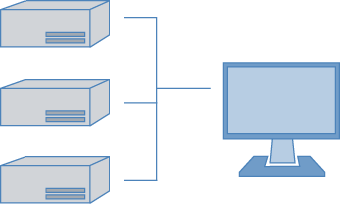
Use this app to validate that the default settings correctly submit jobs to a cluster. These default settings are taken from the preferences. The app allows you to override the default cluster settings, test modifications to the current setup, and test different settings for connecting ... En savoir plus

These examples demonstrate how to use a job sequence to perform a programmatic sequence of operations, including solving; saving the model to file; and generating and exporting plot groups, results, and images. In the blog post associated with these files, "How to Use Job Sequences to ... En savoir plus
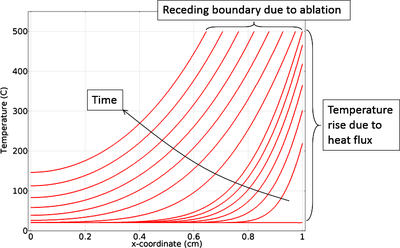
This example exemplifies how to model thermal ablation by taking into account material removal. A more detailed description of the phenomenon and the modeling process can be seen in the blog post "Modeling Thermal Ablation for Material Removal". En savoir plus
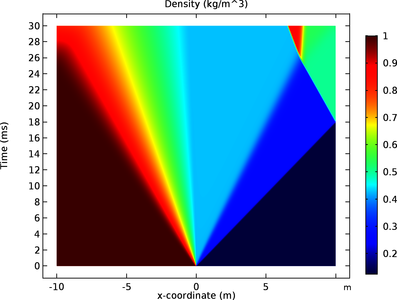
The compressible Euler equations are implemented in the Wave Form PDE interface with nodal discontinuous Lagrange shape functions to compute the flow in a shock tube. The purpose of this application is to simulate the flow in the tube and estimate the distributions of pressure, density, ... En savoir plus

See how to generate a mesh from scanned data via two different workflows. For both examples, the data file is imported in an Interpolation function. In the first workflow, the data is applied on a Grid dataset and a Filter dataset is used to filter out the data to represent the femur. ... En savoir plus

This example simulates the temperature dynamics in cylindrical battery, initially at room temperature, after being placed in an oven. As the temperature increases, various exothermal decomposition reactions are activated, which in turn result in further heating of the battery. En savoir plus
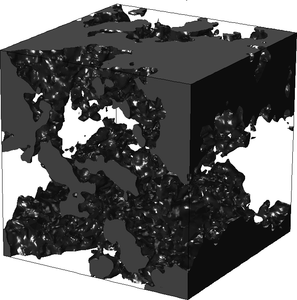
These examples show how to use the tools under the Results node to generate and visualize randomized material data with prescribed statistical properties. The randomness is controlled through a spectral density distribution, which defines the spatial frequency content of the material ... En savoir plus
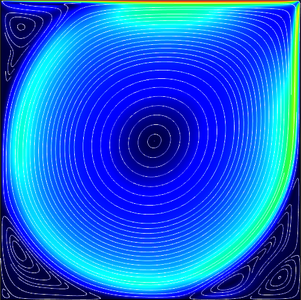
This example demonstrates how to define the lid-driven cavity benchmark in the field of computational fluid dynamics. In the model setup, a 2D square cavity has a tangentially moving wall that induces a large vortex in the center of the cavity, and small vortices in the corners. The ... En savoir plus

This document explains how to install and run COMSOL Multiphysics® and COMSOL Server™ with Microsoft® Azure. This requires that you have first acquired a Floating Network License (FNL) or COMSOL Server License (CSL) from COMSOL. The license manager software can run ... En savoir plus

This is a simple 1D model demonstrating ultrafast heat transfer simulations for femtosecond pulsed laser heating. Specifically, the following three models are implemented and compared with conventional Fourier heat conduction (known as parabolic one-step, POS): Hyperbolic one-step ... En savoir plus


