
La Bibliothèque d'Applications présente des modèles construits avec COMSOL Multiphysics pour la simulation d'une grande variété d'applications, dans les domaines de l'électromagnétisme, de la mécanique des solides, de la mécanique des fluides et de la chimie. Vous pouvez télécharger ces modèles résolus avec leur documentation détaillée, comprenant les instructions de construction pas-à-pas, et vous en servir comme point de départ de votre travail de simulation. Utilisez l'outil de recherche rapide pour trouver les modèles et applications correspondant à votre domaine d'intérêt. Notez que de nombreux exemples présentés ici sont également accessibles via la Bibliothèques d'Applications intégrée au logiciel COMSOL Multiphysics® et disponible à partir du menu Fichier.
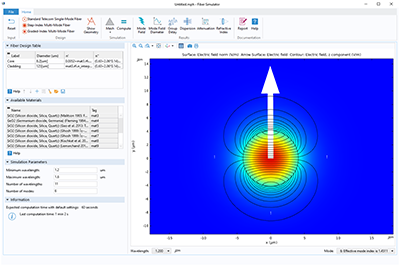
The transmission speed of optical waveguides is superior to microwave waveguides because optical devices have a much higher operating frequency than microwaves, enabling a far higher bandwidth. Single-mode step-index fibers are used for long-haul (even transoceanic) communication, ... En savoir plus
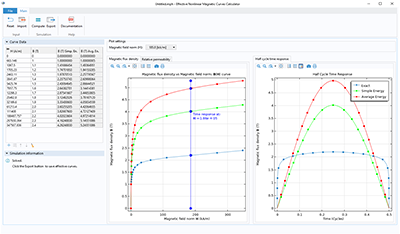
This app demonstrates the following: Importing measured data from a text file Handling measured data using methods Exporting the results to a text file Exporting the results as COMSOL Material Library file. The app is a companion to the Effective Nonlinear Constitutive Relations ... En savoir plus
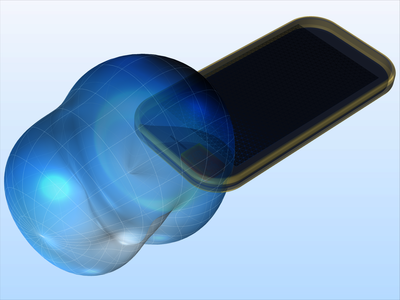
Electrical components in wireless communication systems are designed to be small and lightweight while maintaining decent performance and efficiency. Antennas are essential components in mobile devices and are required to fit in the limited space allowed by industrial specifications. To ... En savoir plus
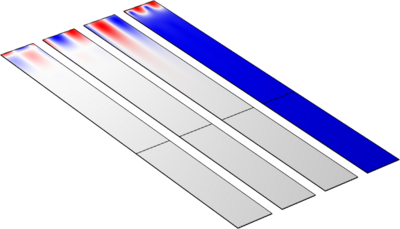
In the surface acoustic waves industry different crystal cuts of piezoelectric materials are used, e.g. 128ᵒ YX LiNbO3, AT&ST quartz, 42ᵒ YX LiTaO3, etc. Direct data isn’t available for all cuts. The standard approach is to use the so-called Euler angle rotation. COMSOL supports it ... En savoir plus
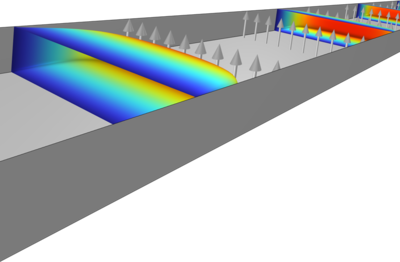
In nuclear fusion reactors, the conducting fluid, such as the fusion plasma and the liquid metal in the reactor blanket, will interact with the background magnetic field. This phenomenon is referred to as magnetohydrodynamics (MHD). The electromagnetic field and fluid flow are fully ... En savoir plus
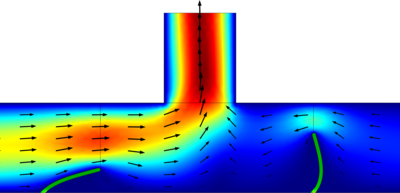
Micropumps are key components of microfluidic systems with applications ranging from biological fluid handling to microelectronic cooling. This model simulates the mechanism of a valveless micropump, that is designed to be effective at low Reynolds numbers, overcoming hydrodynamic ... En savoir plus
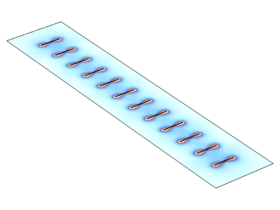
This example of a dipole antenna array demonstrates a cost-effective analysis using the Boundary Element Method (BEM). When dealing with a large array made of metallic radiators, the Finite Element Method (FEM) would necessitate greater computational resources. The simulation results ... En savoir plus
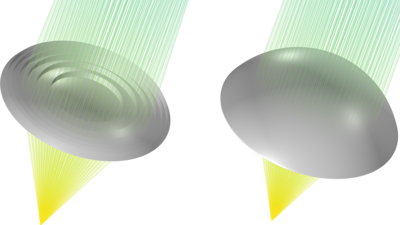
A Fresnel lens can be constructed from a plano-convex lens as a way to reduce the thickness. This model models the collimation property of a Fresnel lens and demonstrates the geometry operation of making a Fresnel lens from a plano-convex lens. En savoir plus
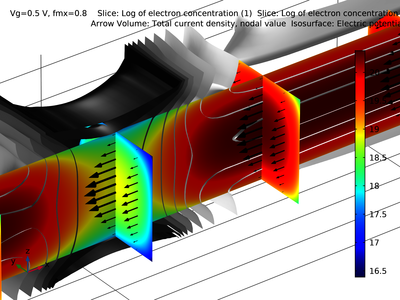
This 3D model of a nanowire MOSFET employs the density-gradient theory to add the effect of quantum confinement to the conventional drift-diffusion formulation, without requiring excessively high computational costs. The oxide layer is simulated explicitly with geometric domains, and ... En savoir plus
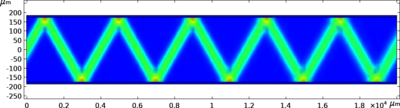
The bidirectional formulation of the Beam Envelopes interface can be used not only for counter-propagating wave simulations but also for waves propagating to up to two directions. In this model, an almost collimated Gaussian beam is excited at the left boundary and exhibits total ... En savoir plus


