
La Bibliothèque d'Applications présente des modèles construits avec COMSOL Multiphysics pour la simulation d'une grande variété d'applications, dans les domaines de l'électromagnétisme, de la mécanique des solides, de la mécanique des fluides et de la chimie. Vous pouvez télécharger ces modèles résolus avec leur documentation détaillée, comprenant les instructions de construction pas-à-pas, et vous en servir comme point de départ de votre travail de simulation. Utilisez l'outil de recherche rapide pour trouver les modèles et applications correspondant à votre domaine d'intérêt. Notez que de nombreux exemples présentés ici sont également accessibles via la Bibliothèques d'Applications intégrée au logiciel COMSOL Multiphysics® et disponible à partir du menu Fichier.
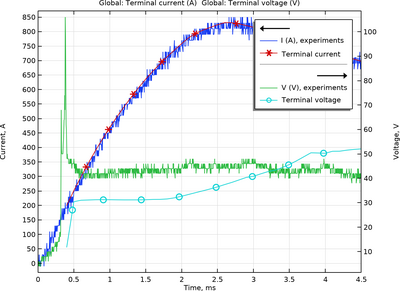
This model presents a 2D simulation of transient arc discharge movement along guided copper rails. While accurately modeling transient arcs typically requires a 3D simulation, the 2D approach offers greater efficiency and remains valuable for initial investigations and demonstration ... En savoir plus
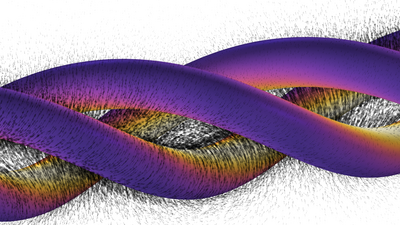
These models demonstrate various ways of exciting magnetic fields using the Magnetic Field Formulation interface in the AC/DC Module, an add-on to the COMSOL Multiphysics® software. To learn more about these models, see the accompanying blog post “Modeling of Excitations with ... En savoir plus
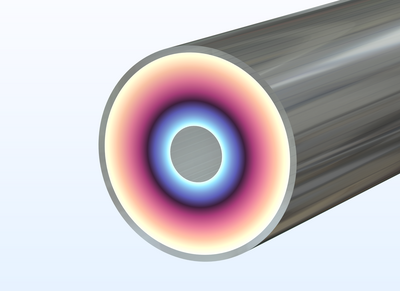
This example demonstrates how to compute transmission line parameters such as series resistance, series inductance, shunt conductance, and shunt capacitance per unit length using the predefined Transmission Line RLGC Parameters multiphysics interface. The demonstration also includes the ... En savoir plus

This is a transient model of an electromagnetic plunger with stopper restricting the linear motion. The model consists of a magnetic core, nonmagnetic guider, multi-turn coil, nonmagnetic stopper/blocker, and magnetic plunger attached to the spring and damper at the base. The ... En savoir plus
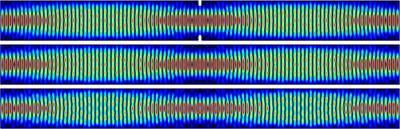
This model demonstrates three different ways to find the eigenfrequencies of a rectangular metallic cavity. The first method uses an eigenfrequency study step together with the Electromagnetic Waves, Beam Envelopes interface. Here, it is important to define a wave vector for the physics ... En savoir plus
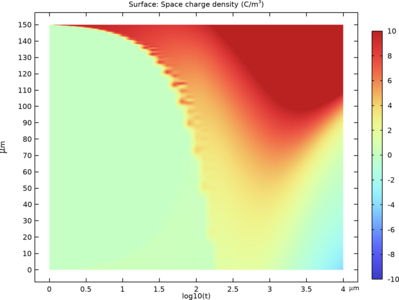
The study explores charge transport dynamics in polyethylene, a common solid dielectric insulation material. It employs a bipolar charge transport model to calculate the densities of electrons, holes, and their trapped counterparts. The simulation's outcomes for discharge current and ... En savoir plus
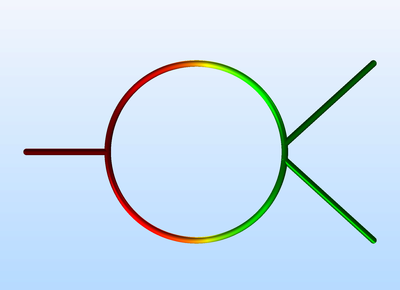
Some conventional three-port power dividers are resistive power dividers and T-junction power dividers. Such dividers are either lossy or not matched to the system reference impedance at all ports. In addition, isolation between two coupled ports is not guaranteed. The Wilkinson power ... En savoir plus

A corner cube retroreflector can be used to reflect rays in a direction exactly antiparallel to their initial direction, regardless of the angle of incidence. This tutorial shows how to simulate the reflection of a bundle of rays at a corner cube retroreflector using the Geometrical ... En savoir plus
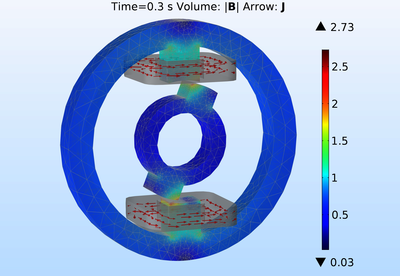
Switched reluctance motors work on the principle of reluctance torque. The stator and rotor will interact to minimize the reluctance for the flux path. This application simulates the behavior of the motor when the stator winding is excited with a step voltage and when the rotor is at a ... En savoir plus
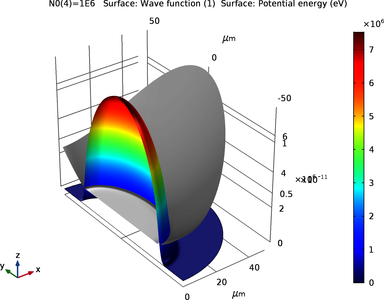
This tutorial model solves the Gross–Pitaevskii Equation for the ground state of a Bose–Einstein condensate in a harmonic trap, using the Schrödinger Equation interface in the Semiconductor Module. The equation is essentially a nonlinear single-particle Schrödinger Equation, with a ... En savoir plus


