
La Bibliothèque d'Applications présente des modèles construits avec COMSOL Multiphysics pour la simulation d'une grande variété d'applications, dans les domaines de l'électromagnétisme, de la mécanique des solides, de la mécanique des fluides et de la chimie. Vous pouvez télécharger ces modèles résolus avec leur documentation détaillée, comprenant les instructions de construction pas-à-pas, et vous en servir comme point de départ de votre travail de simulation. Utilisez l'outil de recherche rapide pour trouver les modèles et applications correspondant à votre domaine d'intérêt. Notez que de nombreux exemples présentés ici sont également accessibles via la Bibliothèques d'Applications intégrée au logiciel COMSOL Multiphysics® et disponible à partir du menu Fichier.
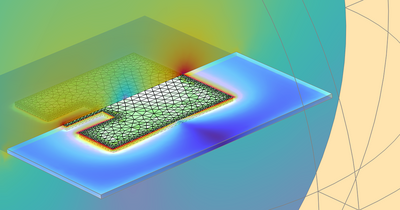
One of the ways we can simplify and reduce the size and computational complexity of a finite element model is by using any symmetries present in a model. In this entry, you can find three practical examples highlighting how to exploit symmetries in RF or wave optics modeling. They all ... En savoir plus
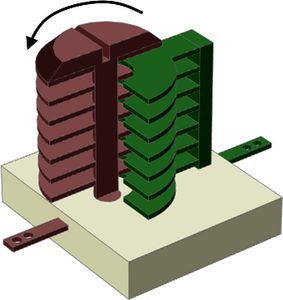
A trimmer capacitor has a variable capacitance. One way of obtaining this is to use parallel facing electrodes with a variable overlap area. In this example, the capacitance can be changed by turning one electrode using a screwdriver. Typically a linear angular response is desired. ... En savoir plus
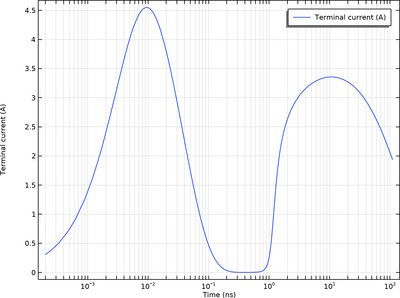
This model shows how to simulate the complex discharge physics behind the well-known electrostatic discharge (ESD). The model connects the Electrical Discharge interface with the Circuit interface to simulate how ESD current is generated when a human hand touches metal. En savoir plus
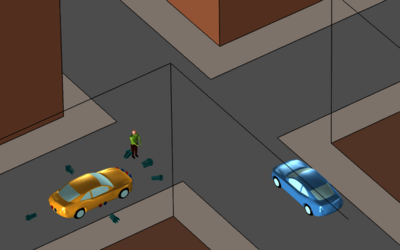
Light Detection And Ranging (LIDAR) is used extensively in self-driving cars to perform the quantitative ranging of the surroundings obstacles. The LIDAR system consists of a laser beam which gets broadened using a MEMS mirror with a particular horizontal and vertical field of view ... En savoir plus
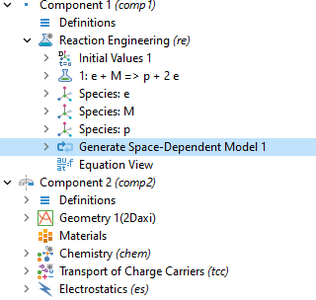
The example shows how to generate a discharge model from the Reaction Engineering interface with a self-defined discharge chemistry. It reproduces the library model 127181 (Double-Headed Streamer in Parallel-Plate Electrodes). En savoir plus
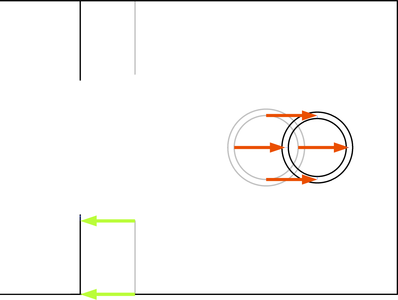
This model demonstrates how to find the optimal size and position of a water pipe in an air chamber, so that the energy absorption in the water is maximized. The objective is implemented as a constraint, so that the optimization terminates, when the desired performance is achieved. En savoir plus
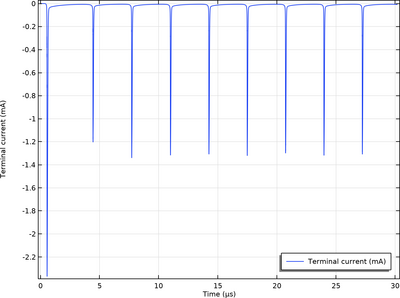
This example simulates Trichel pulses produced by negative corona discharge under a point-to-plate configuration. The electron density and the electric field are obtained, as well as the discharge current. The discharge current clearly shows the pulsating characters. Each current pulse ... En savoir plus

This model compares the numerical and analytical solutions for the capacitance matrix of two non-concentric spheres. It also illustrates the relation between the Maxwell capacitance matrix and the mutual capacitance matrix. Learn more about this model in the blog post "How to Calculate ... En savoir plus

The model illustrate the technique to calculate the magnetic stiffness in a 3D geometry of a permanent magnet axial magnetic bearing. The Magnetic Fields physics is used to model the bearing and compute the magnetic forces. The Deformed Geometry and Sensitivity physics are used to ... En savoir plus
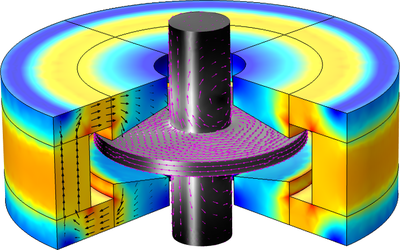
This model illustrates the working principle of an axial homopolar induction bearing. An electrically conducting rotor rotating in a magnetic field produced by a permanent magnets induces eddy currents on the conducting rotor. The eddy currents, in turn, produce a magnetic field that ... En savoir plus


