
La Bibliothèque d'Applications présente des modèles construits avec COMSOL Multiphysics pour la simulation d'une grande variété d'applications, dans les domaines de l'électromagnétisme, de la mécanique des solides, de la mécanique des fluides et de la chimie. Vous pouvez télécharger ces modèles résolus avec leur documentation détaillée, comprenant les instructions de construction pas-à-pas, et vous en servir comme point de départ de votre travail de simulation. Utilisez l'outil de recherche rapide pour trouver les modèles et applications correspondant à votre domaine d'intérêt. Notez que de nombreux exemples présentés ici sont également accessibles via la Bibliothèques d'Applications intégrée au logiciel COMSOL Multiphysics® et disponible à partir du menu Fichier.
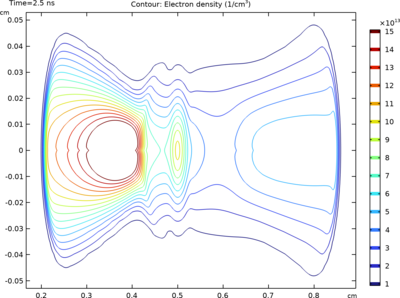
This model simulates the propagation of a double-headed streamer in nitrogen at atmospheric pressure. Initially, electron-positive ion clusters were introduced between two parallel electrodes, subjecting the gas to a strong background electric field of 52 kV/cm. Subsequently, both the ... En savoir plus
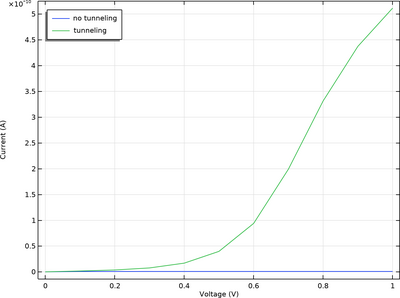
This model shows how to model a simple Metal–Insulator–Metal (MIM) diode. The two metal electrodes are defined on each side using the Metal Contact feature. Two studies were performed: one without quantum tunneling across the potential barrier and the other including it, using the WKB ... En savoir plus
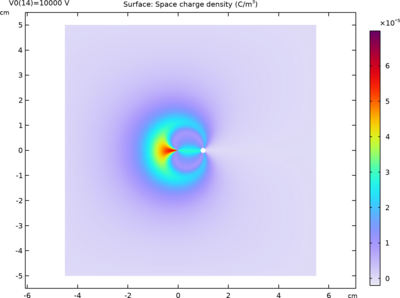
This model utilizes a continuation solver to efficiently compute the current–voltage characteristics of a corona discharge generated by a wire-to-wire configuration. It provides a flexible framework that can be easily adapted to study other discharge configurations and types. En savoir plus
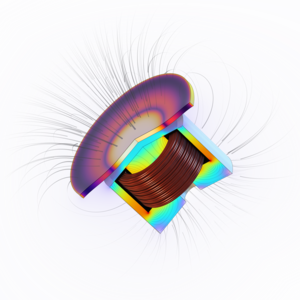
A magnetic diaphragm is a flexible, thin structure that interacts with magnetic fields to perform mechanical or sensing functions. When subjected to an external magnetic field, the diaphragm deforms due to magnetomechanical interactions, converting magnetic energy into mechanical ... En savoir plus
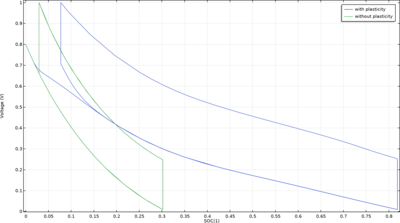
This example shows how to model Lithium diffusion in a silicon electrode that swells. The model shows how swelling-induced plastic deformation can increase the maximum state of charge (SOC). En savoir plus
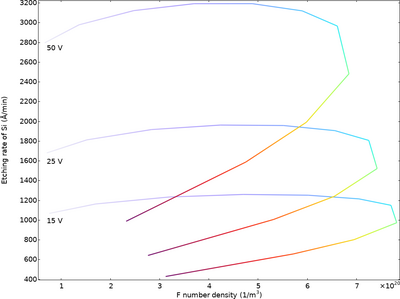
In this example, the etching of silicon in a CF4/O2 plasma reactor is studied using a global model. Parametric sweeps for ion energy and oxygen mole fraction are computed. En savoir plus

Radial magnetic coupling between two permanent magnet rotors is modeled using the Rotating Machinery, Magnetic interface. The permanent magnets in the inner and the outer rotors are outward flux-focused and inward flux-focused to maximize the coupling torque. En savoir plus

This proof-of-concept model showcases how to handle a Gaussian beam propagating in the negative y direction in 2D. The model includes several studies, including a parametric sweep, to cover a wide combination of settings describing the background Gaussian beam, such as settings for ... En savoir plus
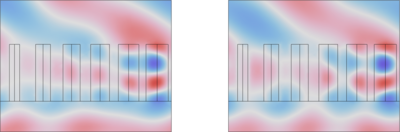
This model is based on the Metasurface Beam Deflector model. The performance is improved using shape optimization by allowing both the radii and the position of the individual pillars to change. En savoir plus
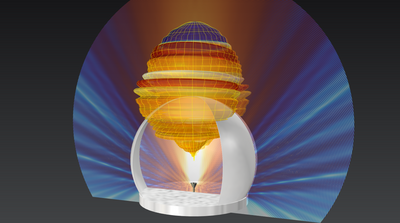
This model demonstrates an efficient approach to simulating a thin, spherical, large radome using a 2D axisymmetric formulation with cubic discretization. The axisymmetric method captures full 3D behavior for azimuthally symmetric geometries at only a fraction of the computational cost. ... En savoir plus


