
La Bibliothèque d'Applications présente des modèles construits avec COMSOL Multiphysics pour la simulation d'une grande variété d'applications, dans les domaines de l'électromagnétisme, de la mécanique des solides, de la mécanique des fluides et de la chimie. Vous pouvez télécharger ces modèles résolus avec leur documentation détaillée, comprenant les instructions de construction pas-à-pas, et vous en servir comme point de départ de votre travail de simulation. Utilisez l'outil de recherche rapide pour trouver les modèles et applications correspondant à votre domaine d'intérêt. Notez que de nombreux exemples présentés ici sont également accessibles via la Bibliothèques d'Applications intégrée au logiciel COMSOL Multiphysics® et disponible à partir du menu Fichier.
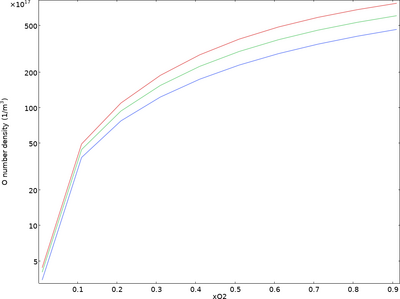
In this example, an CF4/O2 plasma reactor at low pressure is studied using a global model. Parametric sweeps for pressure and oxygen mole fraction are computed. En savoir plus
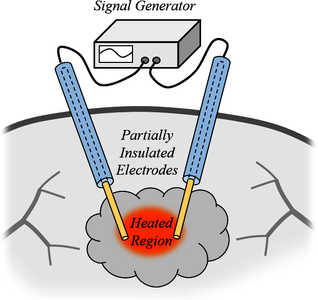
This example shows how to model tissue ablation through applying RF radiation. A more detailed description of the phenomenon and the modeling process can be seen in the blog post "Study Radio Frequency Tissue Ablation Using Simulation". En savoir plus
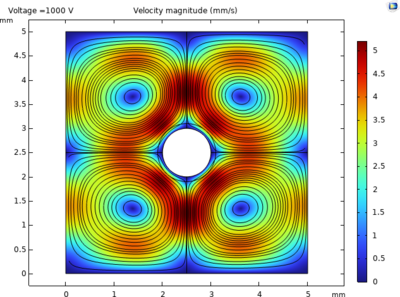
This model simulates the electrohydrodynamic (EHD) flow of a dielectric liquid around a wire electrode positioned between two parallel flat-plate electrodes. The ion transport is described using the Poisson–Nernst–Planck equations, while fluid motion is governed by the Navier–Stokes ... En savoir plus
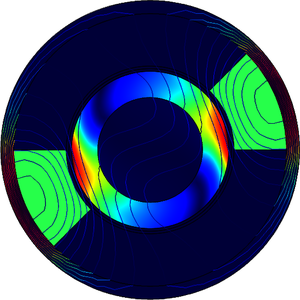
This single-phase induction motor model is used to compare with Testing Electromagnetic Analysis Method (TEAM) workshop problem 30. The Magnetic Fields physics interface is used to model the motor in the frequency domain at 60 Hz. The Velocity (Lorentz Term) feature is used to model the ... En savoir plus
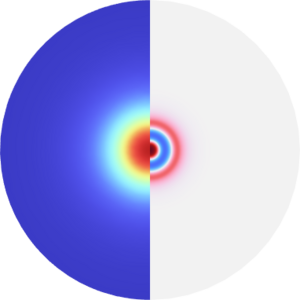
Stimulated Brillouin Scattering (SBS) describes a nonlinear interaction between light and sound. In optical fibers, SBS can be detrimental for power or communication purposes, but can be leveraged for sensing applications. The SBS gain spectrum quantifies the optic-acoustic mode ... En savoir plus
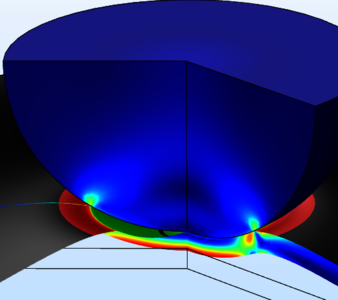
A steel ball is pressed down against a rubber membrane. When the contact pressure exceeds a certain value, the two parts start sticking together. When the ball is retracted, the membrane is pulled upwards in the bonded region. During the retraction, the bond is partially broken. This ... En savoir plus
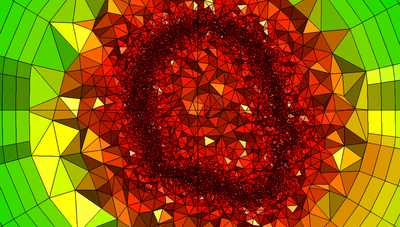
Creating irregular geometries can be a good solution, even the only option, for some types of applications. These files present a way to use a text file with material properties defined in coordinates to assign different materials even though there is only one regular domain. The same ... En savoir plus
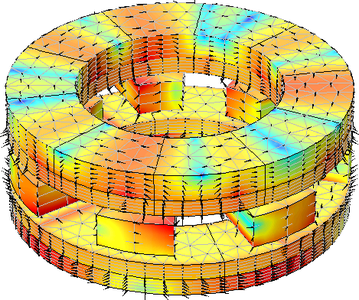
In this model, an axial field magnetic gear with a gear ratio of 5:2 is modeled. Both the high-speed and low-speed rotors consist of permanent magnets and back iron. The low-speed rotor consists of five pole pairs, while the high-speed rotor consists of two pole pairs and the stationary ... En savoir plus
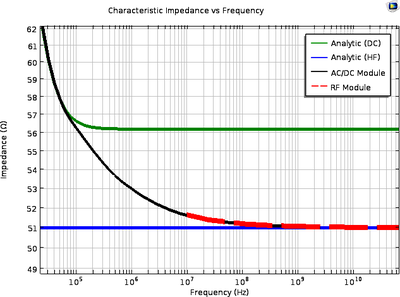
Electrical cables, also called transmission lines, are used everywhere in the modern world to transmit both power and data. These cables carry electromagnetic energy, but instead of dealing with the full complexity of the electromagnetic fields, they are more commonly classified ... En savoir plus
In this model, the transmitter (microstrip patch) and receiver (Yagi–Uda) antennas are modeled simultaneously in the FEM domain and are coupled with FEM–BEM coupling. The results are compared with the analytical Friis transmission formula. In detail, the emw and emw2 interfaces find out ... En savoir plus


