
La Bibliothèque d'Applications présente des modèles construits avec COMSOL Multiphysics pour la simulation d'une grande variété d'applications, dans les domaines de l'électromagnétisme, de la mécanique des solides, de la mécanique des fluides et de la chimie. Vous pouvez télécharger ces modèles résolus avec leur documentation détaillée, comprenant les instructions de construction pas-à-pas, et vous en servir comme point de départ de votre travail de simulation. Utilisez l'outil de recherche rapide pour trouver les modèles et applications correspondant à votre domaine d'intérêt. Notez que de nombreux exemples présentés ici sont également accessibles via la Bibliothèques d'Applications intégrée au logiciel COMSOL Multiphysics® et disponible à partir du menu Fichier.
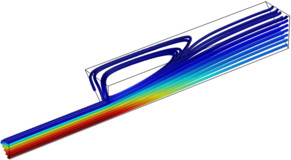
This tutorial model solves the incompressible Navier-Stokes equations in a backstep geometry using the Laminar Flow interface. A characteristic feature of fluid flow in geometries of this kind is the recirculation region that forms where the flow exits the narrow inlet region. The model ... En savoir plus
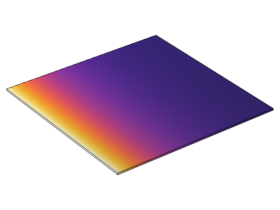
This example models heat transfer in a thin rectangular metal plate. Because the plate’s thickness is only 1/100 of its length and width, you can simulate the process using a 2D approximation. The plate has a fixed temperature at one end and is isolated at the other. A surrounding liquid ... En savoir plus
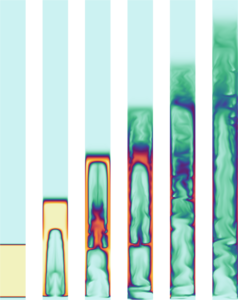
Circulating fluidized beds are widely used in the food & beverage, pharmaceutical, chemical, and energy industries to achieve efficient contact between solid and fluid reactants. This model visualizes how a circulating fluidized bed operates. In the model, the dispersed phase, which ... En savoir plus
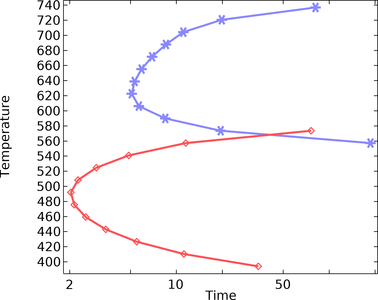
During quenching of steel, austenite decomposes into phases such as ferrite, pearlite, bainite, and martensite. A common way to illustrate the phase transformation characteristics of a particular steel alloy is to use transformation diagrams. Two of the most commonly used diagram types ... En savoir plus
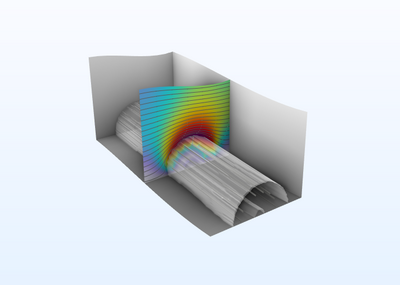
This thermo-hydro-mechanical (THM) model of artificial ground freezing couples heat transfer, groundwater flow, and soil mechanics to capture ice formation, pore-pressure changes, and ground deformation during tunnel excavation. The freezing process is modeled with the apparent heat ... En savoir plus
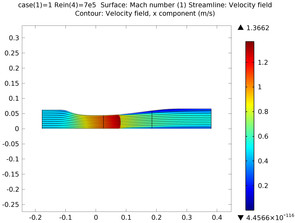
In this model the high speed turbulent gas flow in a converging and diverging nozzle is modeled using the High Mach Number Flow interface. The diffuser is transonic in the sense that the flow at the inlet is subsonic, but due to the contraction and the low outlet pressure, the flow ... En savoir plus
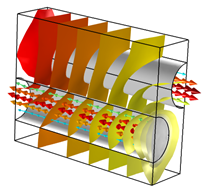
The example concerns a stainless-steel MEMS heat exchanger, which you can find in lab-on-a-chip devices in biotechnology and in microreactors such as for micro fuel cells. This model examines the heat exchanger in 3D, and it involves heat transfer through both convection and ... En savoir plus
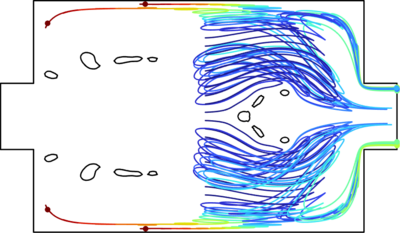
This example performs a topological optimization for a Tesla microvalve for an oscillating pressure drop. A Tesla microvalve inhibits backward flow using friction forces rather than moving parts, and therefore the objective is to maximize the average flow rate. The design can be ... En savoir plus
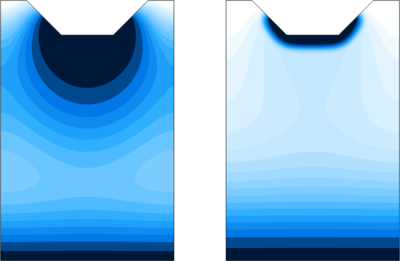
This example shows how to set up a model of furrow irrigation in a nonuniform soil column. It employs the Unsaturated Dual Permeability feature, which links two Richards' Equations through a fluid transfer function. This scenario can be regarded as a benchmark problem for dual ... En savoir plus
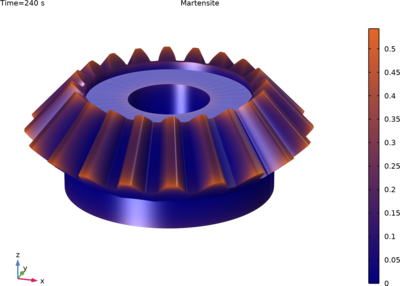
A 3D model is used to simulate the cooling of a bevel gear from an austenitic state. Phase material properties and phase transformation data are imported into the model. The final phase composition and the residual stress state are computed. Phenomena such as thermal strains, phase ... En savoir plus


