
La Bibliothèque d'Applications présente des modèles construits avec COMSOL Multiphysics pour la simulation d'une grande variété d'applications, dans les domaines de l'électromagnétisme, de la mécanique des solides, de la mécanique des fluides et de la chimie. Vous pouvez télécharger ces modèles résolus avec leur documentation détaillée, comprenant les instructions de construction pas-à-pas, et vous en servir comme point de départ de votre travail de simulation. Utilisez l'outil de recherche rapide pour trouver les modèles et applications correspondant à votre domaine d'intérêt. Notez que de nombreux exemples présentés ici sont également accessibles via la Bibliothèques d'Applications intégrée au logiciel COMSOL Multiphysics® et disponible à partir du menu Fichier.

This model represents a test case of a flow in an elastic tube which is present in several applications. This specific case models viscoelastic flow and represents steady flow in a channel in which part of the upper wall is replaced by an elastic plate subjected to an external pressure. ... En savoir plus
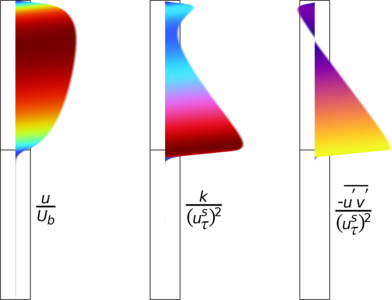
This setup demonstrates how the characteristics of turbulent flow in a channel are modified by the presence of an adjacent porous region. Asymmetric velocity profiles, higher turbulence levels, and higher friction coefficients both at the solid wall and the fluid-porous interface are ... En savoir plus
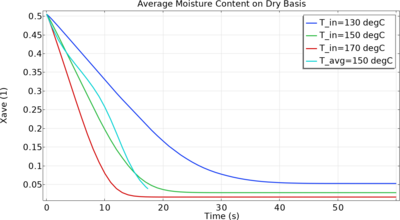
This model demonstrates how to vary the inlet temperature in a superheated steam drying process so as to minimize the time, while constraining both the energy consumption and the final moisture content. En savoir plus

Silicon carbide (SiC) epitaxial furnaces are a specialized equipment for the production and preparation of SiC epitaxial wafers. This example model demonstrates the process of preparing an SiC epitaxial wafer based on the physical vapor transport (PVT) method in a furnace. This involves ... En savoir plus
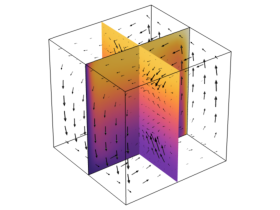
This example studies the stationary state of free convection in a cavity filled with air and bounded by two vertical plates. To generate the buoyancy flow, the plates are heated at different temperatures, set in a range to keep the flow laminar. En savoir plus
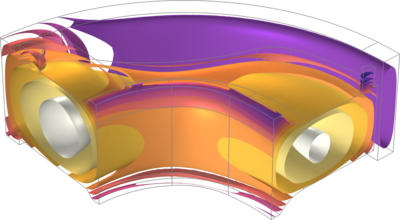
Modeling curing is important in a wide variety of applications such as for devices utilizing polymer materials, rubber materials, plastics, and concrete. Curing is usually an exothermic reaction. In the current example, curing of butyl rubber is studied in a 3D mold for an automotive ... En savoir plus
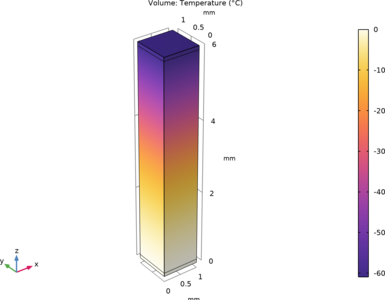
A thermoelectric leg is a fundamental component of a thermoelectric cooler (or heater). For example, a thermocouple is a thermoelectric module typically made of two thermoelectric legs: one made of p-type and of one n-type semiconductor material which are connected in series electrically ... En savoir plus
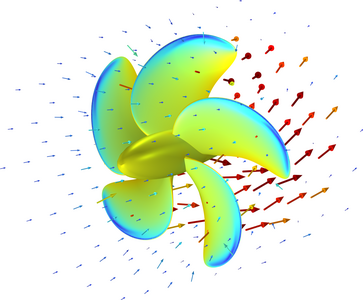
A propeller is the propulsion device of a ship. This model studies the open water performance of the KP505 propeller[1]using the frozen rotor method with RANS turbulence model. Thrust and torque coefficient, and open water efficiency of the propeller at different advance coefficients ... En savoir plus
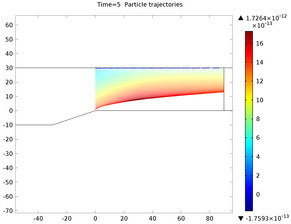
When a temperature gradient in a gas exists, suspended particles will tend to move from regions of high temperature to low. The force which produces this effect is called the thermophoretic force. Gas molecules colliding with a particle from the hot side have a higher velocity than the ... En savoir plus
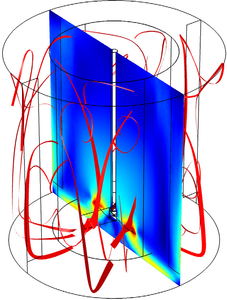
This tutorial example simulates the flow in a flat bottom mixer containing, agitated by a pitched four blade impeller, where the fluid is water, and flow is assumed to be turbulent. The flow in the mixer is modeled using the k-ε turbulence model, and a time-dependent simulation ... En savoir plus


