
La Bibliothèque d'Applications présente des modèles construits avec COMSOL Multiphysics pour la simulation d'une grande variété d'applications, dans les domaines de l'électromagnétisme, de la mécanique des solides, de la mécanique des fluides et de la chimie. Vous pouvez télécharger ces modèles résolus avec leur documentation détaillée, comprenant les instructions de construction pas-à-pas, et vous en servir comme point de départ de votre travail de simulation. Utilisez l'outil de recherche rapide pour trouver les modèles et applications correspondant à votre domaine d'intérêt. Notez que de nombreux exemples présentés ici sont également accessibles via la Bibliothèques d'Applications intégrée au logiciel COMSOL Multiphysics® et disponible à partir du menu Fichier.
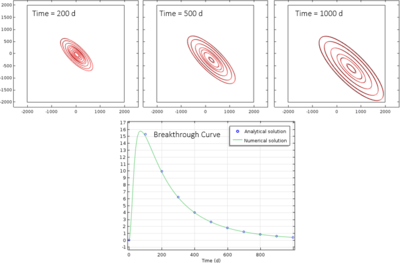
Predicting the transport of solutes that move with subsurface fluids is of general interest in environmental engineering and geosciences. Solutes may not only be pollutants but also artifical tracers added to the groundwater for investigation purposes. This model tracks a solute over ... En savoir plus
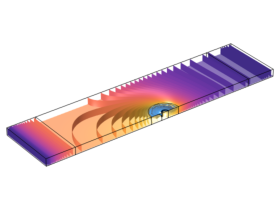
In friction stir welding, a rotating tool moves along the weld joint and melts the aluminum through the generation of friction heat. The tool’s rotation stirs the melted aluminum such that the two plates are joined. In this model, two aluminum plates are joined by generating friction ... En savoir plus
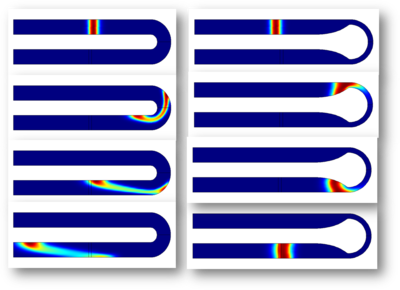
This model studies the dispersion of neutral species band through curved microchannel in an Electroosmotic flow (EOF) . Using Optimization module, geometric optimization is carried out to minimize the curve-induced dispersion.The central idea is to parametrically represent the geometry ... En savoir plus
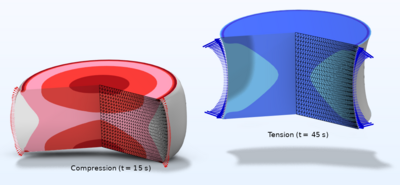
This model demonstrates how to set up a fully coupled poroviscoelastic model of biological tissues. The model is benchmarked by simulating a cyclic uniaxial tension–compression test on human brain tissue. En savoir plus
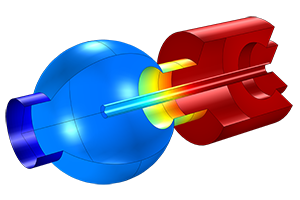
This model shows how to simulate the time-dependent adsorption and desorption of water in a vacuum system at low pressures. The water is introduced into the system when a gate valve to a load lock is opened and the subsequent migration and pumping of the water is modeled. En savoir plus
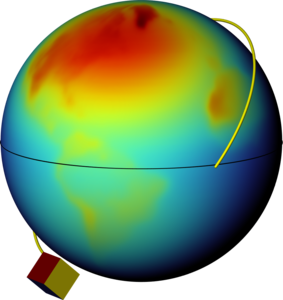
This model demonstrates how to define Earth properties that are spatially varying on the planet. A satellite in orbit experiences solar, albedo, and planetary infrared (IR) loads, where albedo and planetary IR can vary with latitude and longitude. In this example, these inputs are read ... En savoir plus
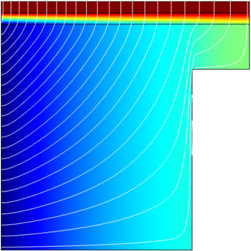
Fluids that move through pore spaces in an aquifer or reservoir can shield the porous medium from stress because they bear part of the load from, for instance, overlying rocks, sediments, fluids, and buildings. Withdrawing fluids from the pore space increases the stress the solids bear, ... En savoir plus
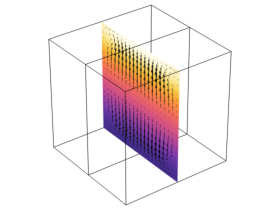
This example studies the stationary state of free convection in a cavity filled with water and bounded by two vertical plates. To generate the buoyancy flow, the plates are heated at different temperatures, bringing the regime close to the transition between laminar and turbulent. To ... En savoir plus
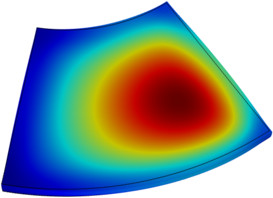
Tilted pad thrust bearings are used in rotating machineries with high thrust loading. The thrust load is transferred from a sliding part to a stationary part through hydrodynamic oil films. The tilted pad thrust bearing consists of a series of flat surfaces sliding over stationary tilted ... En savoir plus
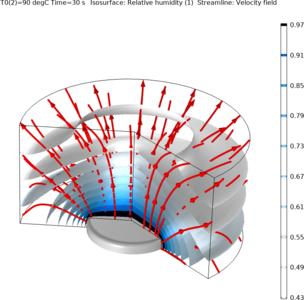
This tutorial model demonstrates the use of the Moisture Flow coupling node to account for the Stefan flow in moist air, over an evaporation surface. The effects on the velocity field and vapor concentration are presented with different ambient temperature conditions. En savoir plus


