
La Bibliothèque d'Applications présente des modèles construits avec COMSOL Multiphysics pour la simulation d'une grande variété d'applications, dans les domaines de l'électromagnétisme, de la mécanique des solides, de la mécanique des fluides et de la chimie. Vous pouvez télécharger ces modèles résolus avec leur documentation détaillée, comprenant les instructions de construction pas-à-pas, et vous en servir comme point de départ de votre travail de simulation. Utilisez l'outil de recherche rapide pour trouver les modèles et applications correspondant à votre domaine d'intérêt. Notez que de nombreux exemples présentés ici sont également accessibles via la Bibliothèques d'Applications intégrée au logiciel COMSOL Multiphysics® et disponible à partir du menu Fichier.
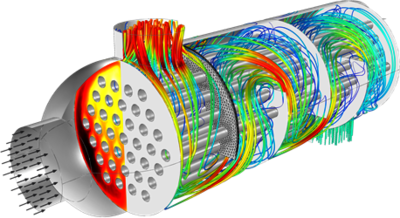
Shell-and-tube heat exchangers are commonly used in oil refineries and other large chemical processes. In this model, two separated fluids at different temperatures flow through the heat exchanger, one through the tubes (tube side) and the other through the shell around the tubes (shell ... En savoir plus
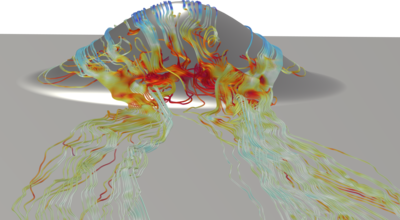
The present example simulates the turbulent flow over a 3D hill geometry using the Large Eddy Simulation (LES) interface with synthetic turbulence at the inlet boundary. En savoir plus
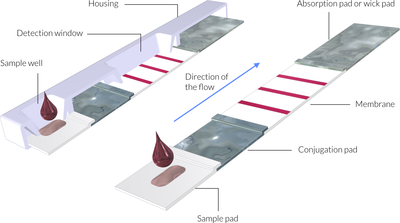
This example introduces three different models for a lateral flow assay for the detection of coronavirus antibodies. These models are as follows: 3D model for studying possible symmetries in the spreading of the liquid sample in the test strip. The 3D model shows that the flow is ... En savoir plus
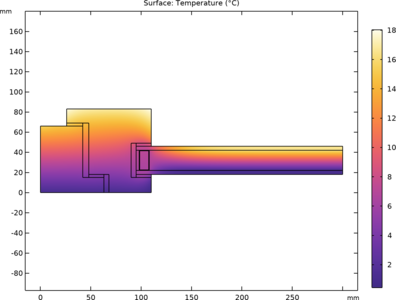
During the design of a building, environmental issues have gained considerable influence in the entire project. One of the first concerns is to improve thermal performances. In this process, simulation software are key tools to model thermal losses and performances in the building. The ... En savoir plus
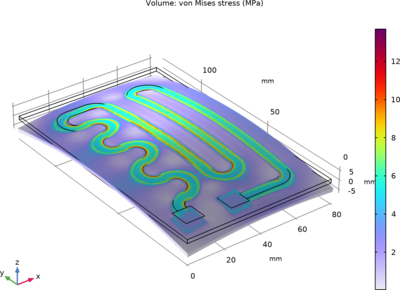
Small heating circuits find use in many applications. For example, in manufacturing processes, they heat up reactive fluids. The device in this tutorial example consists of an electrically resistive layer deposited on a glass plate. The layer results in Joule heating when a voltage is ... En savoir plus

Wastewater treatment is a several-step process for removing contaminants. Firstly, large, solid particles are removed through sedimentation, flotation, and filtration. And then in a second step, biological treatment causes the smaller particles to aggregate, forming so called flocs. ... En savoir plus

This example simulates the underground storage of CO2 in a part of the Johansen formation off the coast of Norway. The CO2 is injected using an injection well at a rate of 15 kg/s over a period of 25 years, after which the well is closed. The model is used to compute the spreading of CO2 ... En savoir plus

This example shows how the mixing capability of a stirred vessel can be evaluated. To efficiently reach the steady operational conditions the turbulent flow is solved for using a frozen rotor analysis, and a following time dependent simulation. When a quasi-steady flow field has ... En savoir plus
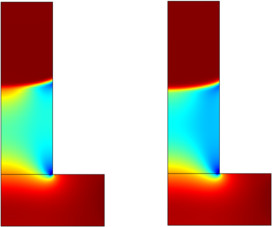
This example studies a narrow vertical cylinder placed on top of a reservoir filled with water. Because of wall adhesion and surface tension at the air/water interface, water rises through the channel. Surface tension and wall adhesive forces are often used to transport fluid through ... En savoir plus
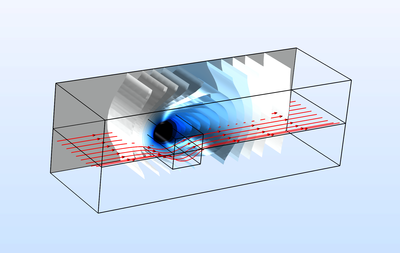
This example is a benchmark problem for simulating phase change in porous media. It studies the melting process of an ice inclusion within porous media and therefore demonstrates how to couple Darcy's Law with the Heat Transfer in Porous Media interface including phase change. En savoir plus


