
La Bibliothèque d'Applications présente des modèles construits avec COMSOL Multiphysics pour la simulation d'une grande variété d'applications, dans les domaines de l'électromagnétisme, de la mécanique des solides, de la mécanique des fluides et de la chimie. Vous pouvez télécharger ces modèles résolus avec leur documentation détaillée, comprenant les instructions de construction pas-à-pas, et vous en servir comme point de départ de votre travail de simulation. Utilisez l'outil de recherche rapide pour trouver les modèles et applications correspondant à votre domaine d'intérêt. Notez que de nombreux exemples présentés ici sont également accessibles via la Bibliothèques d'Applications intégrée au logiciel COMSOL Multiphysics® et disponible à partir du menu Fichier.
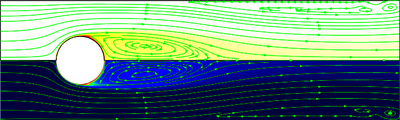
This tutorial demonstrates the use of the Heat and Moisture Flow predefined interface for the modeling of heat transfer and moisture transport in a turbulent air flow, with the quantification of evaporation and condensation on surfaces, and the automatic handling of the associated latent ... En savoir plus
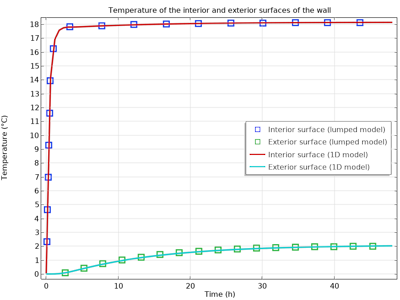
This model performs a transient analysis of the temperature through a house wall. The wall is formed of different layers corresponding to the structure, insulation and plaster. On the exterior and the interior, the wall is exposed to thermal radiation and convective cooling. The results ... En savoir plus
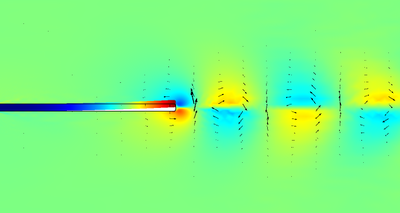
This is a small 2D demonstration model that couples the Linearized Navier-Stokes, Frequency Domain, Solid Mechanics, and Turbulent Flow (k-epsilon) physics interfaces to model the vibrations of a plate located in a 2D viscous parallel plate flow. This type of model is used to model fluid ... En savoir plus
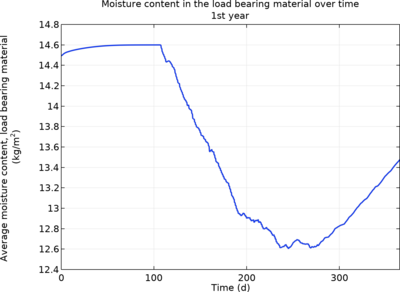
This tutorial demonstrates how to simulate coupled heat and moisture transport in an insulated roof structure composed of a load-bearing layer and an insulation layer. The thermal insulation faces the interior, while a moisture barrier is placed on the exterior side. The load-bearing ... En savoir plus
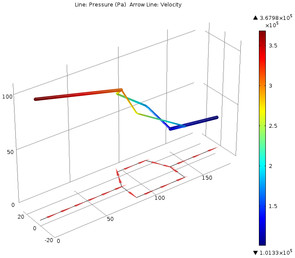
The Pipe Flow interface allows you to simulate non-Newtonian fluids flowing in pipes. This example models a coal slurry being transported in a pipe system where the pipe diameter changes in different sections. The slurry behaves as a non-Newtonian fluid described by the power law model. ... En savoir plus
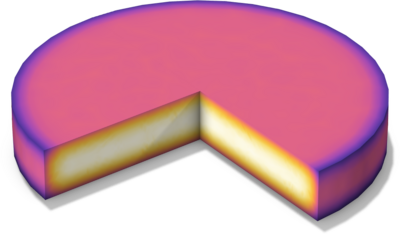
The purpose of this model is to introduce the Semitransparent Surface Feature from the Radiation in Participating Media Interface. It is a variation of the Radiative Cooling of a Glass Plate model with the DOM method. In this version a semitransparent surface is defined on external ... En savoir plus

The process of filling a water balloon is a vivid example for the interaction of fluid pressure and a nonlinear structural material. This model demonstrates how straightforward a FSI simulation model is set up in COMSOL. En savoir plus
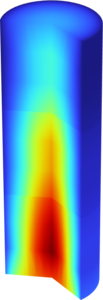
This model simulates a cylindrical furnace with isotropic scattering. It validates the use of the Discrete Ordinates Method for 2D axisymmetric cases, comparing the results with the highly accurate Monte Carlo method. The setup and reference Monte Carlo values are given in: R .P. Gupta, ... En savoir plus
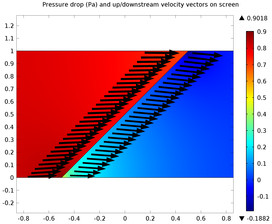
This model simulates the flow through a uniform inclined screen using the Screen feature in Single-Phase Flow physics and compares the results with an analytic solution. En savoir plus
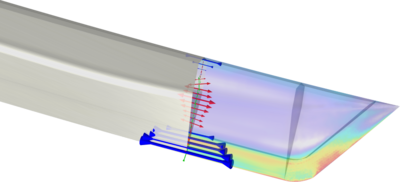
The katana is a legendary Japanese sword used by the samurai in olden days. Here, we present a simple model where we simulate a differential hardening process to explore some of the features of the katana. Learn more in this related blog post: Modeling the Differential Quenching of a ... En savoir plus


