
La Bibliothèque d'Applications présente des modèles construits avec COMSOL Multiphysics pour la simulation d'une grande variété d'applications, dans les domaines de l'électromagnétisme, de la mécanique des solides, de la mécanique des fluides et de la chimie. Vous pouvez télécharger ces modèles résolus avec leur documentation détaillée, comprenant les instructions de construction pas-à-pas, et vous en servir comme point de départ de votre travail de simulation. Utilisez l'outil de recherche rapide pour trouver les modèles et applications correspondant à votre domaine d'intérêt. Notez que de nombreux exemples présentés ici sont également accessibles via la Bibliothèques d'Applications intégrée au logiciel COMSOL Multiphysics® et disponible à partir du menu Fichier.
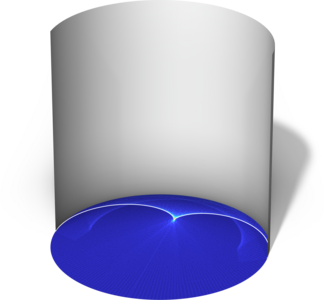
This model demonstrates the caustic effect produced by a cylindrical mirror. It highlights the advantages of the forward ray shooting method when modeling specular reflections from an external radiation source with the Surface-to-Surface Radiation interface. En savoir plus
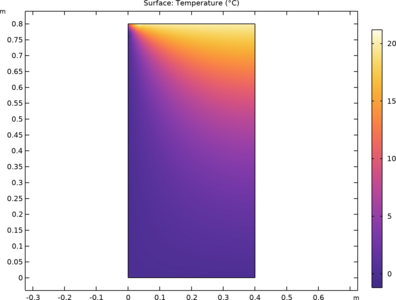
This example studies heat transfer in a square column. Cold and hot temperature conditions are applied to the boundaries. Due to the symmetry of the problem, the geometry is simplified to half of the square. The temperature field is compared with the analytic data. This example ... En savoir plus

Nucleate boiling occurs when a liquid is heated by a source hotter than the saturated fluid temperature but with a heat flux below the critical heat flux. In this regime, high heat flux are possible due to the evaporation of the liquid. This model aims to demonstrate the calculation of ... En savoir plus

Many important processes in the mesoscale can be described by phase-field models. One of the oldest phase-field problems is the spinodal decomposition. Several standardized benchmark problems have been developed by the phase-field community. In this entry, these problems are solved using ... En savoir plus
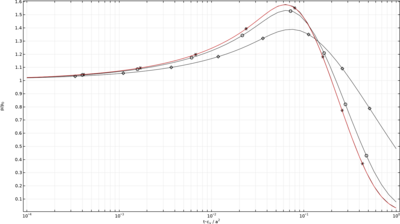
Cryer's problem is a three-dimensional consolidation benchmark. A porous sphere is subjected to a uniform boundary pressure. The pore pressure at the center of the sphere rises due to the Mandel-Cryer effect that is captured by a two-way coupling between Darcy's law and solid mechanics. En savoir plus
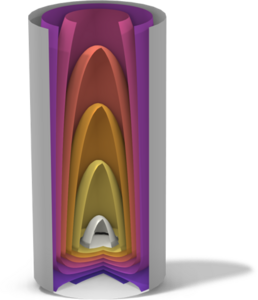
Inside of a combustion chamber, the gas mix behaves as a non-gray medium. Such media require a lot of data and computational resources to get results across the whole spectrum. The Weighted Sum of Gray Gases Model (WSGG) proposes an approach to model the non-gray gas mix as a sum of ... En savoir plus
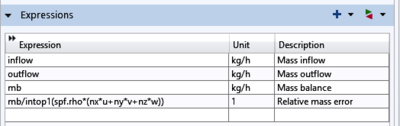
This tutorial model can be used to learn how to calculate mass and energy balances. Get a detailed demonstration in this blog post: How to Calculate Mass Conservation and Energy Balance En savoir plus

Tesla microvalves exploit the non-linear nature of inertial flow to create anisotropic flow resistance. They can be used as robust valves owing to their passive working mechanism, but for many applications the diodicity is too low. Two-dimensional simulations and optimization over ... En savoir plus
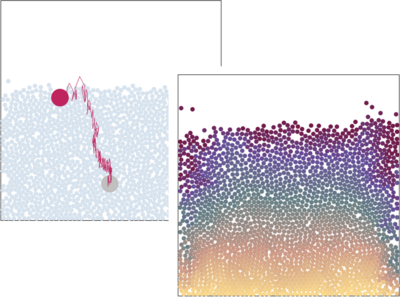
Formally known as size separation in vibrated granular materials, the Brazil nut effect (BNE) (and sometimes the Muesli effect) is a phenomenon that causes large grains to separate from small ones and rise to the top of a granular bed under vibrations. This phenomenon can be studied ... En savoir plus

The NREL Phase VI wind turbine is a widely recognized standard test case in the study of wind turbine aerodynamics, and its wind tunnel test data have become an important benchmark for validating CFD numerical simulation methods. In this validation case, COMSOL Multiphysics is used to ... En savoir plus


