
La Bibliothèque d'Applications présente des modèles construits avec COMSOL Multiphysics pour la simulation d'une grande variété d'applications, dans les domaines de l'électromagnétisme, de la mécanique des solides, de la mécanique des fluides et de la chimie. Vous pouvez télécharger ces modèles résolus avec leur documentation détaillée, comprenant les instructions de construction pas-à-pas, et vous en servir comme point de départ de votre travail de simulation. Utilisez l'outil de recherche rapide pour trouver les modèles et applications correspondant à votre domaine d'intérêt. Notez que de nombreux exemples présentés ici sont également accessibles via la Bibliothèques d'Applications intégrée au logiciel COMSOL Multiphysics® et disponible à partir du menu Fichier.
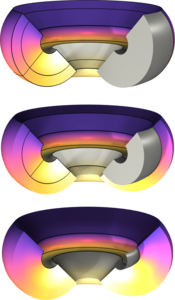
This tutorial model demonstrates the use of the features for heat transfer in layered shells, to account for the curvature of the layers when applying heat fluxes and heat sources. The results obtained with the Heat Transfer in Shells interface applied to a boundary (with extra ... En savoir plus
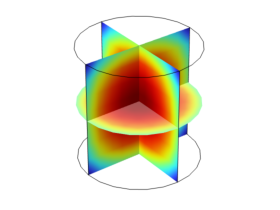
These models use the Discrete Ordinates method (DOM) and P1 approximation to solve a 3D radiative transfer problem in an emitting, absorbing, and linear-anisotropic scattering finite cylindrical medium. Using the S6 quadrature of DOM leads to accurate results, which are needed in ... En savoir plus
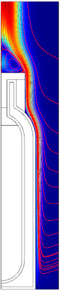
The following example solves a pure conduction and a free-convection problem in which a vacuum flask holding hot coffee dissipates thermal energy. The main interest is to calculate the flask's cooling power; that is, how much heat it loses per unit time. This tutorial model treats the ... En savoir plus
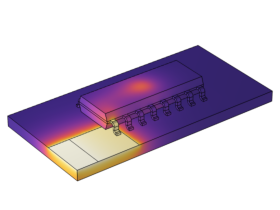
All integrated circuits (ICs) — especially high-speed devices — produce heat. In today’s dense electronic system layouts, heat sources are many times placed close to heat-sensitive ICs. Designers of printed circuit boards often need to consider the relative placement of heat ... En savoir plus
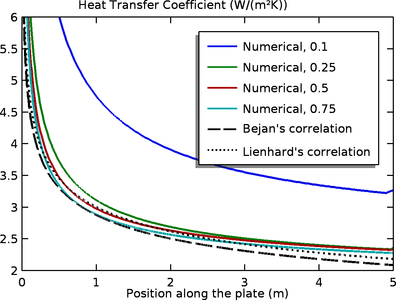
This verification model of nonisothermal turbulent flow over a flat plate compares the heat transfer coefficient obtained from simulation with theoretical values based on Nusselt number correlation functions that can be found in the literature. En savoir plus
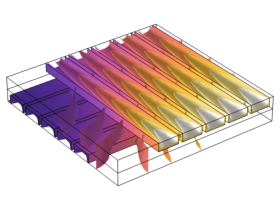
This model solves the fluid flow and heat transfer in a micro heat exchanger made of stainless steel. These types of heat exchangers are found in lab-on-chip devices in biotechnology and micro reactors, for example for micro fuel cells. The model takes heat transferred through both ... En savoir plus
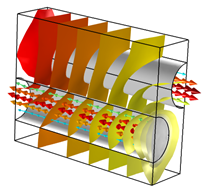
The example concerns a stainless-steel MEMS heat exchanger, which you can find in lab-on-a-chip devices in biotechnology and in microreactors such as for micro fuel cells. This model examines the heat exchanger in 3D, and it involves heat transfer through both convection and ... En savoir plus

A cooling flange in a chemical process is used to cool the process fluid, which flows through the flange. The surrounding air cools the flange via natural convection. In the stationary model, the forced convection to the process fluid is modeled using a constant heat transfer ... En savoir plus
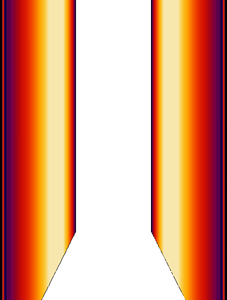
This tutorial shows how to use the Surface-to-Surface Radiation interface to simulate radiative heat transfer with radiation between diffuse emitters and diffuse-and-specular reflectors. This model is separated in two parts. The first part focuses on a validation test for the radiative ... En savoir plus
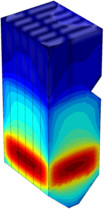
This model uses the discrete-ordinates method (DOM) to analyze the radiative heat transfer in a utility boiler with internal obstacles. DOM is one of the most useful radiation models for prediction of radiative heat fluxes on the furnace walls of a combustion chamber. With this model, ... En savoir plus


