
La Bibliothèque d'Applications présente des modèles construits avec COMSOL Multiphysics pour la simulation d'une grande variété d'applications, dans les domaines de l'électromagnétisme, de la mécanique des solides, de la mécanique des fluides et de la chimie. Vous pouvez télécharger ces modèles résolus avec leur documentation détaillée, comprenant les instructions de construction pas-à-pas, et vous en servir comme point de départ de votre travail de simulation. Utilisez l'outil de recherche rapide pour trouver les modèles et applications correspondant à votre domaine d'intérêt. Notez que de nombreux exemples présentés ici sont également accessibles via la Bibliothèques d'Applications intégrée au logiciel COMSOL Multiphysics® et disponible à partir du menu Fichier.
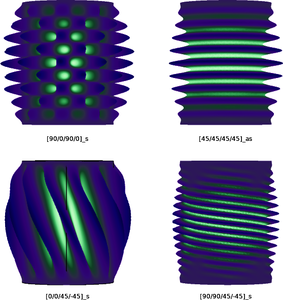
Buckling is a structural instability that can cause a component to fail even when the material remains within the elastic regime. Therefore, determining the critical buckling loads and corresponding mode shapes can be important from a design perspective, even when the applied loads ... En savoir plus
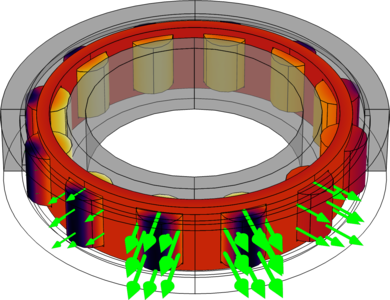
Bearings are used in machines to reduce the friction between moving parts and thereby smooth their relative motion. Rolling element bearings are one of the most widely used bearings, where rolling elements or rollers are used to support the load. These rollers can be of different shapes; ... En savoir plus
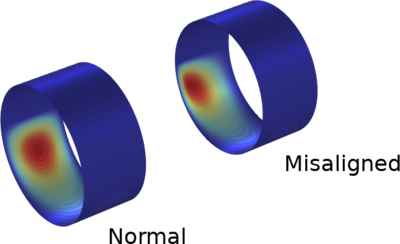
In this example, a rotor supported on two hydrodynamic bearings is analyzed. An eccentric disk located between the two bearings causes the rotor to whirl. One of the bearings is misaligned with the axis of the rotor. The Beam Rotor with Hydrodynamic Bearing interface in the ... En savoir plus
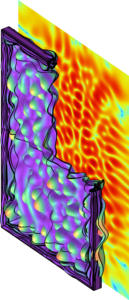
This model presents a practical and efficient method to compute the sound transmission loss (STL) through a building component. Specifically, this example treats the case of a double-glazed window. The method used here is valid for structural components that have a small influence on ... En savoir plus
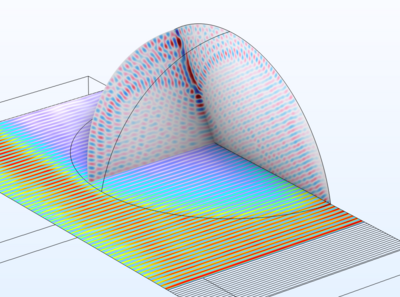
When a droplet is placed on a substrate on which surface acoustic waves (SAWs) are traveling, the energy of the SAWs is transferred into the droplet to form an acoustic field. The transferred energy is attenuated and generates a streaming flow. This type of streaming enables contactless ... En savoir plus
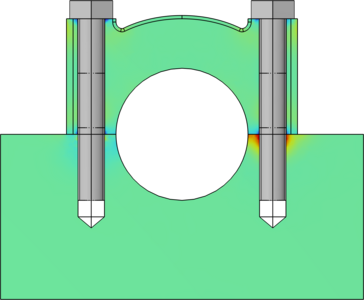
This example shows how to model prestressed bolts. The bolt geometry is taken from the Part Libraries. For comparison, one of the bolts is modeled using a thread contact formulation, whereas the other bolt is connected to the bolt hole by a pure continuity condition. The reduced ... En savoir plus
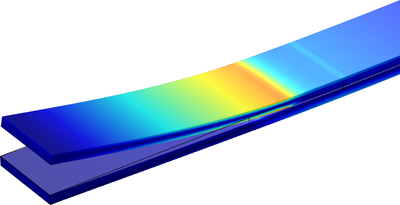
Interfacial failure by delamination or debonding can be simulated with a Cohesive Zone Model (CZM). This example shows the implementation of a CZM with a bilinear traction-separation law. It is used to predict the mixed-mode softening onset and delamination propagation in a composite ... En savoir plus
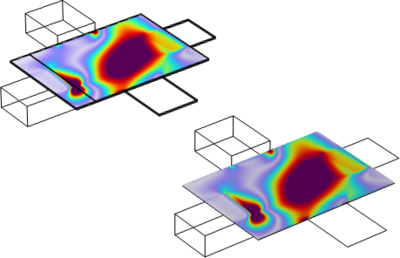
Layered shell elements, which are used for modeling composite shells, often connected to solid and shell elements in a cladding or side-by-side configuration to represent a realistic structure. For such applications, it becomes important to connect layered shell element correctly and ... En savoir plus
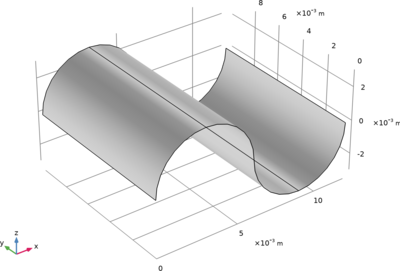
This example presents a homogenized model of a corrugated sheet based on a unit cell approach. The numerically obtained equivalent stiffness matrices are compared with various analytical models. Two corrugation profiles, trapezoidal and round, are considered in this example. En savoir plus
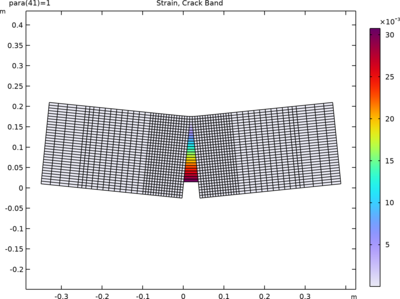
In this example, two model for brittle damage are used to evaluate the fracture of a notched concrete beam subjected to three point bending. The results are compared with experimental data. En savoir plus


