
La Bibliothèque d'Applications présente des modèles construits avec COMSOL Multiphysics pour la simulation d'une grande variété d'applications, dans les domaines de l'électromagnétisme, de la mécanique des solides, de la mécanique des fluides et de la chimie. Vous pouvez télécharger ces modèles résolus avec leur documentation détaillée, comprenant les instructions de construction pas-à-pas, et vous en servir comme point de départ de votre travail de simulation. Utilisez l'outil de recherche rapide pour trouver les modèles et applications correspondant à votre domaine d'intérêt. Notez que de nombreux exemples présentés ici sont également accessibles via la Bibliothèques d'Applications intégrée au logiciel COMSOL Multiphysics® et disponible à partir du menu Fichier.
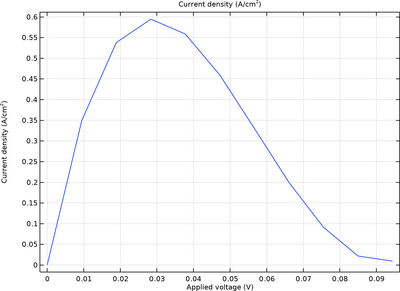
This tutorial demonstrates how to model the band-to-band tunneling across a p–n junction. The tunneling effect is imitated by defining the User-Defined Recombination domain feature which makes the electrons disappear from the conduction band on the n-side and holes disappear from the ... En savoir plus
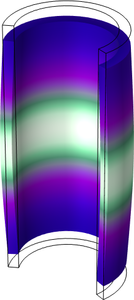
This model calculates the eigenfrequencies and mode shapes of an unconstrained cylinder in axisymmetry. The model is taken from NAFEMS Free Vibration Benchmarks. The eigenfrequencies are compared with the values given in the benchmark report. Three different physics interfaces are ... En savoir plus
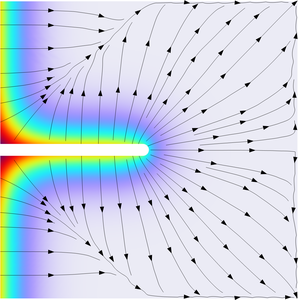
Hydrogen embrittlement refers to the degradation of metal ductility due to the absorption of hydrogen. The metal becomes more brittle and thus cracks might initiate at lower stress levels. It is important to estimate hydrogen concentration and the speed at which it diffuses into the ... En savoir plus
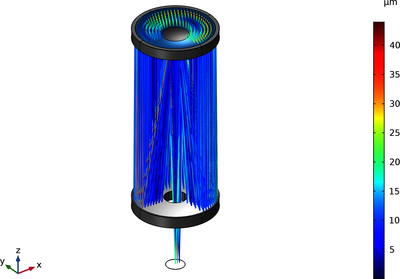
The Gregory-Maksutov telescope is a simple catadioptric telescope comprising a spherical corrector lens and a spherical primary mirror. In this example the corrector lens and mirror are formed using the 'Spherical Lens 3D' and 'Spherical Mirror 3D' parts respectively from the Ray Optics ... En savoir plus
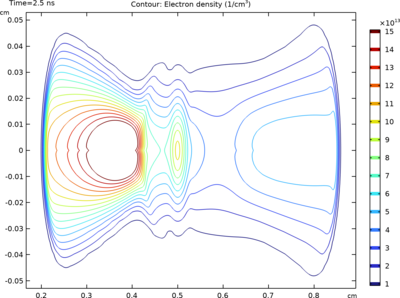
This model simulates the propagation of a double-headed streamer in nitrogen at atmospheric pressure. Initially, electron-positive ion clusters were introduced between two parallel electrodes, subjecting the gas to a strong background electric field of 52 kV/cm. Subsequently, both the ... En savoir plus
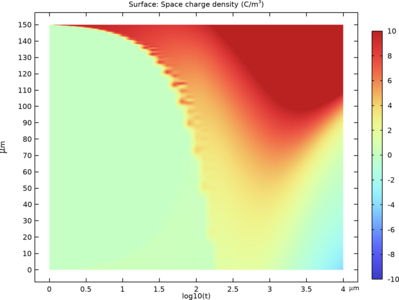
The study explores charge transport dynamics in polyethylene, a common solid dielectric insulation material. It employs a bipolar charge transport model to calculate the densities of electrons, holes, and their trapped counterparts. The simulation's outcomes for discharge current and ... En savoir plus
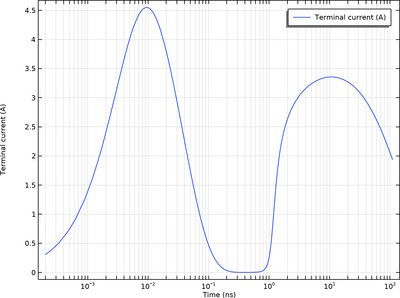
This model shows how to simulate the complex discharge physics behind the well-known electrostatic discharge (ESD). The model connects the Electrical Discharge interface with the Circuit interface to simulate how ESD current is generated when a human hand touches metal. En savoir plus
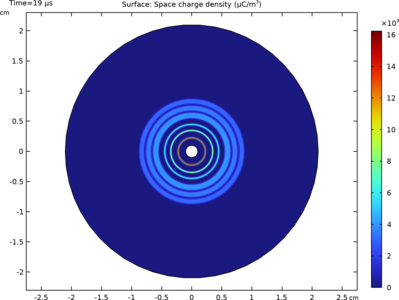
Usually limited to a specific region, corona discharges appear as a consistent luminosity. The attributes of steady glow corona discharges change depending on their polarity. Positive glow corona, also referred to as Hermstein's glow or ultra corona, presents a direct current (DC) aspect ... En savoir plus
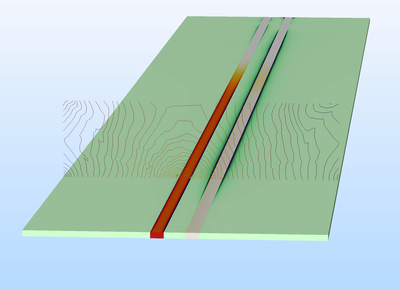
A signal integrity (SI) analysis gives an overview of the quality of an electrical signal transmitted through electrical circuits, such as high-speed interconnects, cables, and printed circuit boards. The quality of the received signal can be distorted by noise from outside the circuit, ... En savoir plus
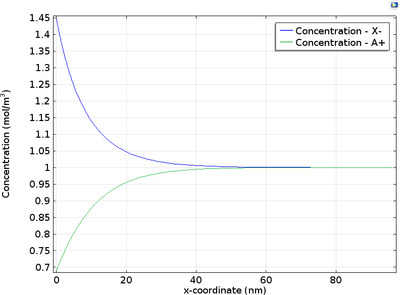
At the electrode-electrolyte interface, there is a thin layer of space charge in a diffuse double layer. This may be of interest when modeling devices such as electrochemical capacitors and nanoelectrodes. This tutorial example shows how to couple the Nernst-Planck equations to the ... En savoir plus


