
La Bibliothèque d'Applications présente des modèles construits avec COMSOL Multiphysics pour la simulation d'une grande variété d'applications, dans les domaines de l'électromagnétisme, de la mécanique des solides, de la mécanique des fluides et de la chimie. Vous pouvez télécharger ces modèles résolus avec leur documentation détaillée, comprenant les instructions de construction pas-à-pas, et vous en servir comme point de départ de votre travail de simulation. Utilisez l'outil de recherche rapide pour trouver les modèles et applications correspondant à votre domaine d'intérêt. Notez que de nombreux exemples présentés ici sont également accessibles via la Bibliothèques d'Applications intégrée au logiciel COMSOL Multiphysics® et disponible à partir du menu Fichier.
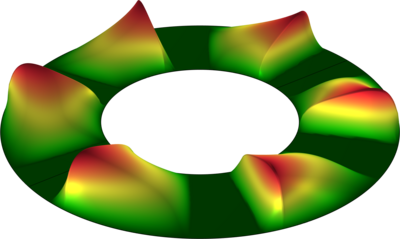
In this tutorial model, a six step thrust bearing is analyzed. A step thrust bearing consists of a stepped bearing surface on which the end of the shaft rotates. The entire assembly is submerged in a lubricant. The shaft collar is assumed to be spinning without any axial motion in the ... En savoir plus
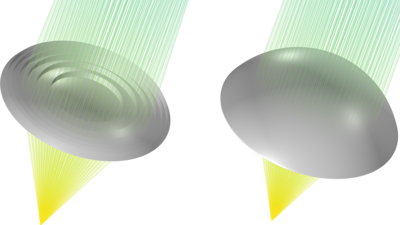
A Fresnel lens can be constructed from a plano-convex lens as a way to reduce the thickness. This model models the collimation property of a Fresnel lens and demonstrates the geometry operation of making a Fresnel lens from a plano-convex lens. En savoir plus
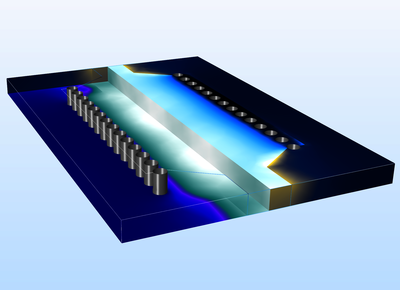
A waveguide-type structure can be fabricated on a substrate by adding vias between the microstrip line and the ground plane. Such a device will behave as a high-pass filter and is attractive because it is easy to fabricate. A model is set up that shows the S-parameters as a function of ... En savoir plus
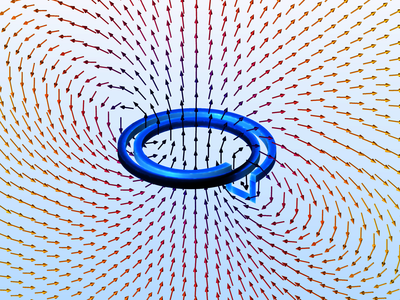
RF coils are important in numerous applications ranging from wireless technology to MRI scanning equipment. This introductory tutorial model demonstrates how to find the fundamental resonance frequency of an RF coil as well as how to perform a frequency sweep to extract the coil's Q ... En savoir plus
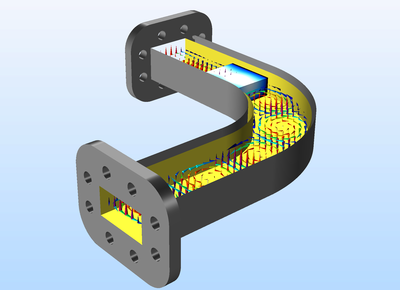
This is a model of an RF waveguide bend with a dielectric block inside. There are electromagnetic losses in the block as well as on the waveguide walls which cause the assembly to heat up over time. The material properties of the block are functions of temperature. The transient thermal ... En savoir plus
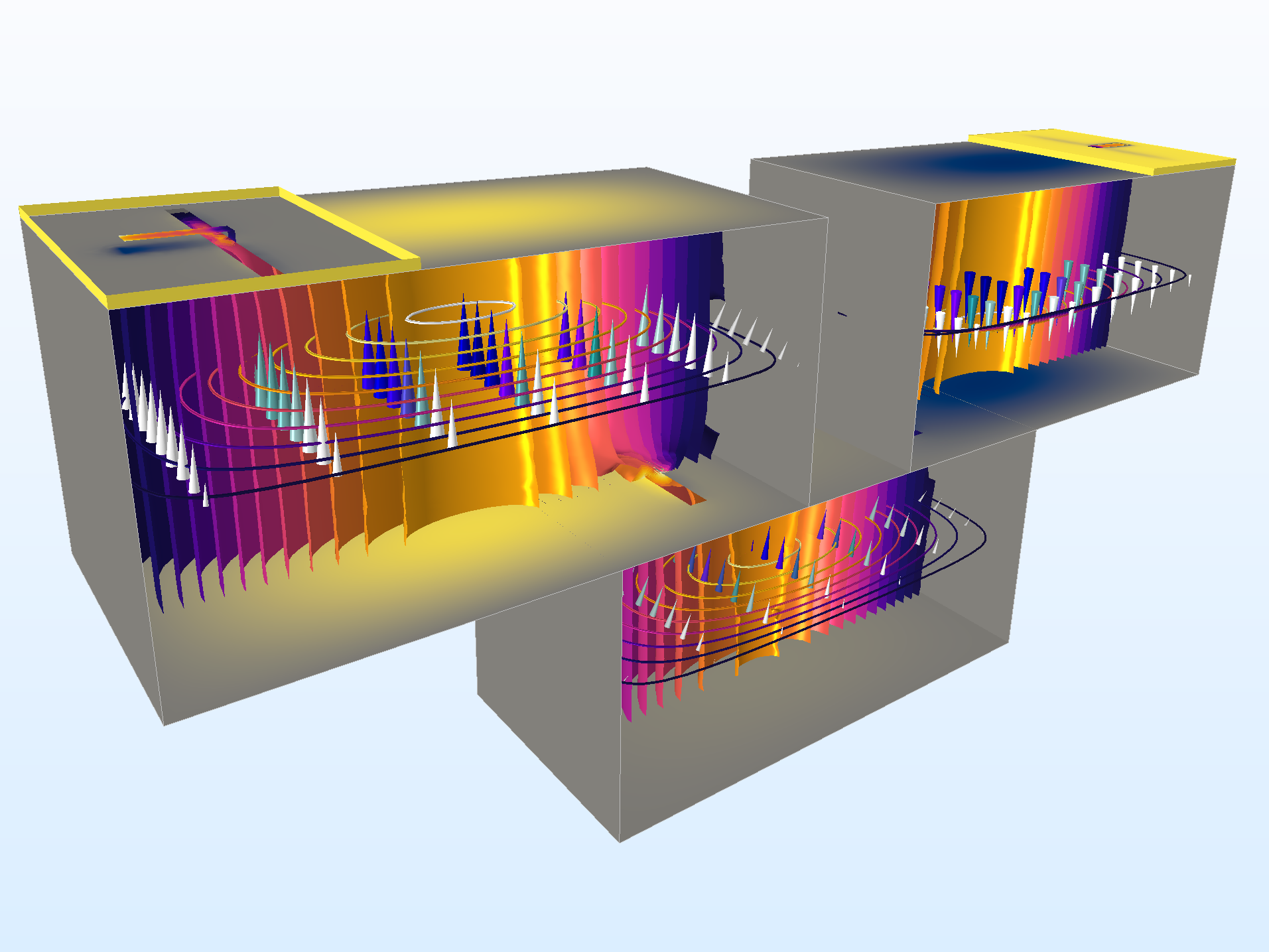
A cascaded cavity filter provides much better bandpass filter performance compared to a single cavity. Out-of-band rejection improves dramatically using a cascaded design. This model uses three rectangular cavity filters coupled via slots. The calculated S-parameters show excellent out ... En savoir plus
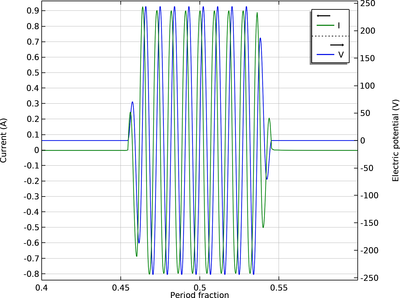
This tutorial model shows how to set up a model of a pulsed capacitive discharge. The on pulse consists of 10 periods of excitation at 13.56MHz, followed by no excitation for 100 periods. The I-V characteristics, the electron density, temperature and plasma potential are studied. En savoir plus
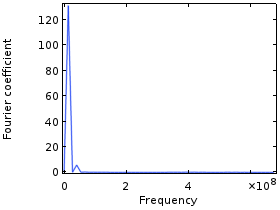
This tutorial model demonstrates how to compute the impedance of a capacitively coupled plasma. The Time Periodic study computes the time periodic solution of the plasma. Subsequently, the solution is transformed to the time domain, after which the fast Fourier transform (FFT) solver is ... En savoir plus
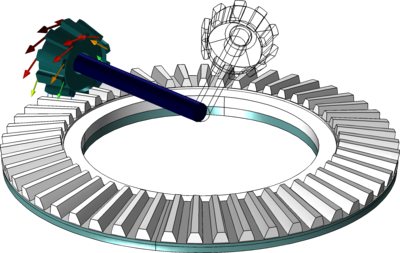
This tutorial model simulates a pair of straight conical bevel gears. The gears are modeled as rigid, but one of the gears is fixed while the other is hinged on a rigid bar. The rigid bar is also hinged at a point lying on the axis of the fixed gear. A transient analysis is performed to ... En savoir plus
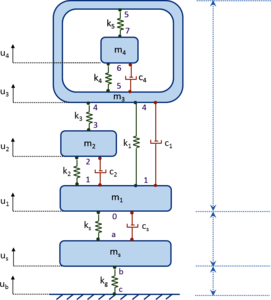
Several mass–spring–damper models have been developed to study the response of a human body where mass, spring, and damper elements represent mass of different body parts, stiffness, and damping properties of various tissues. In this example, a lumped model of a human body having five ... En savoir plus


