
La Bibliothèque d'Applications présente des modèles construits avec COMSOL Multiphysics pour la simulation d'une grande variété d'applications, dans les domaines de l'électromagnétisme, de la mécanique des solides, de la mécanique des fluides et de la chimie. Vous pouvez télécharger ces modèles résolus avec leur documentation détaillée, comprenant les instructions de construction pas-à-pas, et vous en servir comme point de départ de votre travail de simulation. Utilisez l'outil de recherche rapide pour trouver les modèles et applications correspondant à votre domaine d'intérêt. Notez que de nombreux exemples présentés ici sont également accessibles via la Bibliothèques d'Applications intégrée au logiciel COMSOL Multiphysics® et disponible à partir du menu Fichier.
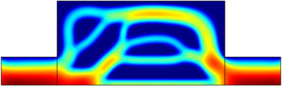
In this application, a solution is pumped through a catalytic bed where a solute species reacts as it gets in contact with the catalyst. The purpose of this example is to maximize the total reaction rate for a given total pressure difference across the bed by finding an optimal catalyst ... En savoir plus
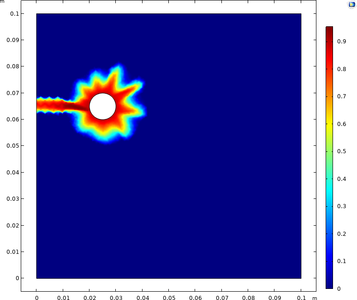
Oxide jacking is the process by which reinforced concrete cracks, due to the corrosion of the reinforcing rebar rods. The corrosion process causes growth of an oxide layer on the rebar, which in turn causes internal stresses in the concrete. If the corrosion process is allowed to ... En savoir plus

This model demonstrates how to setup a Time Domain to Frequency FFT study for a distributed Bragg reflector (DBR) structure. The results agree well with the results of a regular Frequency domain study. En savoir plus

A demonstration of topology optimization using the Structural Mechanics Module and the Optimization Module. The classical MBB beam is solved in 2D using a Helmholtz filter and Solid Isotropic Material Penalization (SIMP) technique to recast the original combinatorial optimization problem ... En savoir plus
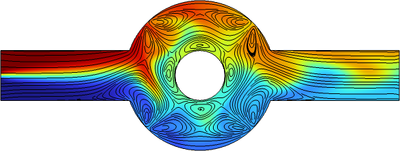
Microlaboratories for biochemical applications often require rapid mixing of different fluid streams. At the microscale, flow is usually highly ordered laminar flow, and the lack of turbulence makes diffusion the primary mechanism for mixing. While diffusional mixing of small ... En savoir plus

Newtonian telescopes, first invented in 1668 by Isaac Netwon, are still used today because of their low cost and simple design. Rays of light propagate from sources located at infinity, into the telescope. The rays reflect off a parabolic mirror, onto a flat mirror, and into the focal ... En savoir plus
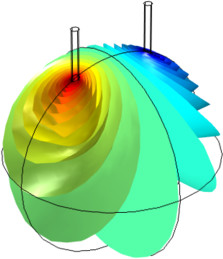
This tutorial example models the currents and the concentration of dissolved metal ions in a battery (corrosion cell) made from an orange and two metal nails. This type of battery is commonly used in chemistry lessons. Instead of an orange, lemons or potatoes can also be used. En savoir plus
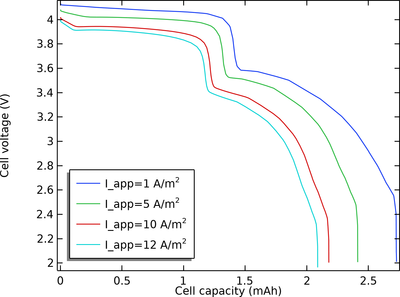
Sodium-ion batteries (SIB) are commonly presented as an alternative to lithium-ion batteries (LIB). The SIB chemistry uses Na+ instead of Li+ for electrolyte charge transport and as redox species in the electrode reactions, with the advantage of Na+ being more abundant and with a ... En savoir plus
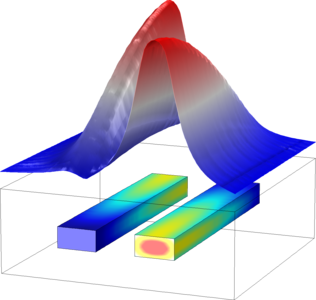
Two embedded optical waveguides in close proximity form a directional coupler. The cladding material is GaAs and the core material is ion-implanted GaAs. The waveguide is excited by the two first supermodes of the waveguide structure - the symmetric and antisymmetric modes. Two numeric ... En savoir plus
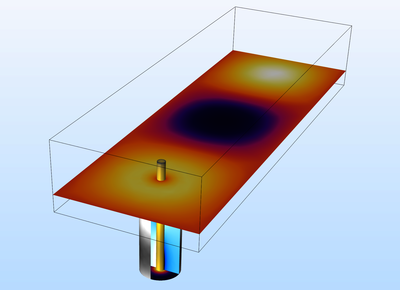
Feeding a waveguide from a coaxial cable is a straightforward way to achieve electromagnetic waves inside a waveguide. Due to its small size and circular shape, the cable contributes significantly to the overall size of the problem. It is therefore necessary to keep the cable as short as ... En savoir plus