
La Bibliothèque d'Applications présente des modèles construits avec COMSOL Multiphysics pour la simulation d'une grande variété d'applications, dans les domaines de l'électromagnétisme, de la mécanique des solides, de la mécanique des fluides et de la chimie. Vous pouvez télécharger ces modèles résolus avec leur documentation détaillée, comprenant les instructions de construction pas-à-pas, et vous en servir comme point de départ de votre travail de simulation. Utilisez l'outil de recherche rapide pour trouver les modèles et applications correspondant à votre domaine d'intérêt. Notez que de nombreux exemples présentés ici sont également accessibles via la Bibliothèques d'Applications intégrée au logiciel COMSOL Multiphysics® et disponible à partir du menu Fichier.
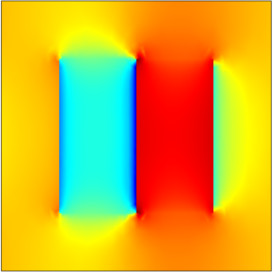
Magnetotellurics is a method for estimating the resistivity profile of the Earth's subsurface using the natural electromagnetic source provided by the ionosphere. This model was defined by Zhdanov et al. in a study published in 1997. In this article, various scientific groups compared ... En savoir plus
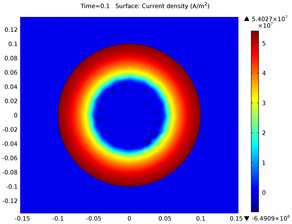
Superconducting materials have zero resistivity up to a certain critical current density, above which the resistivity increases rapidly. To model such a material, this example uses the Magnetic Field Formulation physics interface. The model was based on a suggestion by Dr. Roberto ... En savoir plus
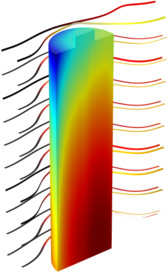
This example simulates the heat profile in an air-cooled cylindrical battery in 3d. The battery is placed in a matrix in a battery pack. The thermal model is coupled to a 1d-battery model that is used to generate a heat source in the active battery material. The model requires the ... En savoir plus

This is a model from electric impedance tomography, a method of imaging the interior permittivity distribution of a body by measuring current and voltage at the surface. This model demonstrates how the shape and placement of figures with different material properties inside a closed ... En savoir plus
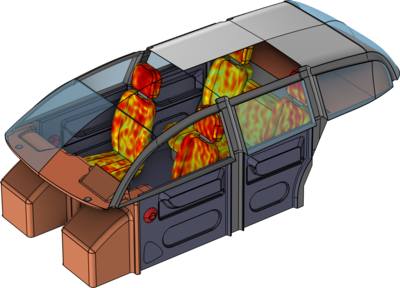
This tutorial shows the analysis of a car cabin in order to study the performance of a sound system in the low to mid frequency range. The cabin is of a typical sedan interior, that is, the inside of a hard-top family car. The model studies the frequency response at the location of a ... En savoir plus
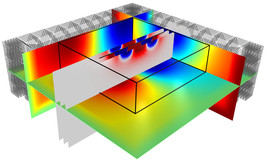
The classical forward problem of geoelectrics (includes electrical resistivity tomography, ERT and earlier techniques as vertical electric sounding, VES) is the calculation of potentials at a given set of electrodes (M,N) while current is injected at other electrodes (A,B) into the ... En savoir plus
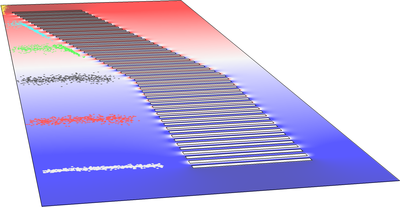
An electrodynamic ion funnel provides an efficient means of transferring ions from regions of high pressure to high vacuum. The ion funnel can couple devices which generally operate at pressures of different orders of magnitude, such as ion mobility spectrometers and mass spectrometers, ... En savoir plus
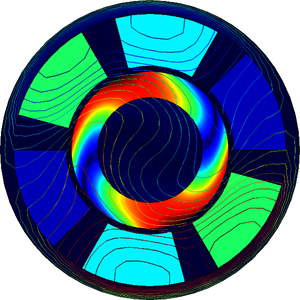
This three-phase induction motor model is used to compare with Testing Electromagnetic Analysis Method (TEAM) workshop problem 30. The Magnetic Fields physics interface is used to model the motor in the frequency domain at 60 Hz. The Velocity (Lorentz Term) feature is used to model the ... En savoir plus
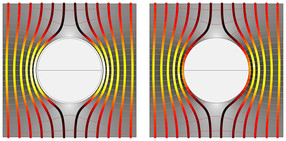
The contact impedance boundary condition is meant to approximate a thin layer of material that impedes the flow of current normal to the boundary, but does not introduce any additional conduction path tangential to the boundary. This example compares the contact impedance boundary ... En savoir plus
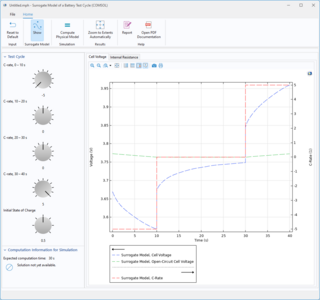
This app demonstrates the usage of a surrogate model function for predicting the cell voltage, cell open circuit voltage and internal resistance of an NMC111/graphite battery cell undergoing a battery test cycle. The surrogate function, a Deep Neural Network, has been fitted to a ... En savoir plus


