
La Bibliothèque d'Applications présente des modèles construits avec COMSOL Multiphysics pour la simulation d'une grande variété d'applications, dans les domaines de l'électromagnétisme, de la mécanique des solides, de la mécanique des fluides et de la chimie. Vous pouvez télécharger ces modèles résolus avec leur documentation détaillée, comprenant les instructions de construction pas-à-pas, et vous en servir comme point de départ de votre travail de simulation. Utilisez l'outil de recherche rapide pour trouver les modèles et applications correspondant à votre domaine d'intérêt. Notez que de nombreux exemples présentés ici sont également accessibles via la Bibliothèques d'Applications intégrée au logiciel COMSOL Multiphysics® et disponible à partir du menu Fichier.
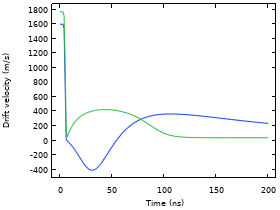
This tutorial model presents a study showing the transient negative mobility and the negative differential conductivity effects in xenon. The stationary and time dependent Boltzmann equation in the two-term approximation is used to compute the electron energy distribution function. ... En savoir plus
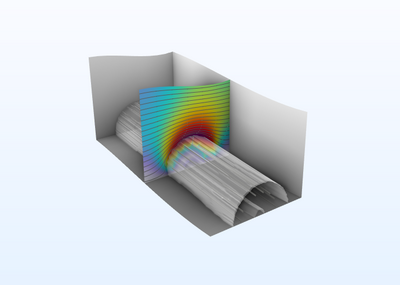
This thermo-hydro-mechanical (THM) model of artificial ground freezing couples heat transfer, groundwater flow, and soil mechanics to capture ice formation, pore-pressure changes, and ground deformation during tunnel excavation. The freezing process is modeled with the apparent heat ... En savoir plus
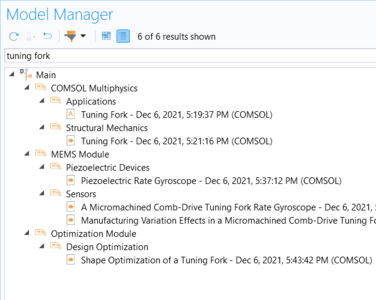
This local demo database for the Model Manager contains an imported copy of the Application Library models in COMSOL Multiphysics® version 6.0 and above. You can add this database from COMSOL Multiphysics® by selecting Download Demo Database for Model Manager from the ... En savoir plus
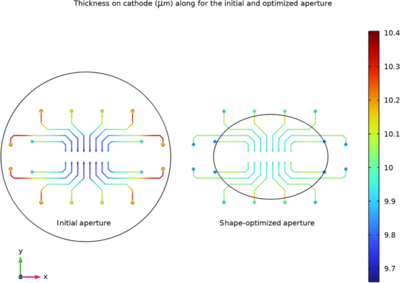
An aperture is often used in electroplating baths in order to improve the uniformity of the deposited metal layer. This example simulates electroplating of a printed circuit board (PCB) in 3D using a secondary current distribution. The size and aspect ratio of the aperture is optimized ... En savoir plus

In this tutorial model, the acoustics of the human ear canal are investigated. The output includes the input impedance and the transfer impedance, as well as the level transformation from the entrance to the ear drum. The geometry of the ear canal used is based on measurements from test ... En savoir plus
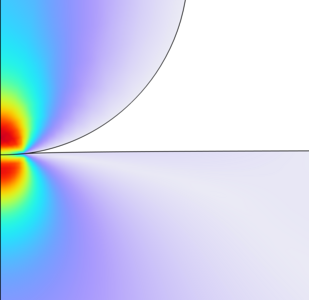
Consider an infinitely long steel cylinder resting on a flat aluminum foundation, where both structures are elastic. The cylinder is subjected to a point load along its top. The objective of this study is to find the contact pressure distribution and the length of contact between the ... En savoir plus
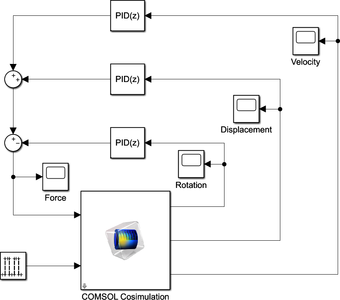
This model shows how to control the position of the base of an inverted pendulum to keep it vertical. The control is performed using a PID controller in Simulink®. The position of the base is constrained within specified limits, and an external force is applied at the base to keep it ... En savoir plus
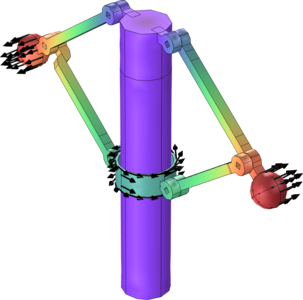
A centrifugal governor is used to control the speed of rotating machinery. One of the most common applications is in controlling the RPM of an engine by regulating the fuel supply. This model illustrates the functioning of a spring loaded centrifugal governor. The dynamics of the ... En savoir plus
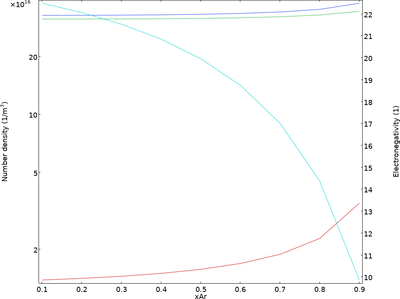
In this example, an SF6/argon plasma reactor at moderate pressure is studied using a global model. The heavy species heat equation is included. Parametric sweeps for input power and argon mole fraction are computed. En savoir plus
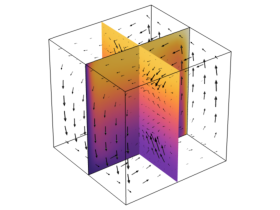
This example studies the stationary state of free convection in a cavity filled with air and bounded by two vertical plates. To generate the buoyancy flow, the plates are heated at different temperatures, set in a range to keep the flow laminar. En savoir plus


