
La Bibliothèque d'Applications présente des modèles construits avec COMSOL Multiphysics pour la simulation d'une grande variété d'applications, dans les domaines de l'électromagnétisme, de la mécanique des solides, de la mécanique des fluides et de la chimie. Vous pouvez télécharger ces modèles résolus avec leur documentation détaillée, comprenant les instructions de construction pas-à-pas, et vous en servir comme point de départ de votre travail de simulation. Utilisez l'outil de recherche rapide pour trouver les modèles et applications correspondant à votre domaine d'intérêt. Notez que de nombreux exemples présentés ici sont également accessibles via la Bibliothèques d'Applications intégrée au logiciel COMSOL Multiphysics® et disponible à partir du menu Fichier.
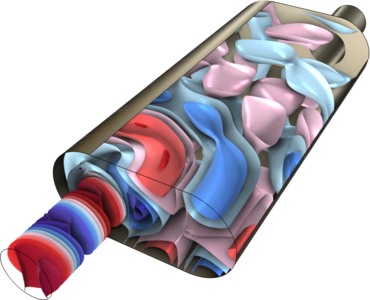
This example describes the pressure wave propagation in a muffler for an internal combustion engine. This example shows how to analyze both inductive and resistive damping in a muffler as well as the use of port boundary conditions. En savoir plus
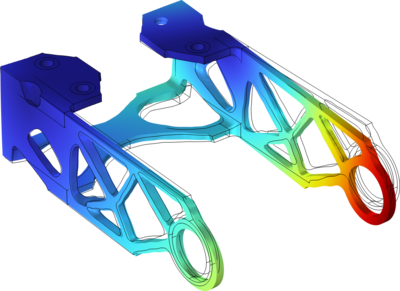
This example shows how to perform a topology optimization with several load and constraint cases. The density feature for topology optimization is used together with a parametric sweep where each optimized solution is used as input for a further improved optimization. The final ... En savoir plus
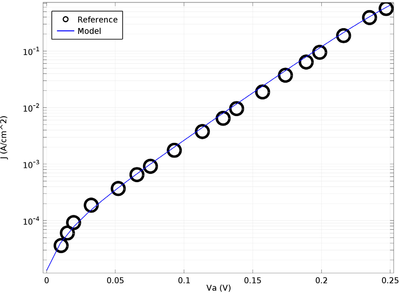
Schottky Contact This benchmark simulates the behavior of an ideal Schottky barrier diode made of a tungsten contact deposited on a silicon wafer. The resulting J-V (current density vs. applied voltage) curve obtained from the model under forward bias is compared with experimental ... En savoir plus
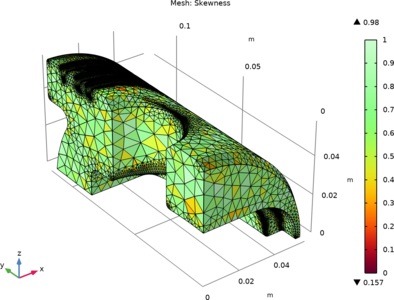
This is a tutorial model that demonstrates how to use mesh parameters such as Minimum element size Resolution of curvature Resolution of narrow regions Maximum element growth rate The instructions also detail how to access the mesh statistics and how to create a mesh plot. En savoir plus

This is an example of optimal control, where the input heating power to a rod is optimized to give a certain temperature on the outside of the rod. This is where the maximum water temperature occurs, while the minimum occurs at the center. Therefore this problem corresponds to the ... En savoir plus
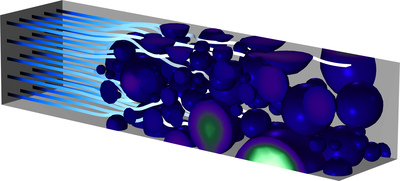
In this example, a heterogeneous NMC (Nickel-Manganese-Cobalt) electrode structure is generated from tomography data using a Model Method. Time-dependent discharge and electrochemical impedance spectroscopy (EIS) simulations are then made on the full 3D geometry. A solid mechanics ... En savoir plus
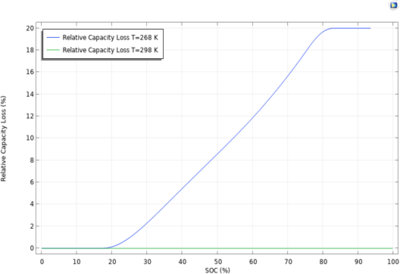
Deposition of metallic lithium on the negative electrode in preference to lithium intercalation is known to be a capacity loss and safety concern for lithium-ion batteries. Harsh charge conditions such as high currents (fast charging) and/or low temperatures can lead to lithium plating. ... En savoir plus
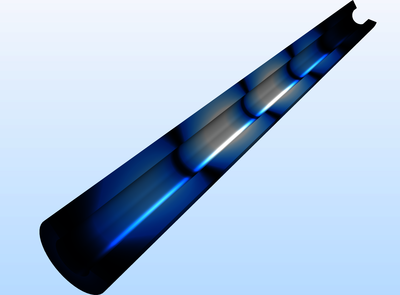
Simulation of Maxwell’s equations in the time domain is useful if the objective of the analysis is to observe a transient phenomenon, to find the time it takes a signal to propagate, or if the materials being modeled are non-linear with respect to the electric or magnetic field strength. ... En savoir plus
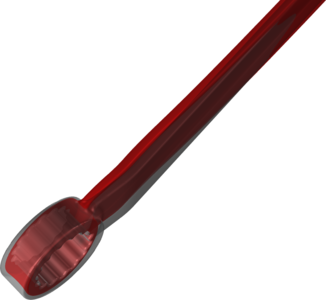
This model shows how to use the Free Shape Boundary feature to increase the stiffness of a wrench without increasing its mass. En savoir plus
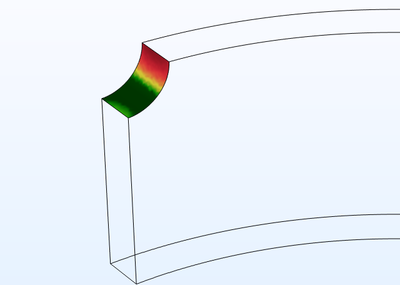
A load carrying component of a structure is subjected to multi-axial cyclic loading during which localized yielding of the material occurs. In this model you perform a low cycle fatigue analysis of the part based on the Smith-Watson-Topper (SWT) model. Due to localized yielding, you ... En savoir plus