
La Bibliothèque d'Applications présente des modèles construits avec COMSOL Multiphysics pour la simulation d'une grande variété d'applications, dans les domaines de l'électromagnétisme, de la mécanique des solides, de la mécanique des fluides et de la chimie. Vous pouvez télécharger ces modèles résolus avec leur documentation détaillée, comprenant les instructions de construction pas-à-pas, et vous en servir comme point de départ de votre travail de simulation. Utilisez l'outil de recherche rapide pour trouver les modèles et applications correspondant à votre domaine d'intérêt. Notez que de nombreux exemples présentés ici sont également accessibles via la Bibliothèques d'Applications intégrée au logiciel COMSOL Multiphysics® et disponible à partir du menu Fichier.
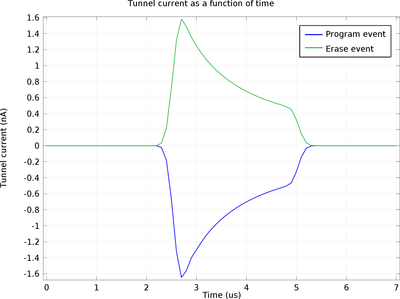
This model calculates the current and charge characteristics of a floating gate Electrically Erasable Programmable Read-Only Memory (EEPROM) device. A stationary study demonstrates the effects of varying the charge stored on the floating gate by computing Current-Voltage curves as a ... En savoir plus
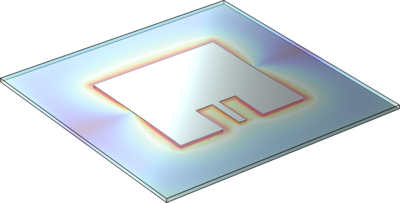
In this tutorial, an uncertainty quantification analysis is performed on the Microstrip Patch Antenna model from the RF Module Application Library to explore how variations in input parameters, such as material properties or geometric variations, impact the antenna’s performance in terms ... En savoir plus
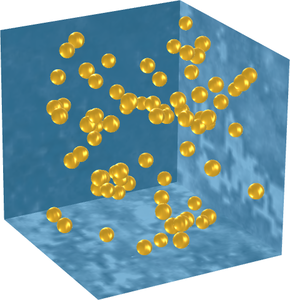
Recovery of precious metals in recycling of electronics, or extraction from ore, is usually performed through leaching of the metal into an aqueous phase. Precious metals require the use of an oxidant, and often, a complexant. In the case of gold, the cyanide anion (CN-) forms a soluble ... En savoir plus
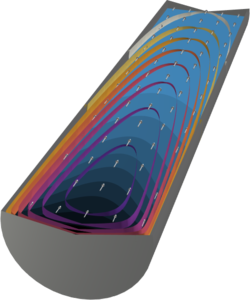
This model uses the Reacting Flow multiphysics interface to simulate a methane steam reformer. The model accounts for the interactions between the chemical reactions, the transport of species, the fluid flow, and the heat transfer in a porous medium. En savoir plus
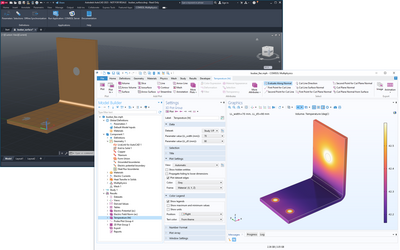
This tutorial model of the Joule heating effect in a busbar demonstrates how to synchronize geometry between the AutoCAD® software and the COMSOL Multiphysics® software, how to modify the geometry from COMSOL Multiphysics®, and how to run a geometric parametric ... En savoir plus
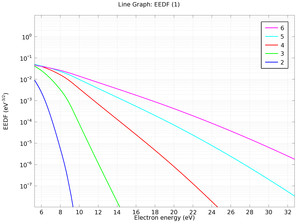
The Boltzmann equation can be solved to validate sets of electron impact collision cross sections. In fact, sets of collision cross sections are traditionally inferred by solving a two-term approximation to the Boltzmann equation and comparing the results to swarm experiments. This model ... En savoir plus
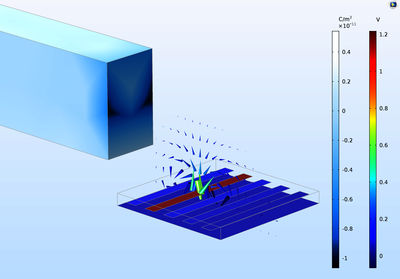
This tutorial model explains how to extract lumped matrices by means of the Stationary Source Sweep study. The capacitance matrix of a five-terminal system is used to infer the position of a metallic object rather like real-world capacitive position sensors. The example illustrates the ... En savoir plus
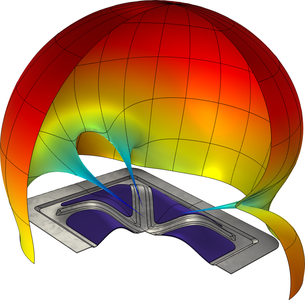
This model presents a method to analyze acoustic damping pads. These pads use a constrained layer of viscoelastic material to dissipate energy and thus reduce the energy radiated as noise. Damping pads are used in many different industries to reduce the noise generated by vibrating ... En savoir plus
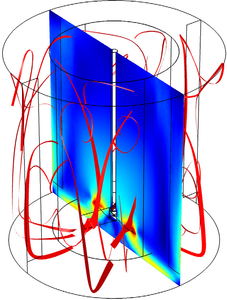
This tutorial example simulates the flow in a flat bottom mixer containing, agitated by a pitched four blade impeller, where the fluid is water, and flow is assumed to be turbulent. The flow in the mixer is modeled using the k-ε turbulence model, and a time-dependent simulation ... En savoir plus
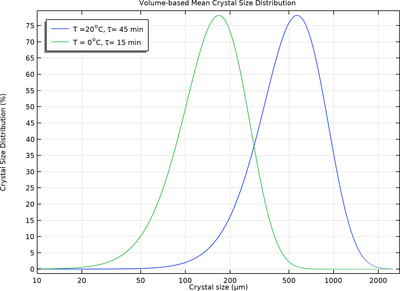
Crystallization is a key separation process in e.g. pharmaceuticals production. It is the process by which a chemical species is separated from solution by forming a crystal. To achieve the required product properties, control over the crystal particle size distribution is necessary. ... En savoir plus


