
La Bibliothèque d'Applications présente des modèles construits avec COMSOL Multiphysics pour la simulation d'une grande variété d'applications, dans les domaines de l'électromagnétisme, de la mécanique des solides, de la mécanique des fluides et de la chimie. Vous pouvez télécharger ces modèles résolus avec leur documentation détaillée, comprenant les instructions de construction pas-à-pas, et vous en servir comme point de départ de votre travail de simulation. Utilisez l'outil de recherche rapide pour trouver les modèles et applications correspondant à votre domaine d'intérêt. Notez que de nombreux exemples présentés ici sont également accessibles via la Bibliothèques d'Applications intégrée au logiciel COMSOL Multiphysics® et disponible à partir du menu Fichier.
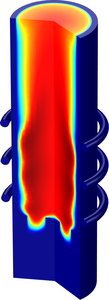
This model investigates the electrical and thermal characteristics of an inductively coupled plasma torch at atmospheric pressure. The discharge is assumed to be in local thermodynamic equilibrium. En savoir plus
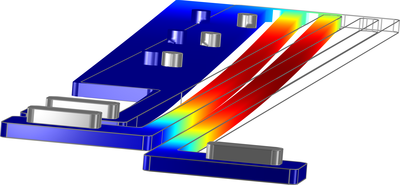
This example model consists of a two-hot-arm thermal actuator made of polysilicon. The actuator is activated through thermal expansion. The temperature increase required to deform the two hot arms, and thus displace the actuator, is obtained through Joule heating (resistive heating). The ... En savoir plus
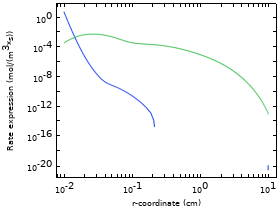
This tutorial presents a study of positive and negative corona discharges in dry air at atmospheric pressure. The discharges are sustained within two electrodes in a coaxial configuration by a high voltage DC source applied to the inner electrode. Two different types of models are used: ... En savoir plus
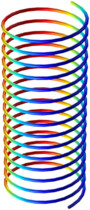
This model computes the trajectory of an ion in a uniform magnetic field using the Newtonian, Lagrangian and Hamiltonian formulations available in the Mathematical Particle Tracing interface. En savoir plus
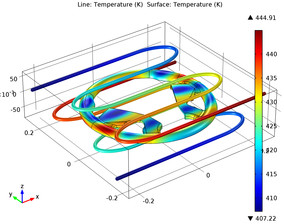
This model shows how you can use the Non-Isothermal Pipe Flow interface together with the Heat Transfer in Solids interface to model the cooling of a injection molded polyurethane part for a car steering wheel. The equations describing the cooling channels are fully coupled to the heat ... En savoir plus
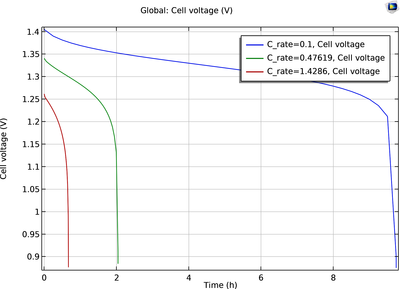
This model reproduces the NiCd battery model and the results presented in De Vidts' and White's paper from 1995. Ref: P. De Vidts, R. E. White, “Mathematical Modeling of a Nickel-Cadmium Cell: Proton Diffusion in the Nickel Electrode”, J. Electrochem. Soc, Vol. 142, No. 5, May 1995. En savoir plus
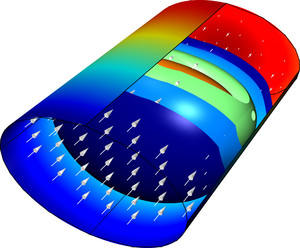
Several factors influence a diesel particulate filter’s (DPF) efficiency and durability. Important issues include the removal of soot particles from the filter membranes and the influence of thermal stress on the ceramic structure, stress that arises during repeated operating cycles. ... En savoir plus
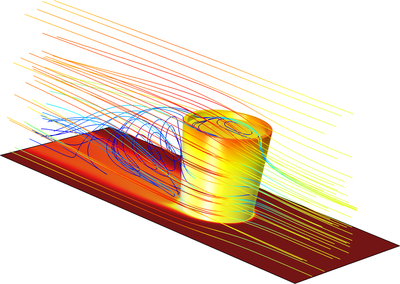
This tutorial shows how to couple three physics interfaces to model evaporative cooling. The effects that need to be taken into account are heat transfer, transport of water vapor, and fluid flow. The Wet Surface feature is used to implement the source term for the water vapor and to ... En savoir plus
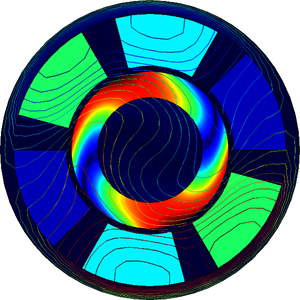
This three-phase induction motor model is used to compare with Testing Electromagnetic Analysis Method (TEAM) workshop problem 30. The Magnetic Fields physics interface is used to model the motor in the frequency domain at 60 Hz. The Velocity (Lorentz Term) feature is used to model the ... En savoir plus
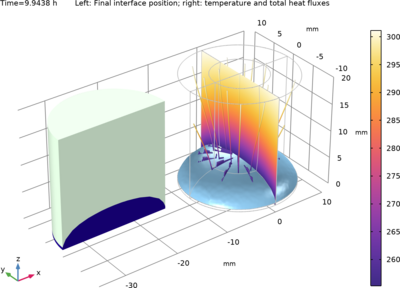
Freeze-drying, or lyophilization, is a process for drying heat-sensitive substances such as foods, blood plasma, and antibiotics. The wet substance is frozen and then, through sublimation, ice (or some other frozen solvent) is removed in the presence of a high vacuum. This example ... En savoir plus