
La Bibliothèque d'Applications présente des modèles construits avec COMSOL Multiphysics pour la simulation d'une grande variété d'applications, dans les domaines de l'électromagnétisme, de la mécanique des solides, de la mécanique des fluides et de la chimie. Vous pouvez télécharger ces modèles résolus avec leur documentation détaillée, comprenant les instructions de construction pas-à-pas, et vous en servir comme point de départ de votre travail de simulation. Utilisez l'outil de recherche rapide pour trouver les modèles et applications correspondant à votre domaine d'intérêt. Notez que de nombreux exemples présentés ici sont également accessibles via la Bibliothèques d'Applications intégrée au logiciel COMSOL Multiphysics® et disponible à partir du menu Fichier.
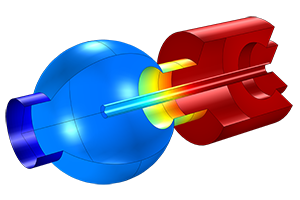
This model shows how to simulate the time-dependent adsorption and desorption of water in a vacuum system at low pressures. The water is introduced into the system when a gate valve to a load lock is opened and the subsequent migration and pumping of the water is modeled. En savoir plus
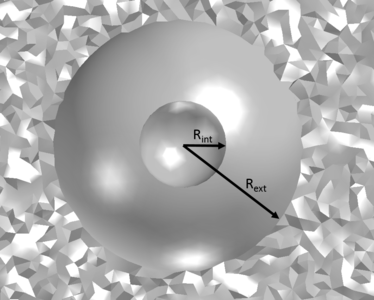
When simulating surface-to-surface radiation, we rely on the view factors between elements of diffuse surfaces that emit and receive radiation. To compute surface-to-surface radiation in a given geometry, operators are created by the heat interface and can be used to evaluate view ... En savoir plus

This model shows how to build and solve a radiative heat transfer problem using the Heat Transfer interface. In particular, this 2D model illustrates the use of the surface-to-surface radiation feature. In this model, three surfaces form a cavity. Heat flux is set at two outer ... En savoir plus
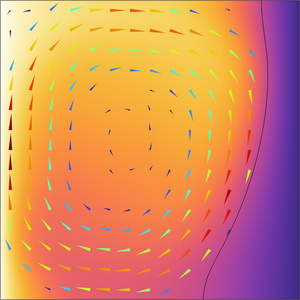
This example demonstrates how to model phase transition by a moving boundary interface according to the Stefan problem. A square cavity containing both solid and liquid tin is submitted to a temperature difference between left and right boundaries. Fluid and solid parts are solved in ... En savoir plus
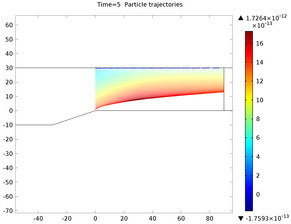
When a temperature gradient in a gas exists, suspended particles will tend to move from regions of high temperature to low. The force which produces this effect is called the thermophoretic force. Gas molecules colliding with a particle from the hot side have a higher velocity than the ... En savoir plus
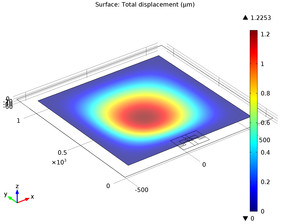
Piezoresistive pressure sensors were some of the first MEMS devices to be commercialized. Compared to capacitive pressure sensors, they are simpler to integrate with electronics, their response is more linear and they are inherently shielded from RF noise. They do, however, usually ... En savoir plus
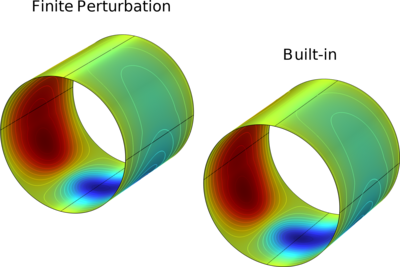
In this verification example, the built-in functionality for calculating dynamic coefficients in hydrodynamic bearings is validated. The results are compared with those obtained using the finite perturbation method to ensure consistency and accuracy. The model showcases how numerical ... En savoir plus
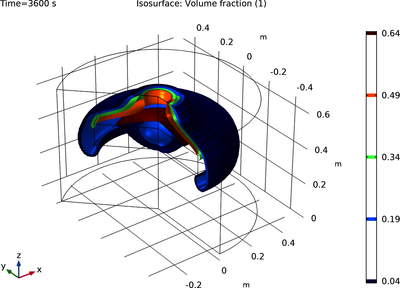
This example demonstrate two-phase flow in a porous medium which contains a low permeable lens. The heavier phase infiltrates the porous medium, so the low permeable lens is infiltrated only when a critical saturation at the outside is reached. En savoir plus
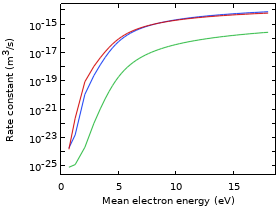
This model solves the Boltzmann equation in the two-term approximation for a background of molecular and atomic hydrogen. Electron mobility and source terms are computed by suitable integration of the electron energy distribution function over electron impact cross sections. En savoir plus
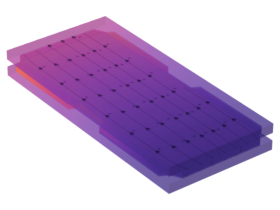
This tutorial models the thermal management of a polymer electrolyte membrane (PEM) fuel cell stack. Operating the stack with a similar temperature profile for all cells is important since an uneven temperature distribution may otherwise result in nonuniform water vapor condensation and ... En savoir plus


