
La Bibliothèque d'Applications présente des modèles construits avec COMSOL Multiphysics pour la simulation d'une grande variété d'applications, dans les domaines de l'électromagnétisme, de la mécanique des solides, de la mécanique des fluides et de la chimie. Vous pouvez télécharger ces modèles résolus avec leur documentation détaillée, comprenant les instructions de construction pas-à-pas, et vous en servir comme point de départ de votre travail de simulation. Utilisez l'outil de recherche rapide pour trouver les modèles et applications correspondant à votre domaine d'intérêt. Notez que de nombreux exemples présentés ici sont également accessibles via la Bibliothèques d'Applications intégrée au logiciel COMSOL Multiphysics® et disponible à partir du menu Fichier.
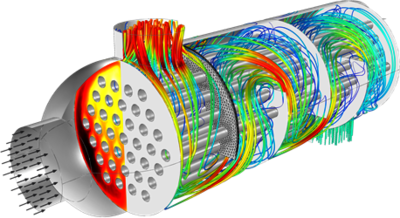
Shell-and-tube heat exchangers are commonly used in oil refineries and other large chemical processes. In this model, two separated fluids at different temperatures flow through the heat exchanger, one through the tubes (tube side) and the other through the shell around the tubes (shell ... En savoir plus
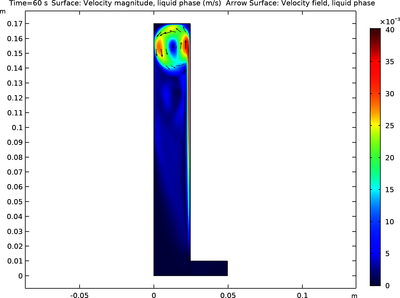
Copper electrowinning is the process of copper extraction from an electrolyte solution and its deposition at the cathode surface, by passing an external current through the electrolytic cell and using an insoluble anode. During the process, oxygen bubbles are generated at the anode ... En savoir plus
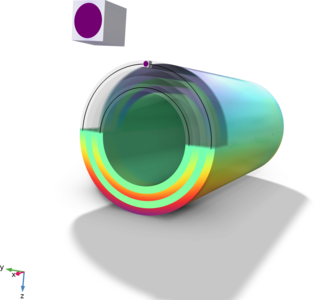
In this example, the structural integrity of a cylinder made by a fiber composite is assessed both at the macroscale and at the microscale level. Along with macroscale analyses, structural composites need microscale stress and failure analyses to identify the critical constituents in ... En savoir plus
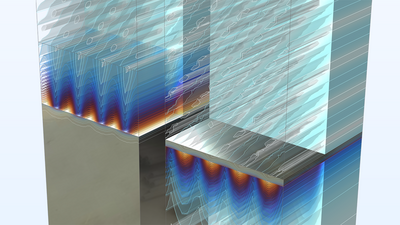
This example demonstrates a simulation setup for exciting surface plasmon polaritons using Otto and Kretschmann configurations. The underlying mechanism is enabled by the interplay between total internal reflection and evanescent-wave coupling phenomena. It also calculates the ... En savoir plus

This version of the balloon inflation example demonstrates how the Shell and Membrane interfaces can be used to model thin structures made of hyperelastic materials. The example is identical to the Model Library model 'Inflation of a spherical rubber balloon', except that the Membrane ... En savoir plus
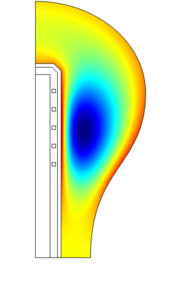
This model simulates an electrodeless lamp with argon/mercury chemistry. The low excitation threshold for mercury atoms means that even though the mercury is present in small concentrations, its behavior dominates. There is strong UV emission from the plasma at 185 nm and 253 nm. The UV ... En savoir plus
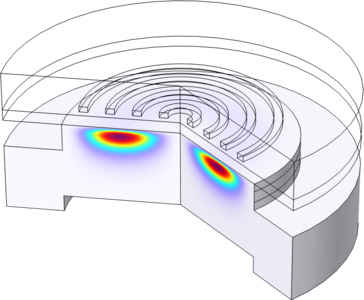
This tutorial model solves for an inductively coupled plasma reactor in a mixture of CF4/O2. The plasma transport, magnetic fields, fluid flow, and heat transfer are solved for fully self-consistently. The oxygen mole fraction of the reactor feed is parameterized. En savoir plus
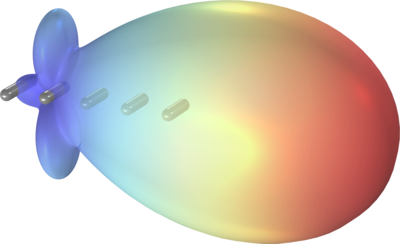
This model demonstrates the use of boundary element method in the Electromagnetic Waves, Boundary Element interface to model an optical Yagi-Uda antenna. The antenna is driven by an electrical point dipole, which is implemented through the background field. The field distribution around ... En savoir plus
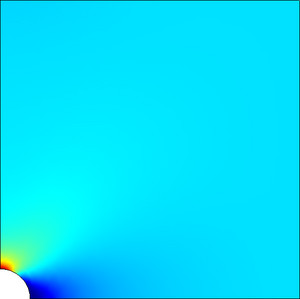
This model describes a static stress analysis to obtain the stress distribution in the vicinity of a small hole in an infinite plate. The model is a classic benchmark and is described in Mechanics of Material, by D. Roylance. The stress level is then compared with the theoretical values. En savoir plus

Trusses are structural members that can only sustain axial forces, but no bending or torsion. In the following example you first build and solve a simple 2D truss model using the 2D Truss interface. Later on, you analyze a 3D variant of the same problem using the 3D Truss interface. This ... En savoir plus


