
La Bibliothèque d'Applications présente des modèles construits avec COMSOL Multiphysics pour la simulation d'une grande variété d'applications, dans les domaines de l'électromagnétisme, de la mécanique des solides, de la mécanique des fluides et de la chimie. Vous pouvez télécharger ces modèles résolus avec leur documentation détaillée, comprenant les instructions de construction pas-à-pas, et vous en servir comme point de départ de votre travail de simulation. Utilisez l'outil de recherche rapide pour trouver les modèles et applications correspondant à votre domaine d'intérêt. Notez que de nombreux exemples présentés ici sont également accessibles via la Bibliothèques d'Applications intégrée au logiciel COMSOL Multiphysics® et disponible à partir du menu Fichier.
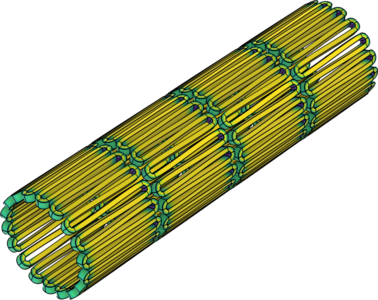
Stents are used in biomedical applications to support the inner wall of veins and arteries. Self-expanding stents made of shape memory alloys work differently from balloon-inflated stents, as these stents are crimped to the artery diameter at low temperature then released while the blood ... En savoir plus
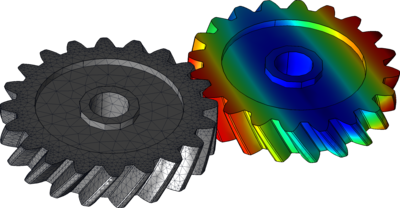
This model illustrates the dynamics of helical gears. It is built using the gears functionality in the Multibody Dynamics interface in COMSOL Multiphysics. A transient study is performed to analyze the effect of constant gear mesh stiffness, varying gear mesh stiffness, and the ... En savoir plus
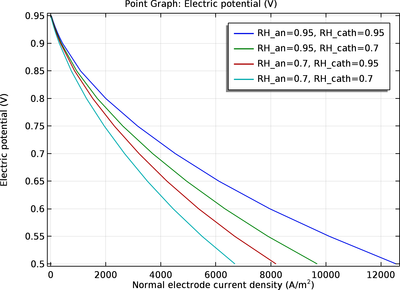
This tutorial models how the relative humidity of the inlet gases impacts the performance of a low-temperature polymer electrolyte membrane-electrode assembly. The model includes humidity-dependent ionomer (electrolyte) conductivities, gas phase mass transport and water ionomer ... En savoir plus
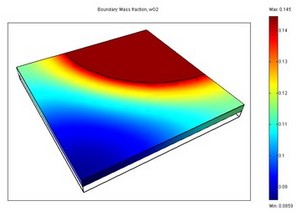
A stationary 3D model of a generic fuel cell cathode describing the mass fraction distribution of oxygen, water, and nitrogen, as well as the current distribution. The model uses Darcy's Law to describe convection, and couples this to Maxwell-Stefan diffusivities to also describe mass ... En savoir plus
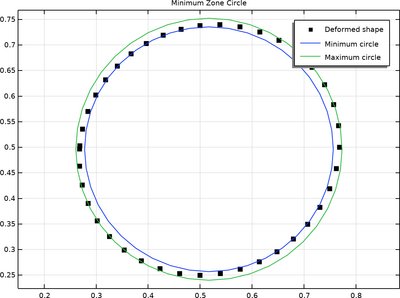
During manufacturing or in-service use, the geometric shape of structural components can deviate from their intended design. For example, a hole may lose its perfectly circular form, making it important to measure and control this deviation. The process of quantifying such deviations is ... En savoir plus
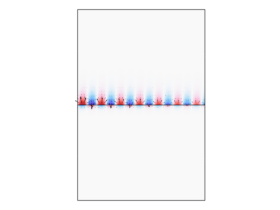
Electromagnetic waves that are confined to propagate along a surface, such as surface plasmon polaritons (SPPs), are of great research interest due to their potential applications in nanoscale manipulation of light. This model demonstrates how to set up a simulation of the propagation ... En savoir plus
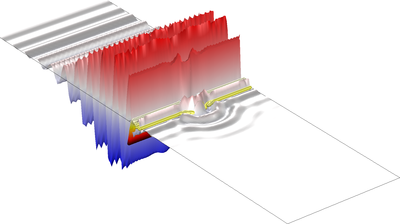
This tutorial shows how to solve the full time-dependent wave equation in dispersive media such as plasmas and semiconductors. The 2D TM in-plane wave model solves for the vector potential from the wave equation and for an auxiliary electric polarization density from an ordinary ... En savoir plus

This tutorial shows how to evaluate the harmonic response of a structure with a moderately nonlinear behavior. A nonlinear problem can only be solved using time-domain analysis. A way to speed up the computation is to use a linearized frequency response analysis to provide good initial ... En savoir plus
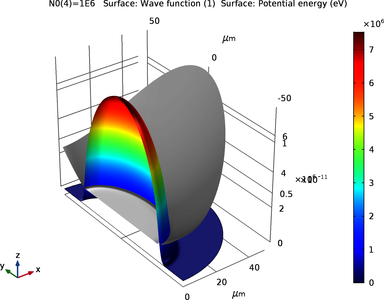
This tutorial model solves the Gross–Pitaevskii Equation for the ground state of a Bose–Einstein condensate in a harmonic trap, using the Schrödinger Equation interface in the Semiconductor Module. The equation is essentially a nonlinear single-particle Schrödinger Equation, with a ... En savoir plus
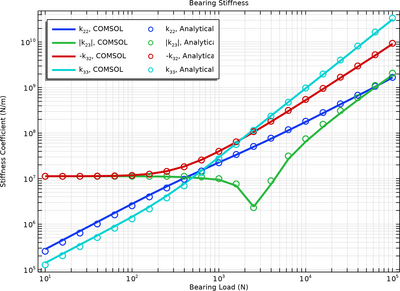
When analyzing rotors, it is common that bearings are modeled through their effective dynamic coefficients about a static equilibrium position. This model illustrates how to compute such coefficients for a cylindrical journal bearing. The bearing length is kept much smaller than its ... En savoir plus


