
La Bibliothèque d'Applications présente des modèles construits avec COMSOL Multiphysics pour la simulation d'une grande variété d'applications, dans les domaines de l'électromagnétisme, de la mécanique des solides, de la mécanique des fluides et de la chimie. Vous pouvez télécharger ces modèles résolus avec leur documentation détaillée, comprenant les instructions de construction pas-à-pas, et vous en servir comme point de départ de votre travail de simulation. Utilisez l'outil de recherche rapide pour trouver les modèles et applications correspondant à votre domaine d'intérêt. Notez que de nombreux exemples présentés ici sont également accessibles via la Bibliothèques d'Applications intégrée au logiciel COMSOL Multiphysics® et disponible à partir du menu Fichier.
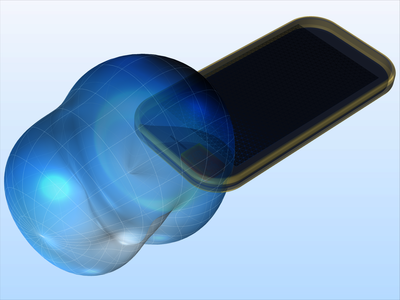
Electrical components in wireless communication systems are designed to be small and lightweight while maintaining decent performance and efficiency. Antennas are essential components in mobile devices and are required to fit in the limited space allowed by industrial specifications. To ... En savoir plus
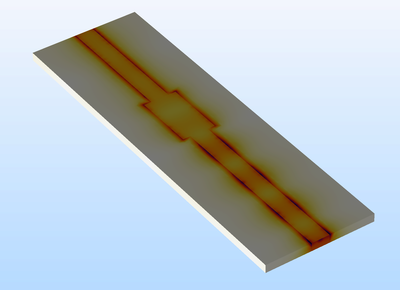
While transient analyses are useful for time domain reflectometry (TDR) to handle signal integrity (SI) problems, many RF and microwave examples are addressed using frequency domain simulations generating S-parameters. However, from the frequency domain data it is difficult to identify ... En savoir plus
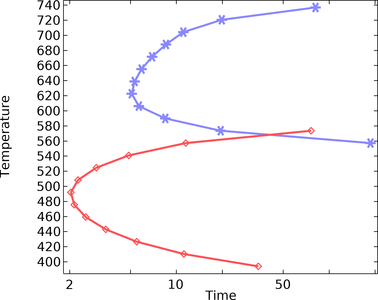
During quenching of steel, austenite decomposes into phases such as ferrite, pearlite, bainite, and martensite. A common way to illustrate the phase transformation characteristics of a particular steel alloy is to use transformation diagrams. Two of the most commonly used diagram types ... En savoir plus
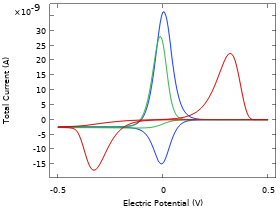
For an electrochemical reaction to occur, the reacting species usually needs to adsorb to the electrode surface before undergoing reduction or oxidation, after which the resulting product species desorbs back into the electrolyte. If the rate of adsorption or desorption is slow in ... En savoir plus
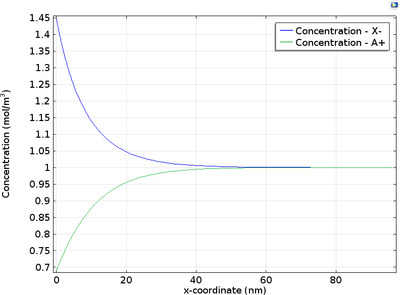
At the electrode-electrolyte interface, there is a thin layer of space charge in a diffuse double layer. This may be of interest when modeling devices such as electrochemical capacitors and nanoelectrodes. This tutorial example shows how to couple the Nernst-Planck equations to the ... En savoir plus
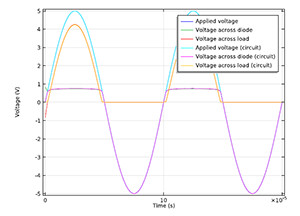
This model extracts spice parameters for a silicon p-n junction diode. The spice parameters are used to create a lumped-element equivalent circuit model of a half-wave rectifier that is compared to a full device level simulation. In this example, a device model is made by connecting a 2D ... En savoir plus
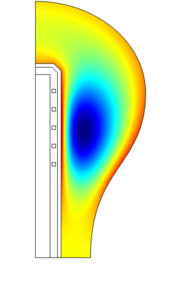
This model simulates an electrodeless lamp with argon/mercury chemistry. The low excitation threshold for mercury atoms means that even though the mercury is present in small concentrations, its behavior dominates. There is strong UV emission from the plasma at 185 nm and 253 nm. The UV ... En savoir plus

Trusses are structural members that can only sustain axial forces, but no bending or torsion. In the following example you first build and solve a simple 2D truss model using the 2D Truss interface. Later on, you analyze a 3D variant of the same problem using the 3D Truss interface. This ... En savoir plus
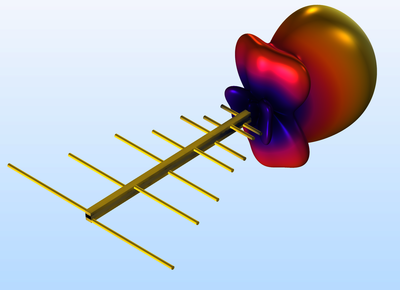
The shape of a log-periodic antenna resembles that of a Yagi-Uda antenna, but is composed of a coplanar array to achieve a wider bandwidth. It is also known as a wideband or frequency-independent antenna. All metallic parts are modeled using the perfect electric conductor (PEC) boundary ... En savoir plus
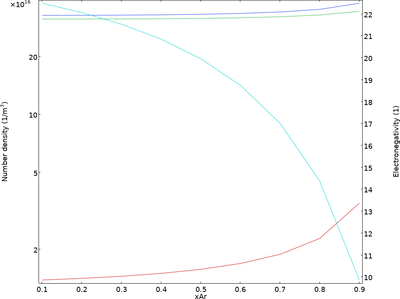
In this example, an SF6/argon plasma reactor at moderate pressure is studied using a global model. The heavy species heat equation is included. Parametric sweeps for input power and argon mole fraction are computed. En savoir plus


