
La Bibliothèque d'Applications présente des modèles construits avec COMSOL Multiphysics pour la simulation d'une grande variété d'applications, dans les domaines de l'électromagnétisme, de la mécanique des solides, de la mécanique des fluides et de la chimie. Vous pouvez télécharger ces modèles résolus avec leur documentation détaillée, comprenant les instructions de construction pas-à-pas, et vous en servir comme point de départ de votre travail de simulation. Utilisez l'outil de recherche rapide pour trouver les modèles et applications correspondant à votre domaine d'intérêt. Notez que de nombreux exemples présentés ici sont également accessibles via la Bibliothèques d'Applications intégrée au logiciel COMSOL Multiphysics® et disponible à partir du menu Fichier.
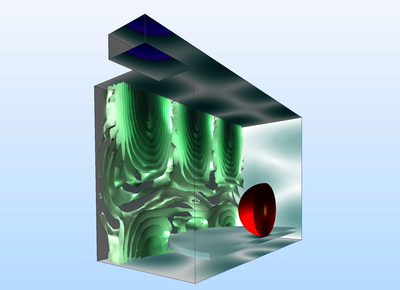
This is a model of the heating process in a microwave oven. The distributed heat source is computed in a stationary, frequency-domain electromagnetic analysis. This is followed by a transient heat transfer simulation showing how the heat redistributes in the food. En savoir plus
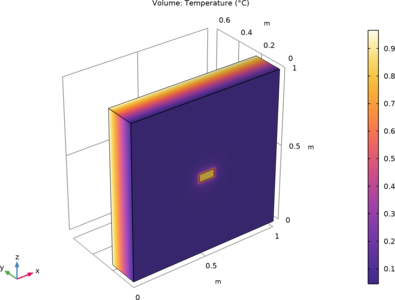
This model studies the heat conduction in a thermal bridge made up of an iron bar and an insulation layer that separates a hot internal side from a cold external side. The heat flux between internal and external side and the maximum temperature on the external wall are compared them with ... En savoir plus
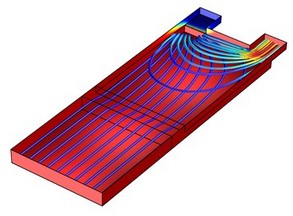
Thermal management has become a critical aspect of today’s electronic systems, which often include many high-performance circuits that dissipate large amounts of heat. Many of these components require efficient cooling to prevent overheating. Some of these components, such as processors, ... En savoir plus
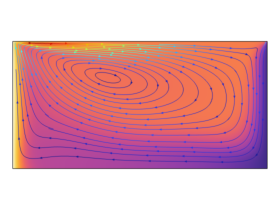
Marangoni convection occurs when the surface tension of an interface (generally liquid-air) depends on the concentration of a species or on the temperature distribution. In the case of temperature dependence, the Marangoni effect is also called thermo-capillary convection. The Marangoni ... En savoir plus
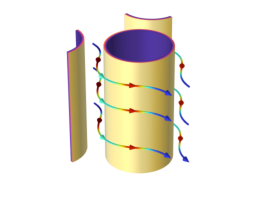
This model studies a part of a shell-and-tube heat exchanger where hot water enters from above. The cooling medium flows through the tubes that, in this model, impose a constant temperature at the walls. Furthermore, the tubes are assumed to be made of stainless steel and the heat flux ... En savoir plus
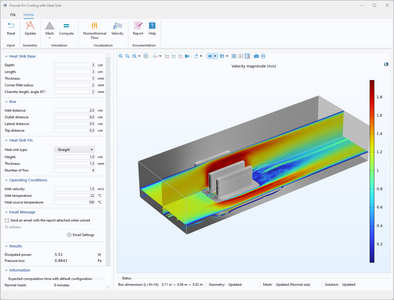
This app demonstrates the following: Geometry parts and parameterized geometries Sending an email with a report when the computation is finished User-defined email server settings which is useful when running compiled standalone applications Options for setting different mesh sizes ... En savoir plus
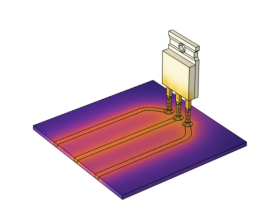
In every system where there is conduction of electric current, and where the conductivity of the material is finite, there will be electric heating. Electric heating, also referred to as Joule heating, is in many cases an undesired by-product of current conduction. This model simulates a ... En savoir plus
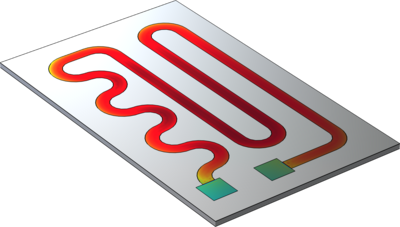
Small heating circuits find use in many applications. For example, in manufacturing processes, they heat up reactive fluids. The device in this tutorial consists of an electrically resistive layer deposited on a glass plate. The layer results in Joule heating when a voltage is applied to ... En savoir plus
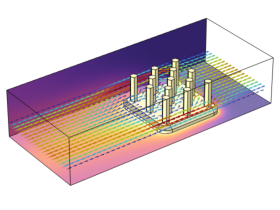
This model is intended as a first introduction to simulations of fluid flow and conjugate heat transfer. It shows you how to: Draw an air box around a device in order to model convective cooling in this box, set a total heat flux on a boundary using automatic area computation, and ... En savoir plus
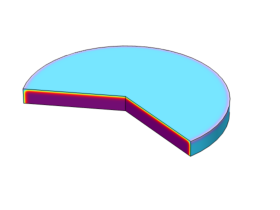
When cooking food, such as a patty, in convection ovens there is a trade off in the heating method. If the patty is heated at a low oven temperature the cooking is slow and the patty dries out, resulting in a poor taste. If the patty is heated rapidly at a high temperature, it is ... En savoir plus


