
La Bibliothèque d'Applications présente des modèles construits avec COMSOL Multiphysics pour la simulation d'une grande variété d'applications, dans les domaines de l'électromagnétisme, de la mécanique des solides, de la mécanique des fluides et de la chimie. Vous pouvez télécharger ces modèles résolus avec leur documentation détaillée, comprenant les instructions de construction pas-à-pas, et vous en servir comme point de départ de votre travail de simulation. Utilisez l'outil de recherche rapide pour trouver les modèles et applications correspondant à votre domaine d'intérêt. Notez que de nombreux exemples présentés ici sont également accessibles via la Bibliothèques d'Applications intégrée au logiciel COMSOL Multiphysics® et disponible à partir du menu Fichier.
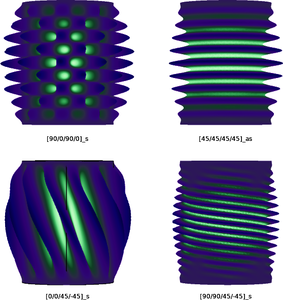
Buckling is a structural instability that can lead to failure of a component even without initial material failure. Computation of the critical buckling loads and mode shapes can therefore be important from a design viewpoint, even though it has previously been determined that the ... En savoir plus

Wastewater treatment is a several-step process for removing contaminants. Firstly, large, solid particles are removed through sedimentation, flotation, and filtration. And then in a second step, biological treatment causes the smaller particles to aggregate, forming so called flocs. ... En savoir plus
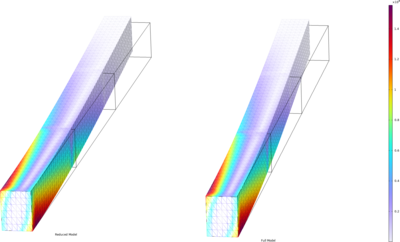
In this tutorial example, the concepts of Component Mode Synthesis (CMS) are introduced through a simple solid model of a cantilever beam. Parts of the beam are reduced by the CMS technique. It is, furthermore, shown how CMS can be used to represent both the static and dynamic behavior ... En savoir plus
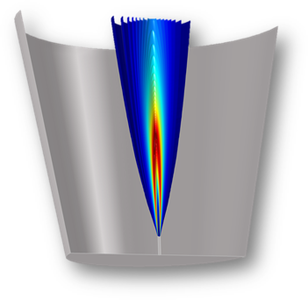
The model simulates non-premixed turbulent combustion of syngas (synthesis gas) in a simple round-jet burner. Syngas is a gas mixture, primarily composed of hydrogen, carbon monoxide and carbon dioxide. The name syngas relates to its use in creating synthetic natural gas. In the model, ... En savoir plus
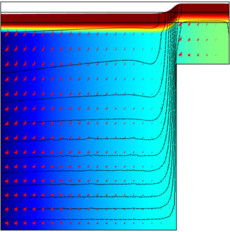
The Poroelasticity interface couples Darcy's law and solid mechanics to assess deformation of porous media that results from fluid withdrawals. The model builds on top of the Terzaghi Compaction example. Results from Terzaghi compaction and Biot poroelasticity analyses are compared to ... En savoir plus

This model studies free and forced vibrations of a deep beam. The solution for eigenfrequency, frequency response and transient analysis are computed using a Timoshenko beam and compared with analytical results. En savoir plus
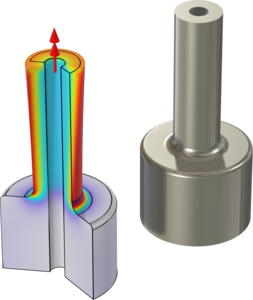
Including circumferential displacements in a 2D axisymmetric Solid Mechanics interface allows to compute twist and bending deformations. This model determines stress concentration factors for a hollow shaft for load cases of axial extension, torsion, as well as bending, using a ... En savoir plus
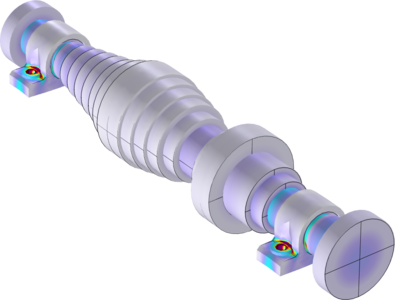
Hydrodynamic bearings generate heat due to the viscous losses in the lubricant. As a result, the temperature of the rotor increases causing deformation and thermal stresses in both the rotor and the bearing housing. This example shows how to model different physical phenomena that are ... En savoir plus
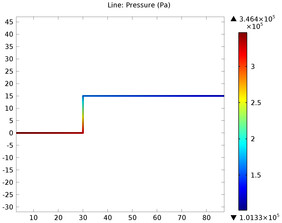
This tutorial model illustrates how to calculate the pressure drop and initial flow rate in a pipe system connected to water tank. The Pipe Flow interface contains ready to use friction models accounting for the surface roughness of pipes as well as pressure losses in bends and valves. En savoir plus
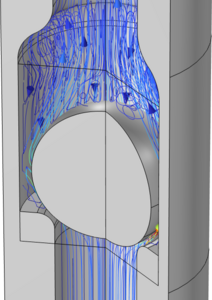
Using a Fluid-Solid Interaction multiphysics interface, the behavior of a spring-loaded ball check valve is studied under varying functional and reverse flow. The fluid force acting on the ball opens the valve at the opening pressure. In the case of a reversed pressure, the ball comes ... En savoir plus