
La Bibliothèque d'Applications présente des modèles construits avec COMSOL Multiphysics pour la simulation d'une grande variété d'applications, dans les domaines de l'électromagnétisme, de la mécanique des solides, de la mécanique des fluides et de la chimie. Vous pouvez télécharger ces modèles résolus avec leur documentation détaillée, comprenant les instructions de construction pas-à-pas, et vous en servir comme point de départ de votre travail de simulation. Utilisez l'outil de recherche rapide pour trouver les modèles et applications correspondant à votre domaine d'intérêt. Notez que de nombreux exemples présentés ici sont également accessibles via la Bibliothèques d'Applications intégrée au logiciel COMSOL Multiphysics® et disponible à partir du menu Fichier.
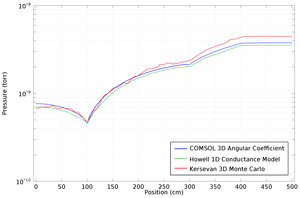
This benchmark model computes the pressure in a system of outgassing pipes with a high aspect ratio. The results are compared with a 1D simulation and a Monte-Carlo simulation of the same system from the literature. En savoir plus

To understand the risk of coagulation and blood clot formation in an abdominal aortic aneurysm (AAA), modeling and simulation can be used to study the blood flow through the AAA. In this example, blood is modeled as an Oldroyd-B fluid. While this is a generic example, if instead using ... En savoir plus
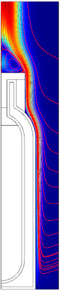
The following example solves a pure conduction and a free-convection problem in which a vacuum flask holding hot coffee dissipates thermal energy. The main interest is to calculate the flask's cooling power; that is, how much heat it loses per unit time. This tutorial model treats the ... En savoir plus
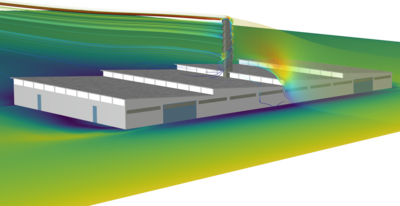
Wind strakes on a chimney impede the uniform detachment along the height of the chimney, which can induce vibrations and eventually lead to fatigue at the footing of the chimney. A stationary turbulent flow simulation is computed for a chimney with strakes mounted on a factory building. ... En savoir plus
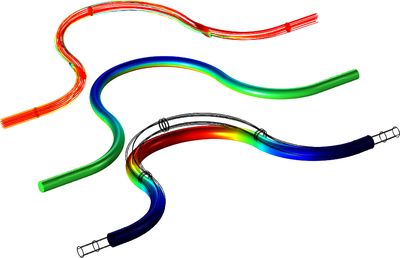
Coriolis flowmeters, also known as mass flowmeters or inertial flowmeters, measure the mass flow rate of a fluid traveling through it. It makes use of the fact that the fluid's inertia through an oscillating tube causes the tube to twist in proportion to the mass flow rate. Typically, ... En savoir plus
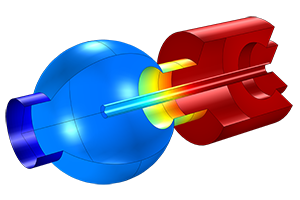
This model shows how to simulate the time-dependent adsorption and desorption of water in a vacuum system at low pressures. The water is introduced into the system when a gate valve to a load lock is opened and the subsequent migration and pumping of the water is modeled. En savoir plus
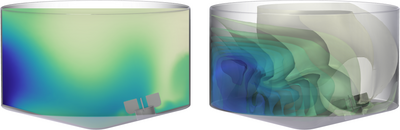
This space-dependent model describes a stirred semibatch reactor used for producing antibody–drug conjugates. The reactor is set up in 3D and the conjugation reactions, turbulent flow, and concentration fields are simulated as functions of time. The resulting yield and drug-to-antibody ... En savoir plus

The process of filling a water balloon is a vivid example for the interaction of fluid pressure and a nonlinear structural material. This model demonstrates how straightforward a FSI simulation model is set up in COMSOL. En savoir plus
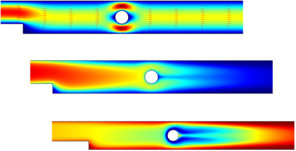
In this tutorial, the heat and mass transport equations are coupled to laminar flow in order to model exothermic reactions in a parallel plate reactor. It exemplifies how you can use COMSOL Multiphysics to systematically set up and solve increasingly sophisticated models using predefined ... En savoir plus
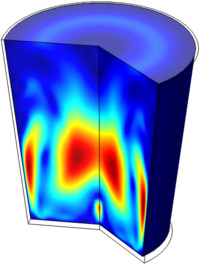
This model treats the free convection and heat transfer of a glass of cold water heated to room temperature. Initially, the glass and the water are at 5 °C and are then put on a table in a room at 25 °C. The nonisothermal flow is coupled to heat transfer using the Heat Transfer module. En savoir plus


