
La Bibliothèque d'Applications présente des modèles construits avec COMSOL Multiphysics pour la simulation d'une grande variété d'applications, dans les domaines de l'électromagnétisme, de la mécanique des solides, de la mécanique des fluides et de la chimie. Vous pouvez télécharger ces modèles résolus avec leur documentation détaillée, comprenant les instructions de construction pas-à-pas, et vous en servir comme point de départ de votre travail de simulation. Utilisez l'outil de recherche rapide pour trouver les modèles et applications correspondant à votre domaine d'intérêt. Notez que de nombreux exemples présentés ici sont également accessibles via la Bibliothèques d'Applications intégrée au logiciel COMSOL Multiphysics® et disponible à partir du menu Fichier.
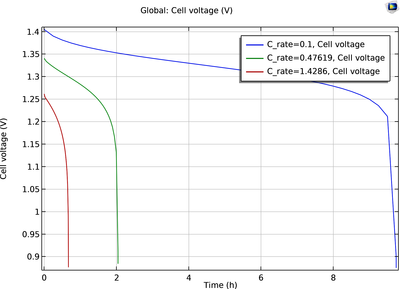
This model reproduces the NiCd battery model and the results presented in De Vidts' and White's paper from 1995. Ref: P. De Vidts, R. E. White, “Mathematical Modeling of a Nickel-Cadmium Cell: Proton Diffusion in the Nickel Electrode”, J. Electrochem. Soc, Vol. 142, No. 5, May 1995. En savoir plus
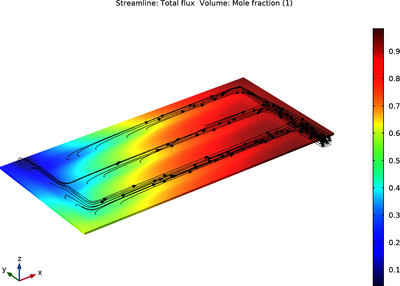
This example models a solid oxide electrolyzer cell wherein water vapor is reduced to form hydrogen gas on the cathode, and oxygen gas is evolved on the anode. The current distribution in the cell is coupled to the cathode mass transfer of hydrogen and water and momentum transport. Two ... En savoir plus

Seawater intrusion is a critical issue in coastal regions, where it endangers both freshwater supplies and the overall quality of groundwater. This example showcases seawater intrusion in a coastal aquifer where a pumping well is located at some distance from the shoreline. The model ... En savoir plus
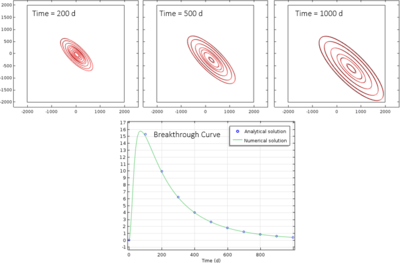
Predicting the transport of solutes that move with subsurface fluids is of general interest in environmental engineering and geosciences. Solutes may not only be pollutants but also artifical tracers added to the groundwater for investigation purposes. This model tracks a solute over ... En savoir plus
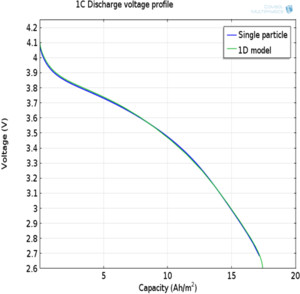
An isothermal single particle model formulation for a lithium-ion battery is presented in this work. The single particle model is a simplification of the 1D formulation for a lithium-ion battery along with a few assumptions. The model is typically valid for low-medium current scenarios. ... En savoir plus
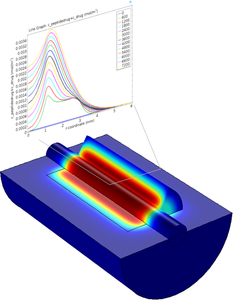
In this example, drug-release from a biomaterial matrix to damaged cell tissue is modeled. Specifically, a nerve guide delivers a regenerating drug to damaged nerve ends. The model involves detailed drug release kinetics, with rate expressions handling drug dissociation/association ... En savoir plus
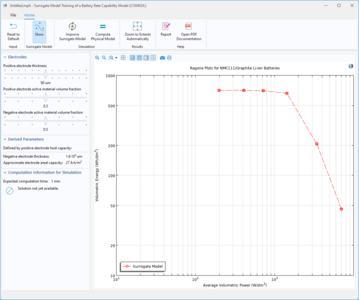
This app demonstrates the usage of a surrogate model function for predicting the rate capability of an NMC111/graphite battery cell. The rate capability is shown in a Ragone plot. The surrogate function, a Deep Neural Network, has been fitted to a subset of the possible input data ... En savoir plus
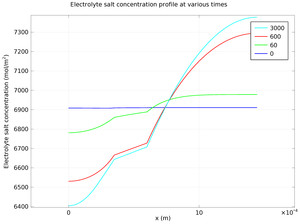
This model simulates the discharge of a Nickel-Metal Hydride (NiMH) battery using the Battery with Binary Electrolyte interface. The geometry is in one dimension and the model is isothermal. The model serves as an introduction to NiMH modeling, and can be further extended to include ... En savoir plus
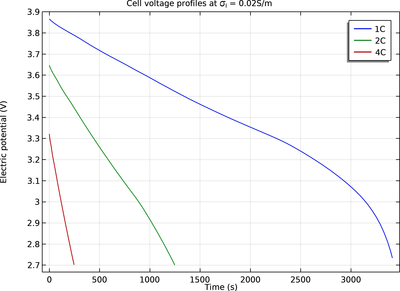
This example demonstrates the Lithium-Ion Battery, Single-Ion Conductor interface for studying the discharge of a lithium-ion battery with solid electrolyte. The geometry is in one dimension and the model is isothermal. The behavior at various discharge currents and solid electrolyte ... En savoir plus
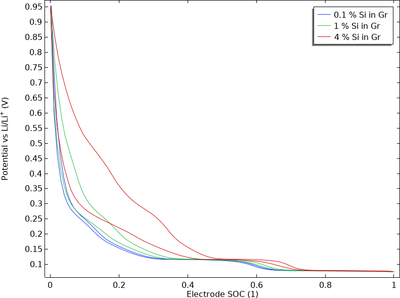
Due to its high capacity, silicon (Si) is often added to graphite in the negative electrode of lithium-ion batteries. Silicon–graphite blended electrodes may exhibit significant thermodynamic voltage hysteresis (“path dependence”) because the equilibrium potential of the lithium–silicon ... En savoir plus


