
La Bibliothèque d'Applications présente des modèles construits avec COMSOL Multiphysics pour la simulation d'une grande variété d'applications, dans les domaines de l'électromagnétisme, de la mécanique des solides, de la mécanique des fluides et de la chimie. Vous pouvez télécharger ces modèles résolus avec leur documentation détaillée, comprenant les instructions de construction pas-à-pas, et vous en servir comme point de départ de votre travail de simulation. Utilisez l'outil de recherche rapide pour trouver les modèles et applications correspondant à votre domaine d'intérêt. Notez que de nombreux exemples présentés ici sont également accessibles via la Bibliothèques d'Applications intégrée au logiciel COMSOL Multiphysics® et disponible à partir du menu Fichier.
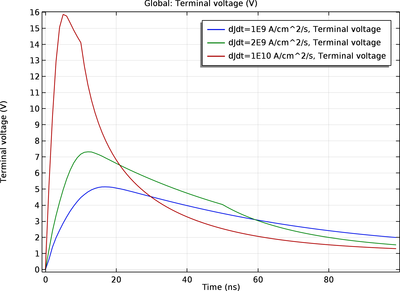
This tutorial simulates the turn-on transient (forward recovery) of a simple PIN diode, based on the book "Fundamentals of Power Semiconductor Devices" by B. J. Baliga (p. 242, 2008 edition). The diode is current driven with a constant ramp rate of 1e9, 2e9 and 1e10 A/cm^2/sec and a ... En savoir plus
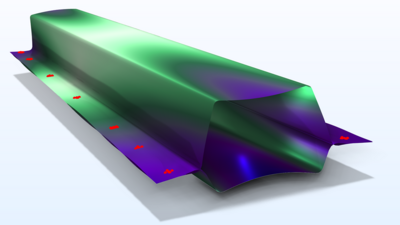
In this example, the natural frequencies of a double hat beam are studied. The beam is made of two thin steel plates, joined together by spot welds along the flanges. The Spot Welds feature sets up multiple mesh-independent connections between the shells. En savoir plus
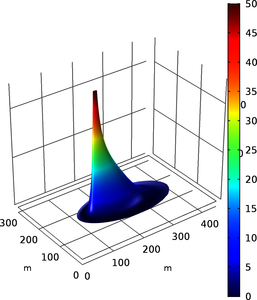
This model tracks a contaminant that enters an aquifer at a point, such as an injection well or toxic spill, and spreads through the aquifer with time. The model has an analytic solution developed by Wilson and Miller. This analytic solution has been used to test several dedicated fluid ... En savoir plus
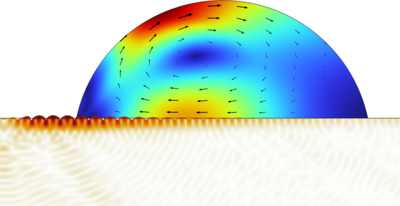
When a droplet is placed on a substrate on which surface acoustic waves (SAWs) are traveling, the energy of the SAWs is transferred into the droplet to form an acoustic field. The transferred energy is attenuated and generates a streaming flow. This type of streaming enables contactless ... En savoir plus
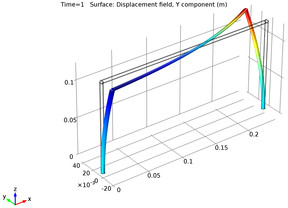
This is a benchmark model for flexible multibody dynamics. This model simulates the dynamic behavior of a planar four-bar mechanism when one of the joints has a defect. The out-of-plane motion in the mechanism, caused by the defect in the joint, is compared with the results from the ... En savoir plus

Example for a geometry sequence to deduce a shell model from an imported solid CAD file. The model demonstrates how to generate parameters from dimensions of a geometry and how to convert a solid CAD geometry into a shell representation using midsurface and extract En savoir plus
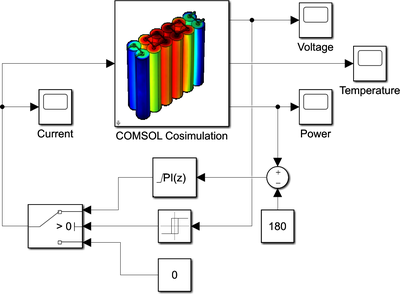
This model computes the temperature distribution in a battery pack that is in use at a specified power. The current is controlled in Simulink® to ensure constant power during usage. En savoir plus
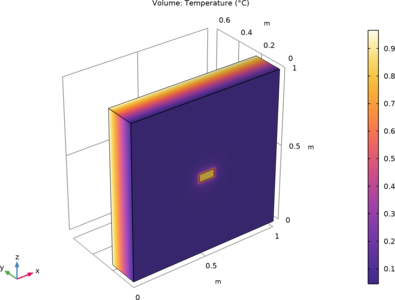
This model studies the heat conduction in a thermal bridge made up of an iron bar and an insulation layer that separates a hot internal side from a cold external side. The heat flux between internal and external side and the maximum temperature on the external wall are compared them with ... En savoir plus
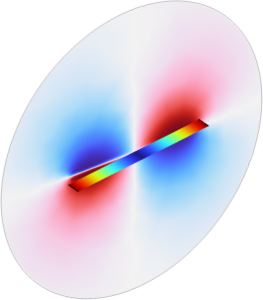
Micromirrors are used in certain MEMS devices to control optic elements. This example model illustrates a mirror that is initially actuated for a short time and then exhibits damped vibrations. It simulates a vibrating micromirror surrounded by air and uses the Thermoviscous Acoustics, ... En savoir plus
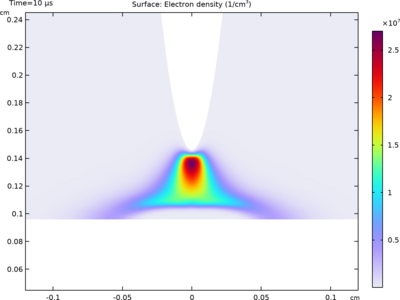
This model simulates a negative dielectric barrier discharge under a point-to-plate electrode configuration. Two solid dielectric layers are inserted into the air gap. A negative voltage of 2.5 kV is applied to the cathode electrode, initiating a corona streamer that propagates and ... En savoir plus


