
La Bibliothèque d'Applications présente des modèles construits avec COMSOL Multiphysics pour la simulation d'une grande variété d'applications, dans les domaines de l'électromagnétisme, de la mécanique des solides, de la mécanique des fluides et de la chimie. Vous pouvez télécharger ces modèles résolus avec leur documentation détaillée, comprenant les instructions de construction pas-à-pas, et vous en servir comme point de départ de votre travail de simulation. Utilisez l'outil de recherche rapide pour trouver les modèles et applications correspondant à votre domaine d'intérêt. Notez que de nombreux exemples présentés ici sont également accessibles via la Bibliothèques d'Applications intégrée au logiciel COMSOL Multiphysics® et disponible à partir du menu Fichier.
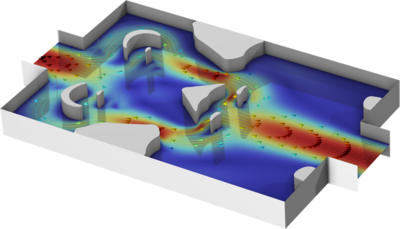
This model performs a topological optimization for a Tesla microvalve. A Tesla microvalve inhibits backwards flow using friction forces rather than moving parts. The design can be optimized by distributing a specific amount of material within the modeling domain. The goal is to maximize ... En savoir plus
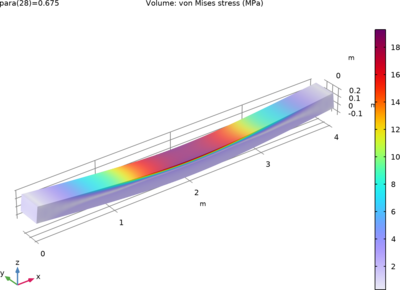
Concrete structures almost always contain reinforcements in the shape of steel bars ("rebars"). In COMSOL, rebars can be modeled either individually by adding a Truss interface to the Solid interface used for the concrete or using the Fiber subfeature to model their global effect. In ... En savoir plus
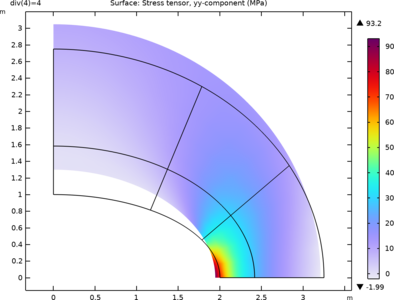
This is a benchmark model for a plane stress problem. The accuracy of the computed stress concentration is evaluated, and a mesh convergence study is performed for different element types. En savoir plus
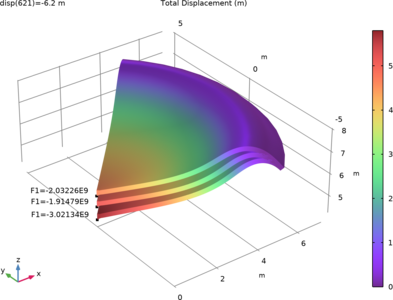
This benchmark studies the nonlinear deformation of a spherical cap subjected to point load at center using 2D axisymmetric Solid Mechanics and Shell interfaces. The results from the Shell interface are compared with Solid Mechanics interface as well as with analytical results given in ... En savoir plus
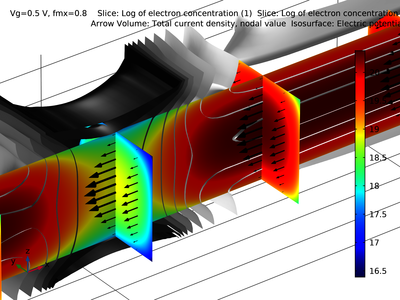
This 3D model of a nanowire MOSFET employs the density-gradient theory to add the effect of quantum confinement to the conventional drift-diffusion formulation, without requiring excessively high computational costs. The oxide layer is simulated explicitly with geometric domains, and ... En savoir plus
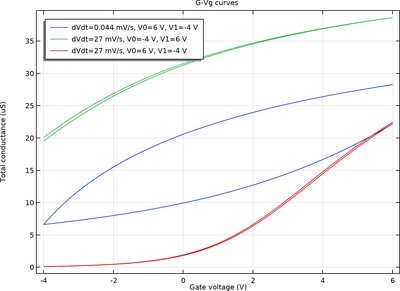
This tutorial analyzes the hysteresis of the conductance-gate-voltage (G-Vg) curves of an InAs nanowire FET, using the density-gradient theory to add the effect of quantum confinement to the conventional drift-diffusion formulation, without a large increase of computational costs. The ... En savoir plus
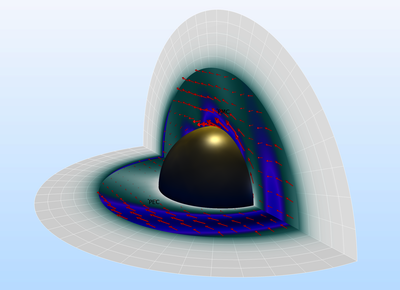
A classic benchmark problem in computational electromagnetics is to solve for the radar cross section (RCS) of a sphere in free space illuminated by a plane wave. This model solves for the RCS of a metallic sphere that has a very high conductivity, which can be treated as a material with ... En savoir plus
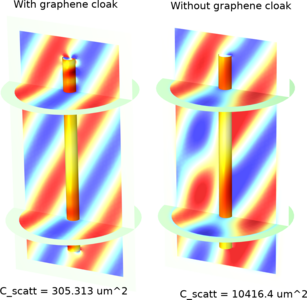
In this model, we introduce a cloaking method using an electrically tuned monolayer of graphene. We will show that when a cylindrical dielectric scatterer is covered in graphene, the scattering cross section is greatly reduced at the designated frequency, making it electromagnetically ... En savoir plus
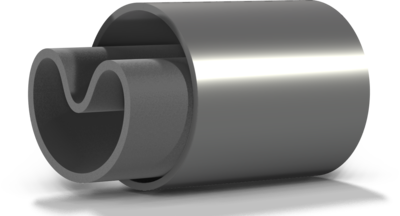
In this example, the Bergstrom–Bischoff material model is used to model the temperature and strain dependent behavior of High Density Polyethylene (HDPE) used, for example, to make liners for damaged pipes in oil and gas applications, or to make type IV hydrogen storage vessels for fuel ... En savoir plus
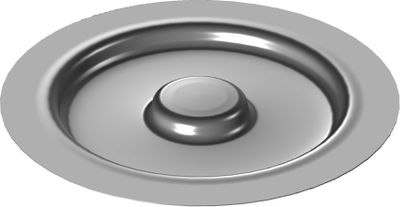
Die forming is a widespread sheet metal forming manufacturing process. The workpiece, usually a metal sheet, is permanently reshaped around a die through plastic deformation by forming and drawing processes. Simulations can be carried out in order to avoid cracks, tears, wrinkles, too ... En savoir plus


