
La Bibliothèque d'Applications présente des modèles construits avec COMSOL Multiphysics pour la simulation d'une grande variété d'applications, dans les domaines de l'électromagnétisme, de la mécanique des solides, de la mécanique des fluides et de la chimie. Vous pouvez télécharger ces modèles résolus avec leur documentation détaillée, comprenant les instructions de construction pas-à-pas, et vous en servir comme point de départ de votre travail de simulation. Utilisez l'outil de recherche rapide pour trouver les modèles et applications correspondant à votre domaine d'intérêt. Notez que de nombreux exemples présentés ici sont également accessibles via la Bibliothèques d'Applications intégrée au logiciel COMSOL Multiphysics® et disponible à partir du menu Fichier.
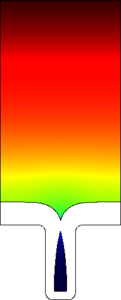
The present model example is based on Copper Deposition in a Trench model available in Electrodeposition Application Library. The nonuniform deposition along the trench surface leads to formation of a cavity/void. Since the Deformed Geometry interface cannot handle topological changes, ... En savoir plus
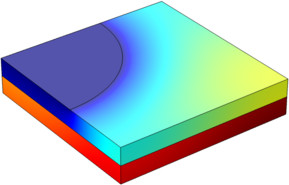
In modeling of transport by diffusion or conduction in thin layers, we often encounter large differences in dimensions of the different domains in a model. If the modeled structure is a so-called sandwich structure, we can replace the thinnest geometrical layers with a thin layer ... En savoir plus
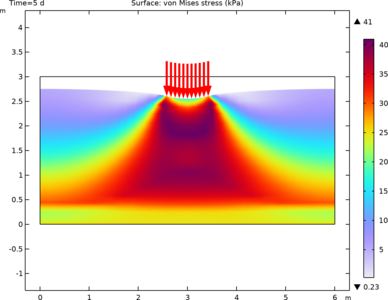
In this example, the transient response of a shallow foundation resting on an unsaturated soil stratum is investigated. The changes in pore suction due to water infiltration and evaporation are analyzed using the Extended Barcelona Basic soil model. The results show how the deformation ... En savoir plus

The powder compaction process is becoming common in the manufacturing industry, thanks to its potential to produce components of complex shape and high strength. In this example, the compaction of iron powder to form an axisymmetric rotational flanged component is analyzed with capped ... En savoir plus
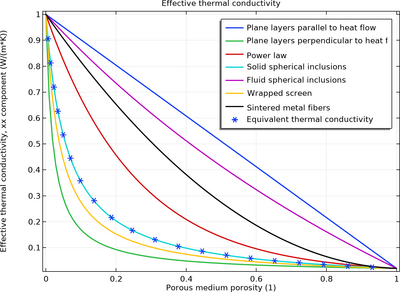
This tutorial presents the averaging models available within the Heat Transfer in Porous Media interface, used to compute the effective thermal conductivity, when the local thermal equilibrium assumption is made. The models are compared for porosities ranging from 0 to 1, and for a ... En savoir plus
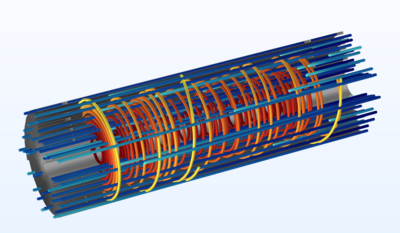
This example models a small reverse osmosis water desalination unit. The unit consists of a spirally wound semi-permeable membrane through which the water is forced under high pressure. The membrane retains the salt, such that on the permeate side fresh water is produced and on the ... En savoir plus
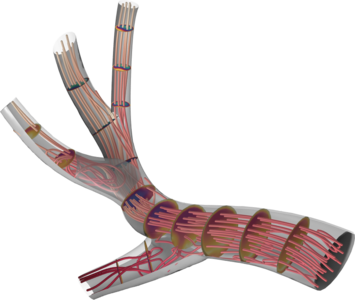
This example treats a pulmonary artery stenosis as a porous medium and demonstrates how to set up a model that combines free and porous media flow of a non-Newtonian fluid. The non-Newtonian behavior of blood is modeled using the Carreau model. En savoir plus
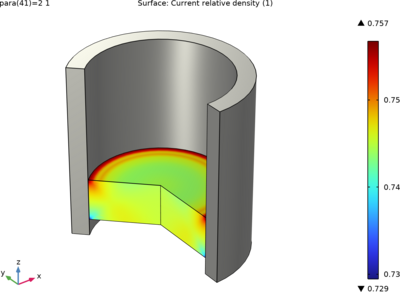
Powder compaction is a popular manufacturing process not only in powder metallurgy, but also in the pharmaceutical industry. The Capped Drucker–Prager model is commonly used for simulating the compaction processes of pharmaceutical powders, where the material properties depend on the ... En savoir plus
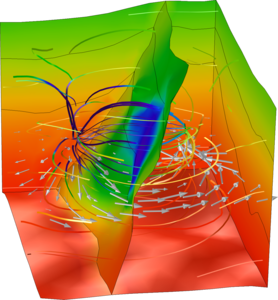
This is one of the two models from the blog post about heat transfer in the subsurface: Coupling Heat Transfer with Subsurface Porous Media Flow Note: Poroelasticity is not included here. En savoir plus
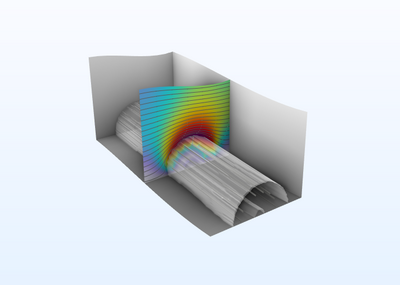
This thermo-hydro-mechanical (THM) model of artificial ground freezing couples heat transfer, groundwater flow, and soil mechanics to capture ice formation, pore-pressure changes, and ground deformation during tunnel excavation. The freezing process is modeled with the apparent heat ... En savoir plus


