
La Bibliothèque d'Applications présente des modèles construits avec COMSOL Multiphysics pour la simulation d'une grande variété d'applications, dans les domaines de l'électromagnétisme, de la mécanique des solides, de la mécanique des fluides et de la chimie. Vous pouvez télécharger ces modèles résolus avec leur documentation détaillée, comprenant les instructions de construction pas-à-pas, et vous en servir comme point de départ de votre travail de simulation. Utilisez l'outil de recherche rapide pour trouver les modèles et applications correspondant à votre domaine d'intérêt. Notez que de nombreux exemples présentés ici sont également accessibles via la Bibliothèques d'Applications intégrée au logiciel COMSOL Multiphysics® et disponible à partir du menu Fichier.
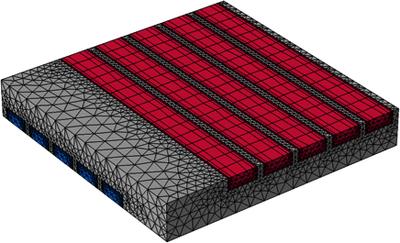
You can use assembly meshing to reduce the number of mesh elements in your model, which is especially useful for conjugate heat transfer simulation in cases where the fluid domains can be handled with swept mesh. These models demonstrate how to use form assembly and discontinuous meshes ... En savoir plus
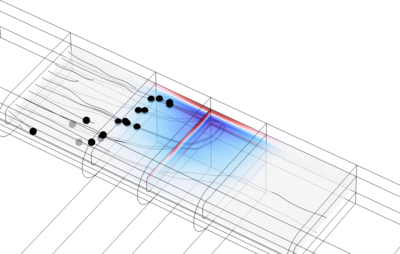
A 3D model of an acoustic trap in a glass capillary with a bias flow through the capillary. The acoustics is actuated by an oscillating electric potential across a piezoelectric transducer, inducing mechanical vibrations in the solid, and an acoustic pressure field in the fluid. The heat ... En savoir plus
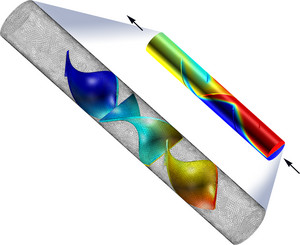
In static mixers, also called motionless or in-line mixers, a fluid is pumped through a pipe containing stationary blades. This mixing technique is particularly well suited for laminar flow mixing because it generates only small pressure losses in this flow regime. This example studies ... En savoir plus
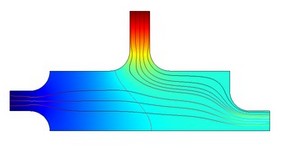
This model shows how a flow model can be coupled to a process control mechanism. Controlling application parameters according to other application parameters is important within process engineering. Most control mechanisms use the data at a wall or an outlet to control inlet ... En savoir plus
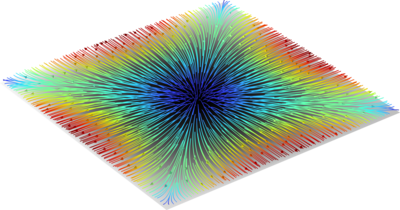
This example describes how to simulate the flow of a thin film of fluid in the gap between two rectangular plates, one of them with a porous facing, when the fluid is squeezed as a consequence of the relative motion between the plates. The model accounts for the ingress and egress of ... En savoir plus
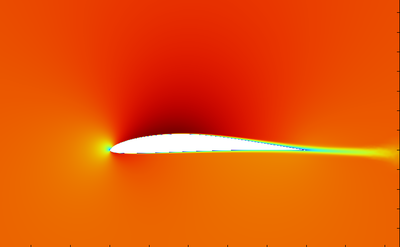
The flow around the Eppler 387 airfoil is computed with the SST turbulence model both with and without the transition model. The reuslts are compared with experimental values. En savoir plus

This model is a benchmark for three-phase flow commonly used in food processing, pharmaceutical industry, and chemical processing. The results are validated against data reported in the literature. A gas bubble rises through two layers of liquid, a lighter liquid resting on top of a ... En savoir plus
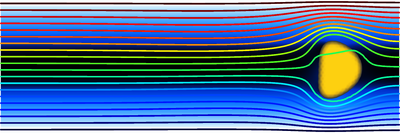
Applying an electric field across a suspension of immiscible liquids may stimulate droplets of the same phase to coalesce. The method known as electrocoalescence has important applications, for instance, in the separation of oil from water. To model electrocoalescence, you need to solve ... En savoir plus
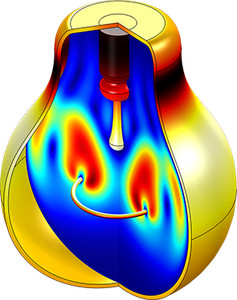
This model treats the free convection of argon gas within a light bulb. It shows the coupling of heat transport (conduction, radiation and convection) to momentum transport (non-isothermal flow) induced by density variations caused by temperature. COMSOL Multiphysics model makes it ... En savoir plus
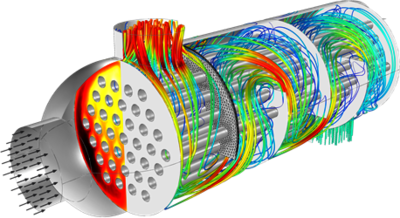
Shell-and-tube heat exchangers are commonly used in oil refineries and other large chemical processes. In this model, two separated fluids at different temperatures flow through the heat exchanger, one through the tubes (tube side) and the other through the shell around the tubes (shell ... En savoir plus


