
La Bibliothèque d'Applications présente des modèles construits avec COMSOL Multiphysics pour la simulation d'une grande variété d'applications, dans les domaines de l'électromagnétisme, de la mécanique des solides, de la mécanique des fluides et de la chimie. Vous pouvez télécharger ces modèles résolus avec leur documentation détaillée, comprenant les instructions de construction pas-à-pas, et vous en servir comme point de départ de votre travail de simulation. Utilisez l'outil de recherche rapide pour trouver les modèles et applications correspondant à votre domaine d'intérêt. Notez que de nombreux exemples présentés ici sont également accessibles via la Bibliothèques d'Applications intégrée au logiciel COMSOL Multiphysics® et disponible à partir du menu Fichier.
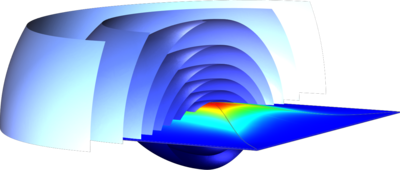
This model analyzes a piezoelectric microelectromechanical system (MEMS) speaker. The speaker, composed of four triangular membranes, uses a layer of lead zirconate titanate (PZT) material with two electrodes on top of a silicon layer as actuators. The triangular membranes are separated ... En savoir plus
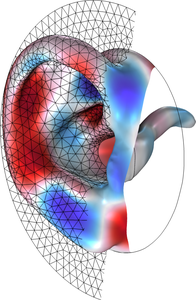
This model is of the P.57 Type 4.3 Full-band Ear Simulator. The model includes the geometry of the ear canal as well as the pinna defined in the ITU-T P.57 standard. The model also includes interpolation data for an ear drum impedance ensuring correct acoustic properties of the ear. The ... En savoir plus
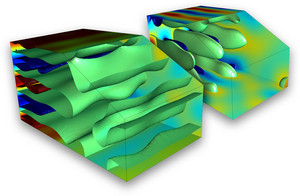
Sound is generated by a point source located in the wall of this test bench car interior. The sound pressure level response at a point of measurement is investigated for a range of frequencies and four different mesh resolutions. The model is first solved with the default direct solvers. ... En savoir plus
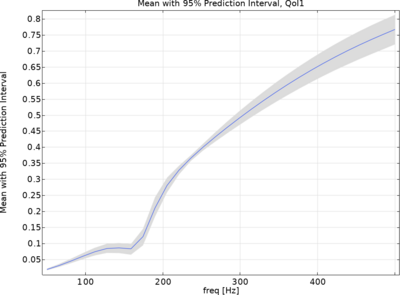
It can in many cases be difficult to get accurate material properties for porous materials. Measuring the properties to high precision can involve lengthy measurements using different techniques. It can therefore be interesting to understand how uncertainties in different material ... En savoir plus
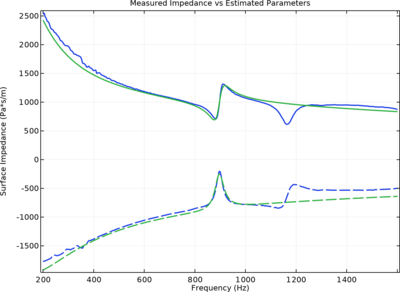
This app is an example of how the poroelastic properties of a porous material can be determined based on measurement done with an impedance tube and parameter estimation. Being able to determine the characteristics of a porous material from a single and simple measurement opens the door ... En savoir plus
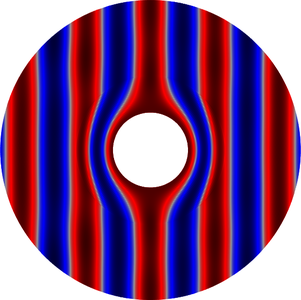
This example demonstrates how to use a background field in a sound scattering problem. The application is an acoustic invisibility cloak made of a metamaterial. Two different types of metamaterials are used, one using an anisotropic acoustic material with varying properties and one using ... En savoir plus
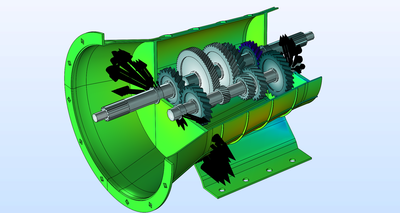
This example is an extension of a model used to study the vibration and noise in a 5-speed synchromesh gearbox in a manual transmission vehicle. In this version of the model, a detailed representation of a roller bearing is used instead of hinge joints with elastic stiffness. First, the ... En savoir plus

Finding acoustic eigenmodes in problems solved with linearized convected acoustic interfaces can be a challenging task. The solution will most often return several non-acoustic vorticity and entropy modes. These are highly damped waves that do not propagate at the speed of sound but with ... En savoir plus
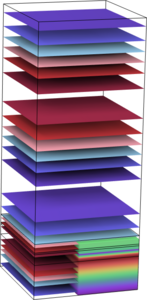
In applications where pressure waves and elastic waves propagate in porous materials filled with air both thermal and viscous losses are important. This is typically the case in insulation materials for room acoustics or lining materials in car cabins. Another example is porous materials ... En savoir plus
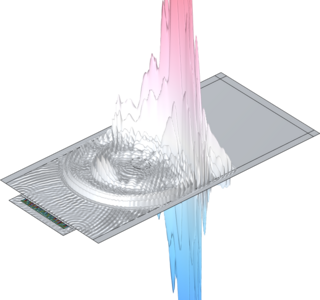
This tutorial demonstrates how to model ultrasound imaging in human tissue using an imaging probe composed of piezoelectric arrays that generate steered and focused beams. Simulating this process requires a transient multiphysics model to accurately capture sound generation, propagation, ... En savoir plus


