
La Bibliothèque d'Applications présente des modèles construits avec COMSOL Multiphysics pour la simulation d'une grande variété d'applications, dans les domaines de l'électromagnétisme, de la mécanique des solides, de la mécanique des fluides et de la chimie. Vous pouvez télécharger ces modèles résolus avec leur documentation détaillée, comprenant les instructions de construction pas-à-pas, et vous en servir comme point de départ de votre travail de simulation. Utilisez l'outil de recherche rapide pour trouver les modèles et applications correspondant à votre domaine d'intérêt. Notez que de nombreux exemples présentés ici sont également accessibles via la Bibliothèques d'Applications intégrée au logiciel COMSOL Multiphysics® et disponible à partir du menu Fichier.
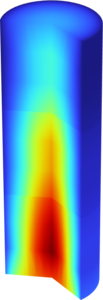
This model simulates a cylindrical furnace with isotropic scattering. It validates the use of the Discrete Ordinates Method for 2D axisymmetric cases, comparing the results with the highly accurate Monte Carlo method. The setup and reference Monte Carlo values are given in: R .P. Gupta, ... En savoir plus
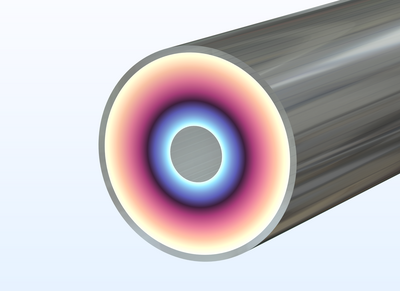
This example demonstrates how to compute transmission line parameters such as series resistance, series inductance, shunt conductance, and shunt capacitance per unit length using the predefined Transmission Line RLGC Parameters multiphysics interface. The demonstration also includes the ... En savoir plus
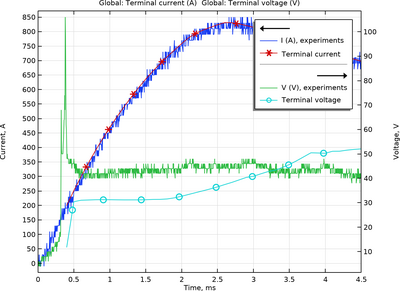
This model presents a 2D simulation of transient arc discharge movement along guided copper rails. While accurately modeling transient arcs typically requires a 3D simulation, the 2D approach offers greater efficiency and remains valuable for initial investigations and demonstration ... En savoir plus

In COMSOL Multiphysics®, you can easily define moving loads and constraints. These three models demonstrate three different approaches for modeling moving loads in the COMSOL® software, including: A user-defined expression A text file of positions over time An imported ... En savoir plus
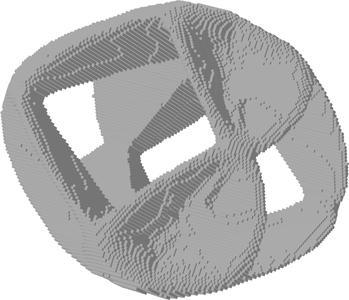
Topology optimization is associated with extreme design freedom which can yield extreme performance. The designs can be easier to manufacture by using milling constraints, at some cost to the performance. This example considers the case of a torsion sphere which is known to feature a ... En savoir plus
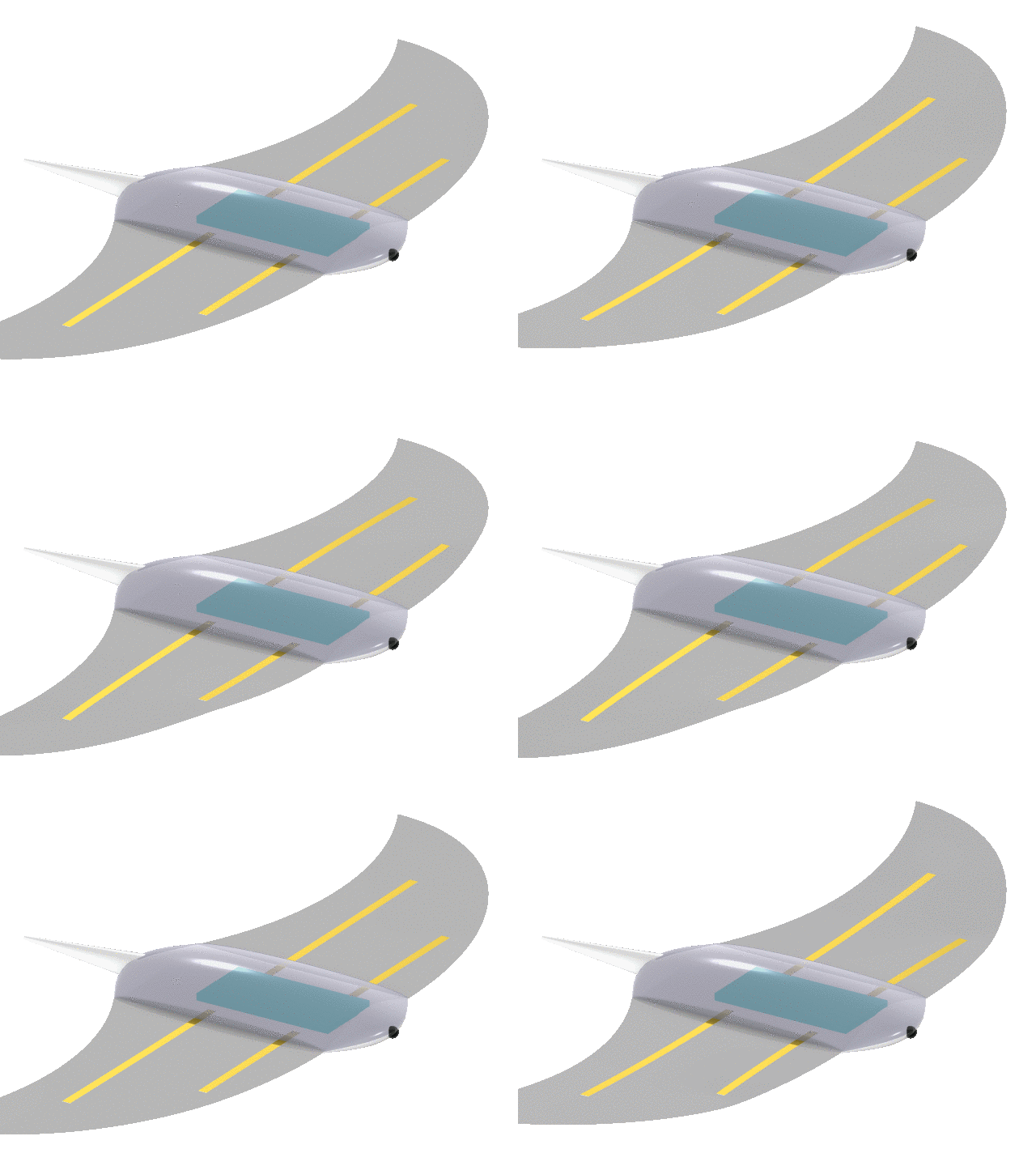
This example shows how to set up an ionic polymer-metal composite (IPMC) as an actuator for a robotic manta ray. Two IPCM beams are integrated into the fin and can be controlled independently. The chemomechanical effect is achieved with the Shrinkage and Swelling multiphysics ... En savoir plus
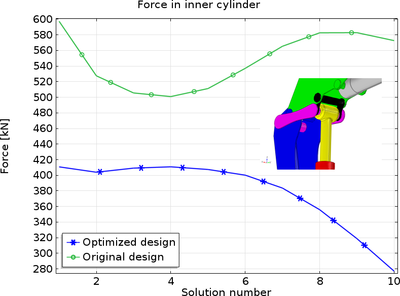
In complex mechanical systems, it can be challenging to find an optimal (or even good enough) solution only through engineering insight or trial-and-error procedures. Using mathematical optimization methods can then be an efficient path to a better design. In this example, a link ... En savoir plus
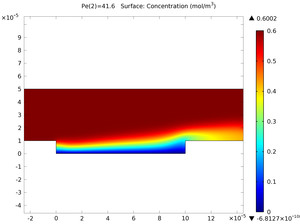
This model demonstrates the impact of convection and diffusion on the transport-limited electrodeposition of a copper microconnector bump (metal post). Microconnector bumps are used in various types of electronic applications for interconnecting components, for instance liquid crystal ... En savoir plus
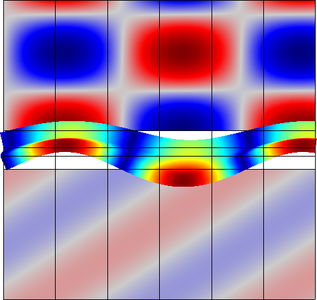
In this model, two fluids are separated by a multilayer solid elastic structure. An acoustic pressure wave impacts the structure resulting in a reflected wave and a transmitted wave with a loss through the structure. This model investigates the transmission loss through the structure. ... En savoir plus
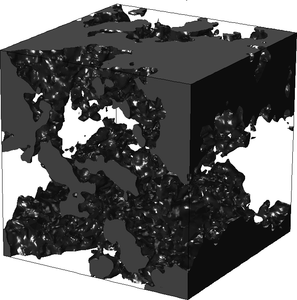
These examples show how to use the tools under the Results node to generate and visualize randomized material data with prescribed statistical properties. The randomness is controlled through a spectral density distribution, which defines the spatial frequency content of the material ... En savoir plus


