
La Bibliothèque d'Applications présente des modèles construits avec COMSOL Multiphysics pour la simulation d'une grande variété d'applications, dans les domaines de l'électromagnétisme, de la mécanique des solides, de la mécanique des fluides et de la chimie. Vous pouvez télécharger ces modèles résolus avec leur documentation détaillée, comprenant les instructions de construction pas-à-pas, et vous en servir comme point de départ de votre travail de simulation. Utilisez l'outil de recherche rapide pour trouver les modèles et applications correspondant à votre domaine d'intérêt. Notez que de nombreux exemples présentés ici sont également accessibles via la Bibliothèques d'Applications intégrée au logiciel COMSOL Multiphysics® et disponible à partir du menu Fichier.

A corner cube retroreflector can be used to reflect rays in a direction exactly antiparallel to their initial direction, regardless of the angle of incidence. This tutorial shows how to simulate the reflection of a bundle of rays at a corner cube retroreflector using the Geometrical ... En savoir plus
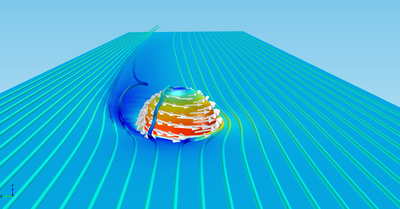
The Magnus effect explains the curl that soccer players can give the ball, resulting in the enjoyable goals that we can see in every FIFA World Cup™. This model looks at the Magnus effect in the laminar and turbulent flow regimes for transient and stationary flows. It also discusses ... En savoir plus
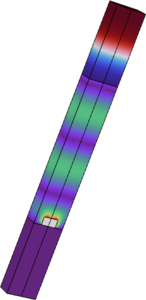
Anechoic coatings are used on submarines to reduce sonar reflections. This model calculates the reflection, absorption, and transmission properties of an anechoic coating on a steel plate. The calculated results from this sub-model can be used in larger system scale models, for example, ... En savoir plus
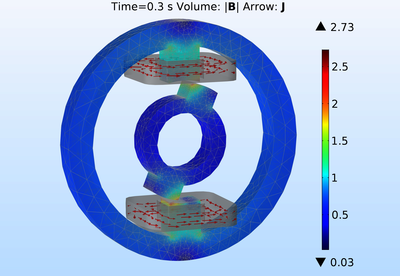
Switched reluctance motors work on the principle of reluctance torque. The stator and rotor will interact to minimize the reluctance for the flux path. This application simulates the behavior of the motor when the stator winding is excited with a step voltage and when the rotor is at a ... En savoir plus

KOH(aq), an alkali metal hydroxide solution, is widely used in anisotropic wet etching technology and is one of the most commonly utilized solutions for micromachining silicon wafers. Anisotropic etching refers to a process where the etching rate varies in different directions, primarily ... En savoir plus
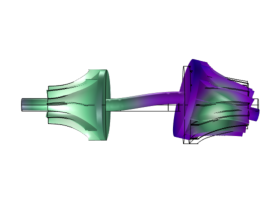
Cross-coupled forces present in a hydrodynamic bearing often act as a negative damping in a rotor. Near the critical speed, this may lead to uncontrolled vibration of the turbocharger causing a risk of bearing failure. In this example, the influence of the cross-coupling forces on the ... En savoir plus

See how to generate a mesh from scanned data via two different workflows. For both examples, the data file is imported in an Interpolation function. In the first workflow, the data is applied on a Grid dataset and a Filter dataset is used to filter out the data to represent the femur. ... En savoir plus
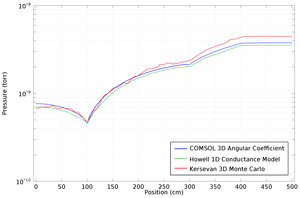
This benchmark model computes the pressure in a system of outgassing pipes with a high aspect ratio. The results are compared with a 1D simulation and a Monte-Carlo simulation of the same system from the literature. En savoir plus

A demultiplexer is a device that directs different frequency bands to different outputs. In this tutorial model, we will design a demultiplexer by performing shape optimization on all initial circular boundaries in a sonic crystal (phononic crystal) configuration. The model uses shape ... En savoir plus

This presentation and series of models show how to use the Deformed Mesh interfaces to model small and large translations and rotations of objects. A more detailed description of these models can be seen in the blog post Model Translational Motion with the Deformed Mesh Interfaces and ... En savoir plus


