
La Bibliothèque d'Applications présente des modèles construits avec COMSOL Multiphysics pour la simulation d'une grande variété d'applications, dans les domaines de l'électromagnétisme, de la mécanique des solides, de la mécanique des fluides et de la chimie. Vous pouvez télécharger ces modèles résolus avec leur documentation détaillée, comprenant les instructions de construction pas-à-pas, et vous en servir comme point de départ de votre travail de simulation. Utilisez l'outil de recherche rapide pour trouver les modèles et applications correspondant à votre domaine d'intérêt. Notez que de nombreux exemples présentés ici sont également accessibles via la Bibliothèques d'Applications intégrée au logiciel COMSOL Multiphysics® et disponible à partir du menu Fichier.
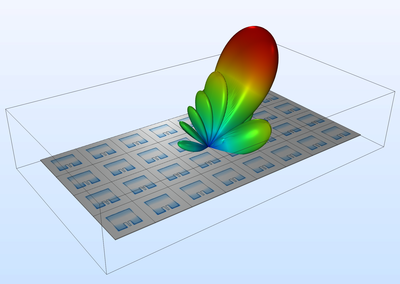
The demand for phased array antennas increases not only for the traditional military industry but also in commercial areas such 5G mobile network platforms, Internet of Things (IoT), and satellite communication applications. This example shows how to design a phased array with a beam ... En savoir plus
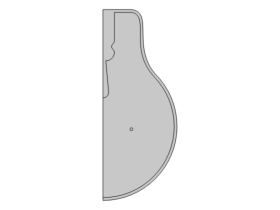
This tutorial introduces a workflow typical of creating geometry for simulation by using Sketch mode to draw complex shapes. Follow the step-by-step instructions to draw the geometry for the analysis of a light bulb. The physics setup is described in the model Free Convection in a Light ... En savoir plus
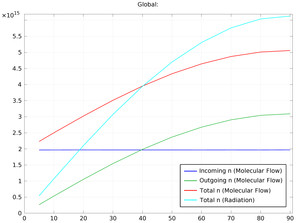
This model computes the particle flux, number density and pressure on the surface of a plate that rotates in a highly directional molecular flow. The results obtained are compared with those from other, approximate, techniques for computing molecular flows. En savoir plus
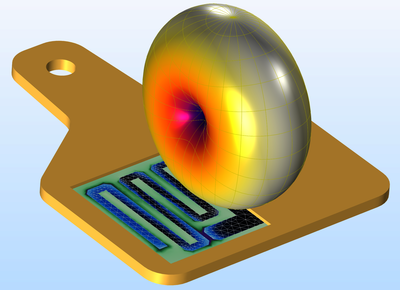
UHF RFID tags are widely used for identifying and tracking animals. This model simulates a passive radio-frequency identification (RFID) tag for the UHF frequency range. With respect to the chip transponder’s complex impedance, a reflection coefficient is computed. This is done using an ... En savoir plus

A tapered slot antenna, also known as a Vivaldi antenna, is useful for wide band applications. Here, an exponential function is used for the taper profile. The objective of this model is to compute the far-field pattern and to compute the impedance of the structure. Good matching is ... En savoir plus
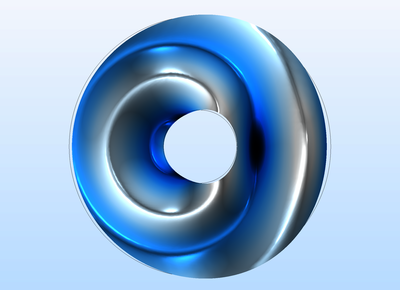
This example model calculates the bistatic radar cross section (RCS) per unit length of a circle using the Electromagnetic Waves, Time Explicit physics interface. A 2D circle is excited by a 200 MHz sinusoidal signal modulated by a temporal Gaussian pulse. A wideband RCS frequency ... En savoir plus
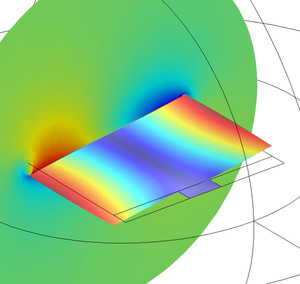
Micromirrors are used in certain MEMS devices to control optic elements. This model of a vibrating micromirror surrounded by air uses the Thermoacoustic-Shell Interaction user interface to model the fluid-solid interaction, and it thus includes the correct viscous and thermal damping of ... En savoir plus
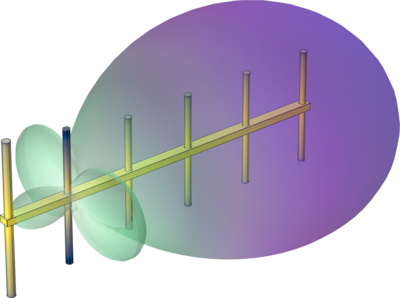
The Yagi–Uda antenna is designed for a specific Wi-Fi band and can reduce eavesdropping by directing signals with the help of directors. This antenna consists of one uniformly spaced reflector and four directors. Simulated results show a maximum 10 dBi gain and a front-to-back ratio of ... En savoir plus
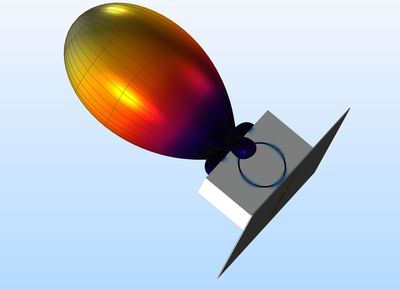
A dielectric resonator placed near a radiating element can be used to increase directivity and gain. Here, a block of quartz dielectric, with additional passive metallic antenna elements, is placed above a slot antenna. The fields in and around the antenna are solved for. The far field ... En savoir plus
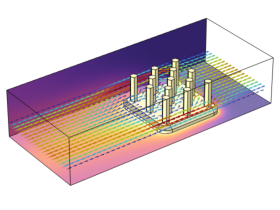
This model is intended as a first introduction to simulations of fluid flow and conjugate heat transfer. It shows you how to: Draw an air box around a device in order to model convective cooling in this box, set a total heat flux on a boundary using automatic area computation, and ... En savoir plus


