
La Bibliothèque d'Applications présente des modèles construits avec COMSOL Multiphysics pour la simulation d'une grande variété d'applications, dans les domaines de l'électromagnétisme, de la mécanique des solides, de la mécanique des fluides et de la chimie. Vous pouvez télécharger ces modèles résolus avec leur documentation détaillée, comprenant les instructions de construction pas-à-pas, et vous en servir comme point de départ de votre travail de simulation. Utilisez l'outil de recherche rapide pour trouver les modèles et applications correspondant à votre domaine d'intérêt. Notez que de nombreux exemples présentés ici sont également accessibles via la Bibliothèques d'Applications intégrée au logiciel COMSOL Multiphysics® et disponible à partir du menu Fichier.
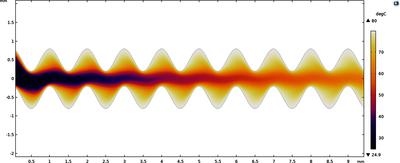
The model has its emphasis on heat transport in a very small heat exchanger that is commonly used in the field of microelectromechanical systems (MEMS). In this case, it might be a reactive processes that needs heating. The heat exchanger itself is constructed by stacking several ... En savoir plus
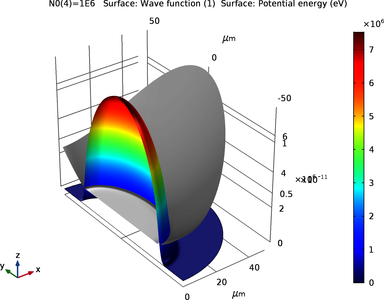
This tutorial model solves the Gross–Pitaevskii Equation for the ground state of a Bose–Einstein condensate in a harmonic trap, using the Schrödinger Equation interface in the Semiconductor Module. The equation is essentially a nonlinear single-particle Schrödinger Equation, with a ... En savoir plus
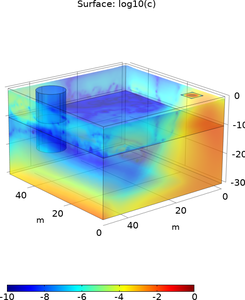
A simple model for groundwater contamination portrays a well that is bored into an aquifer. The aquifer consists of a partially saturated layer and a fully saturated layer. The model investigates how much of the contaminant ends up in the well after a contaminant is introduced in the ... En savoir plus
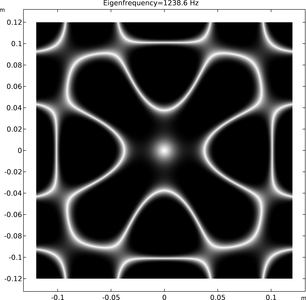
A Chladni plate is a metal plate that is covered in sand and subjected to vibrations. At certain frequencies, the vibrations produce standing waves, resulting in sand patterns formed on the plate. The vibrations are either formed from a violin bow at the side of the plate or a wave ... En savoir plus
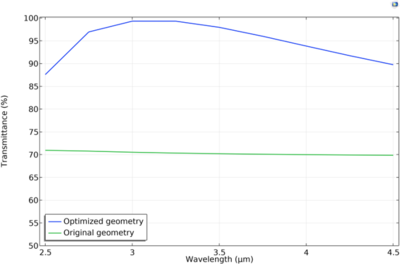
This model showcases the broadband optimization for the Microstructured antireflective coatings that are modeled in the model (#99011). Following are the parameters that are optimized: Rectangular microstructure: Height and width of the rectangular microstructure. Pyramidal ... En savoir plus
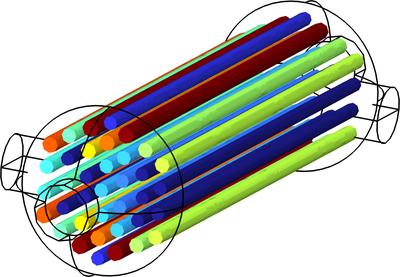
Commercial heat exchangers often feature a complex design. It is significantly easier to build a design with new CAD parameters than to build designs with novel topologies. This model demonstrate how to optimize the size and position of the tubes in a tube and shell heat exchanger. It is ... En savoir plus
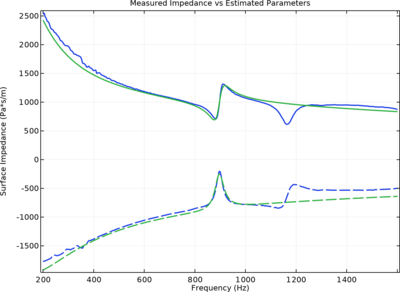
This app is an example of how the poroelastic properties of a porous material can be determined based on measurement done with an impedance tube and parameter estimation. Being able to determine the characteristics of a porous material from a single and simple measurement opens the door ... En savoir plus

This tutorial example illustrates the versatility of the Reaction Engineering interface. The hydrogen iodine reaction is modeled in a batch reactor with constant volume. Both isothermal and non-isothermal conditions are modeled. En savoir plus
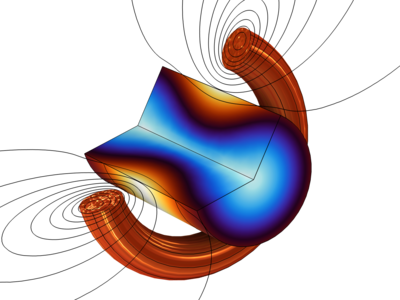
The eddy currents in a conductive cylinder, generated from currents passing through a surrounding coil, are studied. The skin effect in the coil is also studied. En savoir plus
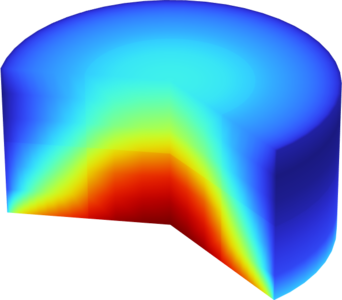
This model simulates a cylindrical furnace with isotropic scattering. It validates the use of the Discrete Ordinates Method for 2D axisymmetric cases, comparing the results with the highly accurate Monte Carlo method. The setup and reference Monte Carlo values are given in: R .P. Gupta, ... En savoir plus


